
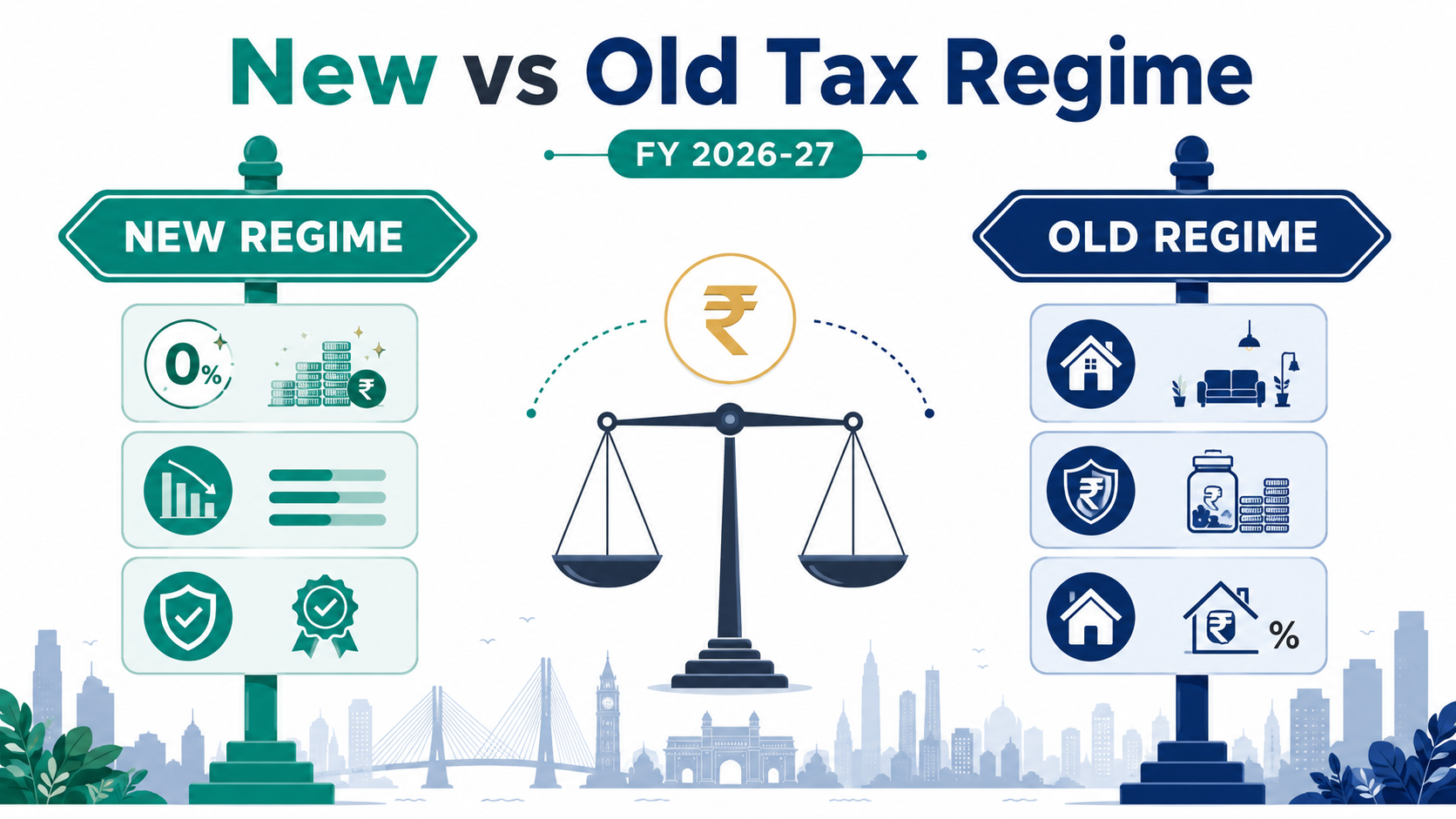
Every April, the same WhatsApp message lands in your HR inbox: “Ma’am, should I pick new regime or old regime?” You answer Anita from accounts, then Rakesh from sales asks the same thing, and by lunch you’re forwarding the same Excel sheet for the fifth time. With the new tax regime now the default and Budget 2025’s ₹12 lakh rebate carrying into FY 2026-27, the question is sharper than ever — and your team is looking at you for the right call.
This is the conversation I keep having with payroll managers across Indian SMEs. So let’s settle it once, with the actual numbers for FY 2026-27, a clean break-even table, and a short list of what you should send to your team this week.
TL;DR — New vs Old Tax Regime FY 2026-27
- New regime is the default for FY 2026-27 (April 2026 – March 2027). Employees must actively opt for the old regime via Form 12BB.
- Effective tax-free income under the new regime: ₹12.75 lakh for salaried staff — that’s ₹12 lakh rebate under Section 87A plus the ₹75,000 standard deduction.
- Old regime makes sense only when an employee’s combined deductions (HRA + 80C + 80D + home loan interest) cross roughly ₹4.5–5 lakh a year.
- HR’s job: collect the regime choice in April, run TDS accordingly, and warn employees they can switch only once per year while filing ITR (if salaried with no business income).
What Actually Changed for FY 2026-27
The new tax regime under Section 115BAC continues as the default for FY 2026-27, with the slabs and ₹60,000 Section 87A rebate from Budget 2025 carried forward unchanged in Budget 2026. The old regime is still available — but only if your employee chooses it in writing at the start of the financial year.
Three things matter for HR right now:
- The basic exemption under the new regime is ₹4 lakh (up from ₹3 lakh earlier).
- The Section 87A rebate is ₹60,000, which means zero tax up to ₹12 lakh taxable income under the new regime.
- The standard deduction is ₹75,000 in the new regime versus ₹50,000 in the old regime — a quiet ₹25,000 advantage most employees miss.
New Tax Regime FY 2026-27: Slabs and Rebate
Under the new regime, salaried employees pay zero income tax up to ₹12.75 lakh in gross salary. Beyond that, here are the slabs that apply to taxable income (after the ₹75,000 standard deduction):
| Taxable Income (₹) | Tax Rate |
|---|---|
| 0 – 4,00,000 | Nil |
| 4,00,001 – 8,00,000 | 5% |
| 8,00,001 – 12,00,000 | 10% |
| 12,00,001 – 16,00,000 | 15% |
| 16,00,001 – 20,00,000 | 20% |
| 20,00,001 – 24,00,000 | 25% |
| Above 24,00,000 | 30% |
What’s allowed in the new regime
The new regime is almost a no-deductions zone, but two things still work in your team’s favour:
- Standard deduction of ₹75,000 for every salaried employee.
- Employer’s NPS contribution under Section 80CCD(2) — deductible up to 14% of Basic + DA for private-sector employees. This is the most underused HR lever in India today.
Conveyance for the differently abled, transport allowance for handicapped employees, and gratuity exemption also continue. Everything else — HRA, LTA, 80C, 80D, home loan interest under Section 24 — is gone in the new regime.
Old Tax Regime FY 2026-27: Slabs and Deductions
The old tax regime keeps the slabs unchanged from the last decade and allows the full menu of deductions Indian taxpayers grew up on. It’s worth using if your employee is genuinely deduction-heavy.
| Taxable Income (₹) | Tax Rate (Below 60 years) |
|---|---|
| 0 – 2,50,000 | Nil |
| 2,50,001 – 5,00,000 | 5% |
| 5,00,001 – 10,00,000 | 20% |
| Above 10,00,000 | 30% |
Senior citizens (60–80 years) get a ₹3,00,000 basic exemption; super senior citizens (80+) get ₹5,00,000. The 87A rebate under the old regime stays at ₹12,500 for income up to ₹5 lakh.
Deductions that still work in the old regime
- Section 80C — PF, ELSS, life insurance, PPF, tuition fees, home loan principal: up to ₹1,50,000.
- Section 80D — Health insurance premiums: ₹25,000 (self/family), ₹50,000 (senior citizen parents).
- HRA exemption under Section 10(13A) — the formula your team already knows.
- Section 24(b) — Home loan interest on self-occupied property up to ₹2,00,000.
- Section 80CCD(1B) — Additional NPS deduction of ₹50,000.
- Standard deduction of ₹50,000 for salaried staff.
Side-by-Side: New vs Old Tax Regime FY 2026-27
| Feature | New Regime | Old Regime |
|---|---|---|
| Default status | Yes (auto-applied) | No (must opt in) |
| Basic exemption | ₹4,00,000 | ₹2,50,000 |
| Section 87A rebate | Up to ₹60,000 (income ≤ ₹12L) | Up to ₹12,500 (income ≤ ₹5L) |
| Standard deduction | ₹75,000 | ₹50,000 |
| HRA exemption | No | Yes |
| 80C, 80D, LTA | No | Yes |
| Home loan interest (self-occupied) | No | Up to ₹2,00,000 |
| Employer NPS 80CCD(2) | Yes (14% of Basic+DA) | Yes (10% of Basic+DA) |
| Best for | Renters, no big investments, simple salary | Home loan + HRA + heavy 80C |
Who Should Pick What: Real Salary Examples
The honest answer is: for most of your team earning under ₹12 lakh, the new regime wins without trying. The break-even moves only when an employee is actively claiming a serious stack of deductions.
The break-even rule of thumb
Use this as a quick filter when an employee asks:
- Annual CTC up to ₹12.75 lakh → New regime, no question. Tax is zero.
- CTC ₹12.75–18 lakh → New regime wins unless deductions (HRA + 80C + 80D + home loan interest) cross ₹4–4.5 lakh.
- CTC ₹18–25 lakh → Compare seriously. Heavy home loan + metro HRA + ₹1.5 lakh 80C usually tips it to old regime.
- CTC above ₹25 lakh with home loan in a metro → Old regime usually wins by ₹40,000–80,000 per year.
I always run two scenarios in our payroll calculator before telling an employee which way to go. Don’t guess on this — ten minutes of maths saves them lakhs over a career.
What HR Should Do in April–May 2026
Your job as HR is not to recommend a regime — it’s to collect a clear declaration, run TDS on that basis, and document it so there’s no ambiguity at year-end. Here’s the checklist I give my clients:
- Send a regime-selection email by April 10 with both regimes’ slabs and the break-even rule of thumb.
- Collect Form 12BB from every employee declaring their regime and estimated investments. Make this digital — emailed forms with PDF attachments get lost. (See our investment declaration checklist for the full process.)
- Default to new regime for any employee who doesn’t respond by the deadline. That’s what the Income Tax Department does.
- Recompute TDS from the April payroll based on declared regime. Don’t carry over last year’s settings.
- Send a mid-year reminder in October for proof submission. Employees who claimed HRA or 80C but can’t produce proof will see TDS spike in February.
- Reconcile in Form 24Q Q4 by May 31 next year, when you’ll also issue Form 16.
Common Mistakes HR Managers Make
I’ve audited payroll at over 60 Indian SMEs, and these five mistakes show up in almost every shop:
- Assuming everyone wants the old regime. Most HR teams default to old regime because that’s how they ran TDS for a decade. With the ₹12 lakh rebate, this is now actively wrong for any employee earning under ₹15 lakh with low deductions.
- Forgetting Section 80CCD(2). The employer’s NPS contribution is deductible in both regimes, up to 14% of Basic+DA in the new regime. It’s the cleanest way to reduce a senior employee’s tax without changing CTC.
- Letting employees switch mid-year. Salaried employees can switch regimes only once per year, at ITR filing. Once you’ve declared, it stays for the year for TDS purposes.
- Ignoring the ₹4 lakh exemption shift. Many payroll engines still have ₹3 lakh hardcoded for the new regime. Check your CTC structure setup before April payroll.
- Confusing employees with options. Send two scenarios with their salary, not a generic table. People decide faster when they see their own number.
Frequently Asked Questions
Can a salaried employee switch from new to old regime every year?
Yes. A salaried employee with no business income can switch between the new and old tax regime every financial year while filing the ITR. The employer, however, deducts TDS based on the regime declared in April — so your in-year salary slip follows that choice until 31 March.
What is the effective tax-free salary under the new regime in FY 2026-27?
For a salaried employee, the effective tax-free salary under the new regime is ₹12.75 lakh per year. This combines the ₹12 lakh Section 87A rebate threshold with the ₹75,000 standard deduction. Any income above this is taxed under the new regime slabs.
Is HRA allowed under the new tax regime?
No. HRA exemption under Section 10(13A) is not available in the new tax regime for FY 2026-27. Employees who pay significant rent — especially in metros like Delhi NCR, Mumbai, or Bangalore — should compare both regimes carefully. The HRA exemption formula still applies only under the old regime.
What happens if an employee doesn’t submit a regime declaration?
If an employee does not declare a regime, the employer must deduct TDS under the new tax regime by default. This rule has been in place since FY 2023-24. The employee can still switch to the old regime while filing their ITR if it works out cheaper for them.
Does the employer’s PF contribution affect regime choice?
No. The employer’s 12% PF contribution on basic salary up to the ₹15,000 ceiling is not taxable in either regime. However, employer contributions to PF, NPS, and superannuation combined that exceed ₹7.5 lakh per year become taxable as a perquisite under Section 17(2)(vii) — relevant only for senior staff.
Which regime is better for someone earning ₹10 lakh with a home loan?
It depends on the home loan interest amount. If the interest paid is above ₹1.5 lakh and the employee also claims HRA or has 80C investments of ₹1.5 lakh, the old regime usually saves ₹30,000–50,000 per year. Below that, the new regime is cleaner and lower-tax.
Make Regime Selection a Two-Click Process
Pushing PDFs over WhatsApp in April is how mistakes happen — and how Form 16 reconciliation in May breaks. EZHRM’s TDS & Form 16 module lets every employee declare their regime, upload Form 12BB, and see their estimated TDS in their self-service portal, so April salaries are computed right the first time.
For the official rule set, the Income Tax Department’s FAQ on new vs old regime is the source you can quote in any internal email.