
Last Tuesday, an HR manager in a 60-person Pune logistics firm called me in mild panic. The Maharashtra Labour Welfare Board had sent a notice asking why their LWF wasn’t deposited for the December 2025 cycle. Her finance team said it was “too small to bother with.” It wasn’t small anymore — three half-yearly periods missed, plus interest, plus the threat of a labour officer visit.
Labour Welfare Fund is one of those statutory items HR teams either forget completely or apply with the wrong rate. The amounts look harmless, the rules change quietly, and inspectors are increasingly asking for proof. So here’s a clean 2026 working guide for your team.
TL;DR — Labour Welfare Fund in 2026
- LWF is a state-level statutory fund — applicable in 16 Indian states/UTs in 2026.
- Both employee and employer contribute fixed rupee amounts (not a percentage).
- Rates range from ₹6 per half-year (Gujarat) to ₹62 per month (Haryana, employer share).
- Deposit cycles vary — monthly, half-yearly (June/December), or annual.
- Each state needs a separate registration. One PAN does not cover multi-state operations.
What is the Labour Welfare Fund (LWF)?
The Labour Welfare Fund is a statutory contribution collected by individual State Labour Welfare Boards in India to provide welfare benefits — healthcare, housing assistance, education scholarships, recreational facilities, and financial aid — to workers and their families. Each state passes its own LWF Act, sets its own rates, and runs its own board. That’s the catch — there is no central LWF rate.
Unlike PF (12% of basic + DA) or ESI (4% of gross), LWF is a flat rupee amount per employee per period. The amount is small. The non-compliance penalty isn’t.
Who has to register for LWF?
The applicability threshold is set by each state. In Maharashtra, any establishment employing 5 or more workers comes under the Act. Karnataka reduced its threshold from 50 to 10 employees in 2025 — bringing thousands of small businesses under the net. Tamil Nadu applies it to factories with 5+ workers and certain commercial establishments. Always check the latest notification from the respective State Labour Welfare Board before assuming you’re exempt.
Which states have LWF in 2026?
As of May 2026, LWF is operative in: Maharashtra, Karnataka, Gujarat, Tamil Nadu, West Bengal, Madhya Pradesh, Kerala, Andhra Pradesh, Telangana, Chhattisgarh, Goa, Odisha, Haryana, Punjab, Chandigarh, and Delhi.
Uttar Pradesh, Rajasthan, Bihar, Uttarakhand, and most North-Eastern states do not have an LWF Act in force. No deduction for employees in those states — but multi-state employers still need to register separately for LWF states.
State-wise LWF rates 2026
Here’s the working table your payroll team should keep on the wall. Rates verified against State Labour Welfare Board notifications as of April 2026. Confirm before each filing — states revise quietly.
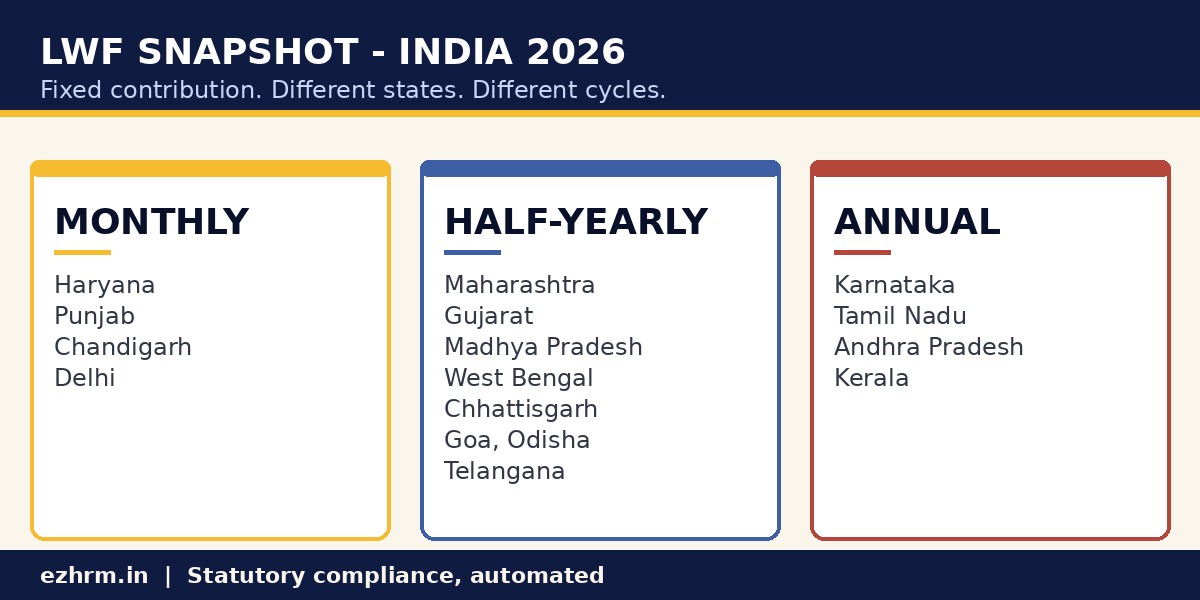
| State | Employee share | Employer share | Frequency | Due date |
|---|---|---|---|---|
| Maharashtra | ₹25 per half-year | ₹75 per half-year | Half-yearly (Jun & Dec) | 15 July / 15 January |
| Karnataka | ₹50 per year | ₹100 per year | Annual | 31 December (deduction); 15 January (deposit) |
| Gujarat | ₹6 per half-year | ₹12 per half-year | Half-yearly (Jun & Dec) | 15 July / 15 January |
| Tamil Nadu | ₹20 per year | ₹40 per year | Annual | 31 January |
| West Bengal | ₹3 per half-year | ₹30 per half-year | Half-yearly (Jun & Dec) | 15 July / 15 January |
| Madhya Pradesh | ₹10 per half-year | ₹20 per half-year | Half-yearly (Jun & Dec) | 15 July / 15 January |
| Andhra Pradesh | ₹30 per year | ₹70 per year | Annual | 31 January |
| Telangana | ₹2 per year | ₹5 per year | Annual | 31 January |
| Kerala | ₹50 per year | ₹50 per year | Annual | By prescribed date |
| Haryana | ₹31 per month | ₹62 per month | Monthly | 15th of following month |
| Chhattisgarh | ₹15 per half-year | ₹30 per half-year | Half-yearly | 15 July / 15 January |
| Goa | ₹60 per half-year | ₹180 per half-year | Half-yearly | By prescribed date |
| Delhi | ₹0.75 per month | ₹2.25 per month | Half-yearly (Jun & Dec) | 15 July / 15 January |
| Punjab & Chandigarh | ₹5 per month | ₹20 per month | Monthly | 15th of following month |
| Odisha | ₹20 per half-year | ₹40 per half-year | Half-yearly | 15 July / 15 January |
Recent revisions to note: Maharashtra increased rates from ₹12/₹36 to ₹25/₹75 in March 2024. West Bengal hiked employer share from ₹6 to ₹30 in January 2024. Karnataka revised to ₹50/₹100 in 2025 along with the threshold drop. If your payroll software still uses the older numbers, you have arrears to clear.
Who is exempt from LWF?
LWF generally does not apply to:
- Employees in a managerial or supervisory capacity drawing above the wage ceiling defined in each state Act (the ceiling differs — Maharashtra exempts those drawing over ₹3,500 in supervisory roles, Karnataka has no salary ceiling).
- Apprentices engaged under the Apprentices Act, 1961.
- Persons employed in a purely seasonal or casual capacity for less than 30 working days in a period (state-specific).
- Establishments outside the LWF state list (no LWF Act = no contribution).
For most office-based companies with employees on monthly payroll, exemptions are rare. Don’t assume your senior managers are exempt without checking the state-specific definition.
How to deduct, deposit, and file LWF — step by step
- Register with the State Labour Welfare Board. Use the state’s online portal — Maharashtra (mlwb.in), Karnataka (klwb.karnataka.gov.in), Tamil Nadu (labour.tn.gov.in), and so on. Each state needs its own registration even if you’re a single legal entity.
- Identify covered employees. Pull the headcount on the cut-off date specified by the state — usually 30 June and 31 December for half-yearly states. Filter out exempt categories.
- Deduct the employee share in the right month. For half-yearly states, the deduction usually goes on the June or December salary. Miss the cycle and you cannot deduct retroactively — the employer absorbs both halves.
- Compute employer share. Apply the state-specific employer rate against the same headcount.
- Generate the challan online. Most states (Maharashtra, Karnataka, Haryana, Delhi) now accept online payment with auto-generated challans. A few still use physical demand drafts.
- File the return. Form A in Maharashtra, Form D in Karnataka, Form A in Gujarat — file along with payment proof by the due date. Keep the acknowledgement for inspections.
- Update employee records. Reflect the LWF deduction on the payslip line item — auditors check for this.
For monthly states like Haryana and Punjab, this entire cycle repeats by the 15th of every month. For Karnataka and Andhra Pradesh, it’s once a year — set a January reminder.
What HR managers get wrong about LWF
Mistake 1: Treating it as optional because the amount is tiny. A 100-employee Gujarat office owes only ₹1,800 per half-year in total LWF. But penalties run 10–50% plus interest, and labour officers flag it during routine inspections. Cheap to comply, expensive to ignore.
Mistake 2: Using outdated rates. Maharashtra (March 2024), West Bengal (January 2024), and Karnataka (2025) all revised rates recently. If your system still deducts ₹12 in Maharashtra, you’re under-paying — and the difference is recoverable from the employer, not the employee.
Mistake 3: One registration for multiple states. Each state board needs its own registration number. A Bangalore-headquartered SaaS firm with a Mumbai sales office and a Chennai support team needs three separate LWF registrations.
Mistake 4: Forgetting the deduction window. In half-yearly states, the employee share comes off the June or December salary only. If your payroll runs without flagging it, the employer becomes liable for the full amount. Set a calendar reminder for the 25th of June and December.
Mistake 5: Confusing LWF with ESI or PF. All three apply simultaneously to the same employee. LWF is not a substitute for either. And unlike PF, LWF deductions do not qualify for Section 80C tax benefit for the employee.
LWF vs PF vs ESI vs Professional Tax — quick comparison
| Feature | LWF | EPF | ESI | Professional Tax |
|---|---|---|---|---|
| Governing body | State Labour Welfare Board | EPFO (Central) | ESIC (Central) | State government |
| Applicability | 16 states/UTs | 20+ employees, all India | 10+ employees (most states), gross ≤ ₹21,000 | 21 states + Puducherry |
| Contribution basis | Fixed rupee amount | 12% of basic + DA (cap ₹15,000) | 4% of gross (0.75% emp + 3.25% er) | Slab-based by salary |
| Frequency | Monthly / Half-yearly / Annual | Monthly (by 15th) | Monthly (by 15th) | Monthly / Half-yearly / Annual |
| Tax deduction for employee | None | Section 80C | Not applicable | Section 16(iii) |
For deeper rules on each, see our guides on filing PF ECR in 2026, ESI return filing, and Professional Tax state-wise slabs.
Frequently asked questions about LWF
Is LWF compulsory for all companies in India?
No. LWF is mandatory only in the 16 states/UTs that have enacted the Act — Maharashtra, Karnataka, Tamil Nadu, Gujarat, Haryana, Delhi, Punjab, Chandigarh, West Bengal, Madhya Pradesh, Kerala, Andhra Pradesh, Telangana, Goa, Odisha, and Chhattisgarh. Within these states, applicability depends on the employee count threshold set by each state Act.
Can the employer pay both employee and employer LWF share?
Yes. There is no rule preventing the employer from absorbing the employee share. Some companies do this as a small benefit because the amount is negligible. The total contribution is still deposited under one challan with the State Labour Welfare Board.
Is LWF deduction shown on the payslip?
Yes. LWF should appear as a separate deduction line item on the employee’s payslip in the month it is deducted (June or December for half-yearly states; every month for Haryana, Punjab, and Delhi). Without this, statutory auditors will flag it.
What happens if LWF is missed for a previous period?
You can still pay arrears, but the State Board will levy interest (commonly 1% per month) and a penalty (10–50% depending on the state). Pay the arrears voluntarily before an inspection — penalties for inspector-detected default are higher and can include prosecution under the respective state Act.
Does LWF apply to contract workers?
Yes, in most states. The principal employer is responsible for ensuring the contractor deposits LWF for the contract workforce on site. The state Acts treat contract workers and direct employees the same for LWF coverage. Verify the contractor’s LWF challan during invoice processing.
Where can I find the official LWF notifications?
Use the official State Labour Welfare Board portal for your state — for example, mlwb.in for Maharashtra, klwb.karnataka.gov.in for Karnataka. Notifications are also gazetted on the state labour department website. Avoid relying on third-party blogs alone — rates change without much fanfare.
Closing thought
LWF is the smallest line item in your statutory stack and the easiest one to forget. Build it into your payroll workflow now — set the June and December reminders, register in every state where you operate, and verify rates after every state no