
You finish processing April payroll, breathe a small sigh, and then your finance head pings: “Did we file the ESI half-yearly return yet? May 12 is next week.” Now you’re scrambling through the ESIC portal, hunting for last October’s challan reference, and praying you didn’t miss a temporary employee.
If that scene feels familiar, you’re not alone. ESI confuses HR teams more than PF does — partly because there are two deadlines (monthly contribution + half-yearly return), and partly because the wage ceiling rules quietly trip people up. Here is everything you need to file ESI cleanly in 2026, without the last-minute panic.
TL;DR
- ESI applies to every employee earning gross wages of ₹21,000 or less per month (₹25,000 for persons with disabilities). The wage ceiling has not changed in 2026.
- Employee pays 0.75%, employer pays 3.25% of gross wages — total 4%, deducted monthly.
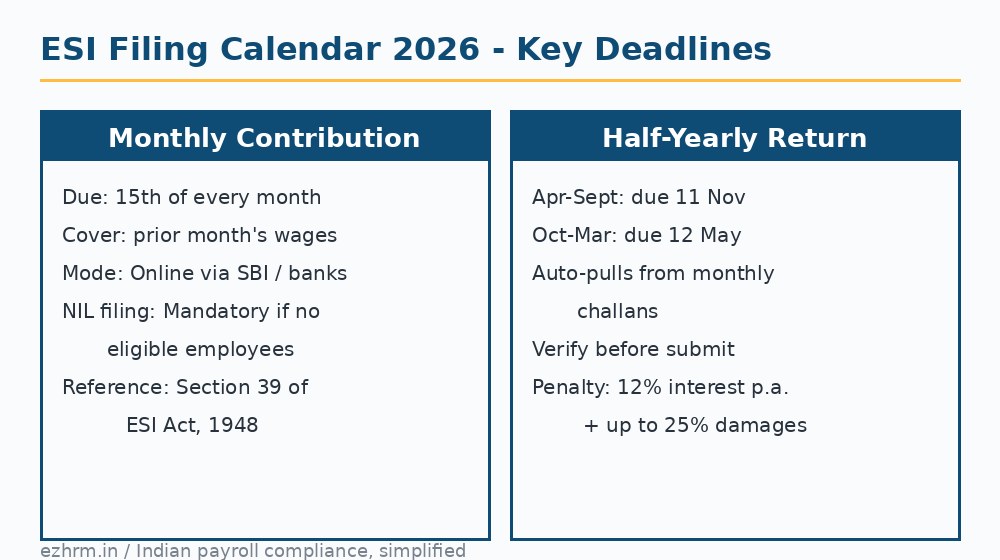
- Two filings matter: monthly contribution by the 15th of the next month, and half-yearly return by 12 May and 11 November.
- Late filing attracts 12% interest per annum + damages of up to 25% under Section 85B of the ESI Act, 1948. Don’t risk it.
What is ESI and Who is Covered in 2026?
ESI (Employees’ State Insurance) is a self-financing social security scheme run by ESIC under the Ministry of Labour & Employment. Established under the ESI Act, 1948, it gives medical care, sickness benefit, maternity benefit, disablement and dependent benefits to insured workers and their families.
Coverage applies if:
- Your establishment has 10 or more employees (some states still use the 20+ threshold for shops & establishments — check your state notification)
- The employee draws gross monthly wages up to ₹21,000 (₹25,000 if the employee has a registered disability)
A factory in Bawana, a 14-person retail store in Connaught Place, a 30-employee BPO in Gurugram — all of them must register with ESIC and contribute monthly.
What counts as “wages” here? Basic + DA + HRA + city compensation + overtime + meal allowance + any other regular payment. Reimbursements like LTA or actual conveyance bills are excluded. Annual bonuses and gratuity payouts are also outside the wage definition for ESI calculation.
ESI Contribution Rates: Who Pays What
The rates have been stable since 1 July 2019:
| Contribution | Rate | Calculated On |
|---|---|---|
| Employee share | 0.75% | Gross wages |
| Employer share | 3.25% | Gross wages |
| Total | 4.00% | Gross wages |
Quick example. For an employee with gross wages of ₹18,000/month:
- Employee deduction: ₹135 (0.75% of 18,000)
- Employer contribution: ₹585 (3.25% of 18,000)
- Total deposit: ₹720 per month
If you want to skip the maths, EZHRM’s free PF & ESI calculator does it instantly for any salary structure.
The “Contribution Period” Rule HR Often Misses
ESI works on two fixed contribution periods each year:
- April to September (benefit period: January to June of next year)
- October to March (benefit period: July to December of next year)
If an employee’s gross salary crosses ₹21,000 mid-period, you continue deducting ESI till the period ends. You cannot stop the moment they cross the ceiling. This is the most common compliance error we see in audits.
The Two Filings You Cannot Miss
1. Monthly Contribution Challan (Due by 15th of every month)
You generate a challan on the ESIC portal listing each employee, their wages, and the contribution amount. After payment, the system issues a Challan Confirmation receipt — keep this for your records. Even in months where you have no eligible employees, you must file a NIL declaration. Skipping NIL filings flags your account for review.
For April 2026 wages, your deadline is 15 May 2026.
2. Half-Yearly Return (Due 12 May and 11 November)
Twice a year, you file a consolidated return summarising six months of contributions for every covered employee. The half-yearly return for October 2025 to March 2026 is due on 12 May 2026. The return pulls data from your monthly challans, so if your monthly filings are clean, the half-yearly return is mostly a verification step.
Step-by-Step: How to File ESI Online on the ESIC Portal
Filing happens at esic.gov.in. Here is the flow:
- Login to the employer portal using your 17-digit ESIC code, username, and password.
- Click “File Monthly Contributions” under the Online Monthly Contribution section.
- Select the contribution period (April 2026, for instance) and download the Excel template if you want to bulk upload.
- Enter or upload employee details: IP number (Insurance Number), name, days worked, wages paid. Days lost or LWP are critical — wrongly entering full days for an employee on unpaid leave inflates your contribution.
- Verify the calculated contribution the portal shows — match it against your payroll register.
- Submit and generate challan. You’ll get a Challan Number.
- Pay online through SBI net banking or any authorised bank. ESIC accepts only online payments now.
- Save the Challan Confirmation PDF. This is your proof of filing.
For the half-yearly return, the portal pulls the data from your monthly challans automatically. You review, certify, and submit.
Common Mistakes HR Managers Make with ESI
After running compliance for a few hundred SMEs, the same mistakes show up again and again:
- Stopping ESI mid-period when salary crosses ₹21,000. As covered above, you have to continue till the contribution period ends.
- Ignoring temporary or contract staff. ESI applies to every covered employee, including casual labour, trainees on stipend, and contract workers (the principal employer is liable if the contractor doesn’t comply).
- Counting only basic salary in wages. ESI is calculated on gross wages, not basic. HRA and other allowances count.
- Missing the NIL filing. Even with zero eligible employees, you must file a NIL declaration that month.
- Treating arrears as current wages. When you pay arrears for a past period, ESI on that arrear is calculated on the original month’s contribution, not the current one.
- Not generating IP numbers for new joiners. Every new ESI-eligible employee must be registered with ESIC within 10 days of joining to get an Insurance Number. Skipping this means they cannot avail benefits, and you face a notice.
ESI Benefits Your Employees Should Actually Use
Most HR managers treat ESI as a deduction line item — but the benefits on the other side are real, and most employees don’t claim them because nobody tells them how. Worth a 5-minute mention in your onboarding session:
- Medical benefit: Free treatment for the insured person and family at any ESIC dispensary or empanelled hospital.
- Sickness benefit: 70% of average daily wages for up to 91 days during certified illness.
- Maternity benefit: 100% of average daily wages for 26 weeks of paid leave.
- Disablement benefit: Cash payment for temporary or permanent disability from work injury.
- Dependants’ benefit: Pension to dependants if the insured worker dies due to employment injury.
- Funeral expenses: ₹15,000 lump sum on the death of an insured worker.
Pointing these out shifts the perception of ESI from “another cut on my payslip” to “actual coverage I have”.
Penalties for Late or Wrong ESI Filing
Under Section 85B of the ESI Act, late deposits attract:
- Simple interest at 12% per annum on delayed contribution
- Damages of 5% to 25% of the unpaid amount, depending on the delay duration
- Possible prosecution and imprisonment of up to 3 years for repeated non-compliance
A delay of one month on a ₹50,000 monthly contribution can quietly cost you ₹500–₹2,500 in damages plus interest. Not catastrophic, but it adds up — and notices from ESIC have a way of arriving at the worst time.
FAQ: Common ESI Questions HR Managers Ask
Is ESI mandatory if my company has only 8 employees?
For most factories and establishments under the ESI Act, the threshold is 10 employees. Some states retain a 20-employee threshold for shops and commercial establishments. Check your state’s gazette notification — Maharashtra, Karnataka, and Delhi all use 10; Punjab and a few others still use 20 for shops.
What if an employee earns ₹21,500 — do I still register them?
No. Anyone with gross wages above ₹21,000 (₹25,000 for persons with disability) is excluded from ESI from day one. They don’t get an IP number, and you don’t deduct contribution from their salary.
Can I file ESI return after the deadline?
Yes, the portal accepts late filings, but you’ll pay 12% interest plus damages. File as soon as possible to keep damages in the lower 5–10% bracket rather than the 25% maximum. The longer you wait, the worse the slab.
Do interns and apprentices come under ESI?
Interns paid a stipend that qualifies as “wages” under the Act are covered. Apprentices registered under the Apprentices Act, 1961 are excluded — but only that specific category. Stipend-based interns from colleges are usually included.
What happens to ESI when an employee resigns mid-month?
You deduct ESI proportionate to wages paid till the last working day. The challan for that month must include them with their actual days worked, and their IP number stays active for the rest of the contribution period for benefit eligibility.
Is the ESI wage ceiling changing in 2026?
The Ministry of Labour has discussed raising the ceiling to ₹25,000 or ₹30,000, but as of April 2026, no notification has been issued. The current ceiling of ₹21,000 still applies. Watch the ESIC portal for circulars.
Build the Discipline, Skip the Panic
ESI is one of those compliances that feels small until it doesn’t. A single missed filing can trigger a notice, an audit, and a working week you’ll never get back. Build the discipline of locking April contributions on the 10th, not the 15th — that buffer saves careers.
If you’re tired of reconciling Excel sheets every month, EZHRM’s statutory compliance module auto-generates ESI and PF challans straight from your monthly payroll run, so the May 12 deadline becomes a 5-minute task instead of a half-day scramble.