
It’s the 12th of the month, the payroll sheet is 80% done, and then it happens — someone’s basic salary got revised, their gross just crossed ₹21,000, and now you’re not sure whether ESI still applies for the rest of the contribution period. If you’ve ever paused mid-payroll run to double-check a PF or ESI number on a calculator, you’re not alone. Every HR manager running payroll for an Indian SME hits this exact moment, usually right before a deadline.
PF and ESI calculation looks simple on paper — a couple of percentages applied to salary — but the ceilings, the EPS split, and the ESI applicability rule trip up even experienced payroll teams. This guide walks through the 2026 rates, the exact formulas, and the filing process, so you can stop second-guessing your numbers.
TL;DR
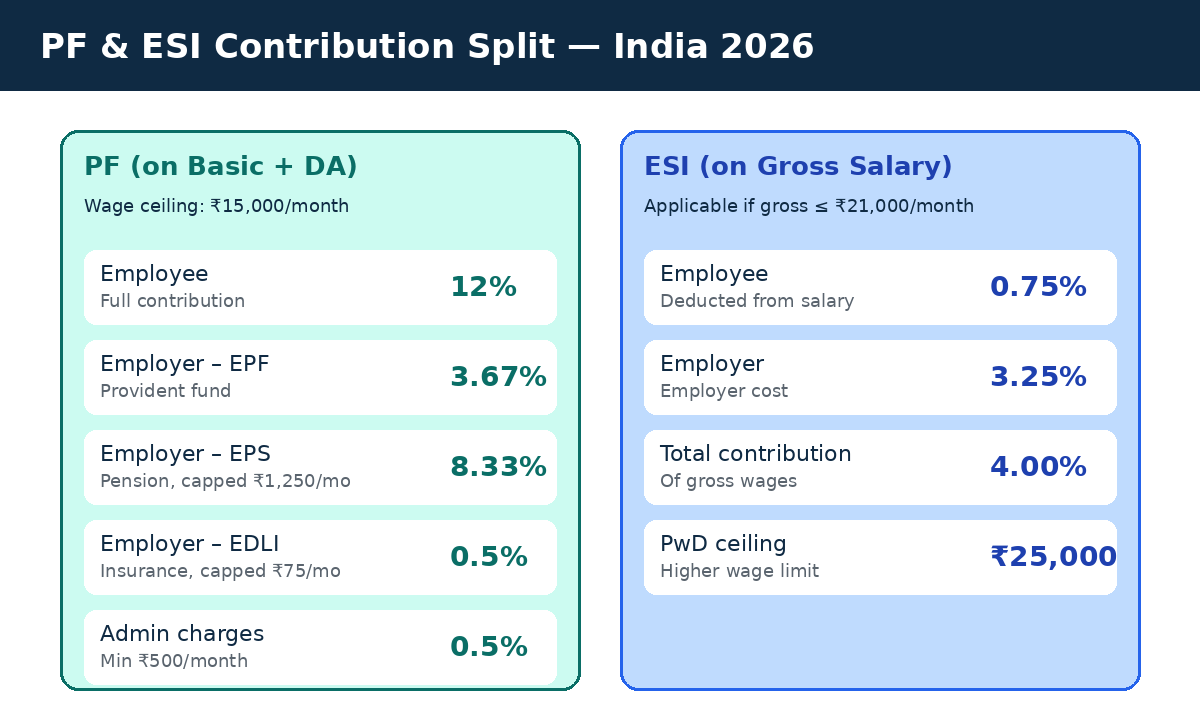
- PF is 12% of Basic + DA from both employee and employer, capped at a ₹15,000 wage ceiling (voluntary contribution allowed above that).
- The employer’s 12% PF share splits into 3.67% EPF, 8.33% EPS (pension, capped at ₹1,250/month), plus 0.5% EDLI and 0.5% admin charges.
- ESI is 4% total (0.75% employee + 3.25% employer) on gross salary, but only applies if gross is ₹21,000/month or less (₹25,000 for persons with disabilities).
- Both are filed monthly — PF via ECR by the 15th, ESI contribution also due by the 15th of the following month.
What Are PF and ESI, and Why HR Can’t Treat Them as One Line Item
PF (Provident Fund) is a retirement savings scheme under the Employees’ Provident Funds & Miscellaneous Provisions Act, administered by the EPFO, where both employer and employee set aside a percentage of wages every month. ESI (Employee State Insurance) is a social security scheme under the ESI Act, 1948, administered by ESIC, that gives lower-wage employees medical and cash benefits in exchange for a small monthly contribution.
They get bundled together in conversation because both are statutory payroll deductions with monthly due dates, but they run on completely different eligibility rules, different wage ceilings, and different government portals. Getting either one wrong — even by a percentage point or a wrong base salary — means either a shortfall notice from EPFO/ESIC or employees quietly getting shortchanged on their retirement corpus or medical cover.
If you’d rather not do this by hand every month, EZHRM’s free PF & ESI calculator runs both calculations instantly — useful for a quick check even if your payroll software already handles it.
PF Calculation 2026: The 12% Formula and the ₹15,000 Ceiling
PF is calculated on Basic + Dearness Allowance (DA), not on gross salary. The statutory wage ceiling for mandatory PF is ₹15,000/month — this hasn’t moved in years, and it stays unchanged even under the new labour codes, though the definition of “wages” that feeds into the base has been tightened so that allowance-heavy structures can’t artificially shrink the PF base.
The formula
- Employee contribution: 12% of PF-eligible Basic + DA (capped at ₹15,000, so max ₹1,800/month unless the employee opts for voluntary PF on actual basic)
- Employer contribution: 12% of the same base, split as 3.67% EPF + 8.33% EPS
- EPS (pension) cap: 8.33% of ₹15,000, capped at ₹1,250/month
- EDLI (insurance): 0.5% of wages, capped at ₹75/month, employer-only
- Admin charges: 0.5% of wages (minimum ₹500/month per establishment), employer-only
Example: for an employee with ₹15,000 basic, employee PF is ₹1,800/month, employer EPF is ₹550.50, employer EPS is ₹1,249.50 (rounded to the ₹1,250 cap in practice), plus EDLI and admin charges on top. Run your own numbers on the PF & ESI calculator rather than doing this in a spreadsheet every month — it’s the same formula, just without the manual rounding errors.
ESI Calculation 2026: 4% Total, and the ₹21,000 Cut-Off That Confuses Everyone
ESI is calculated on gross salary, not Basic + DA. The total contribution is 4% of gross — 0.75% from the employee and 3.25% from the employer — and it applies only when the employee’s gross salary is ₹21,000/month or less (₹25,000/month for persons with disabilities). These rates have been frozen since July 2019 and haven’t changed for FY 2026-27 either.
The rule HR managers get wrong most often: ESI applicability is checked once, at the start of a contribution period (April–September or October–March). If an employee’s gross crosses ₹21,000 mid-period because of a raise or bonus payout, ESI continues to apply for the rest of that six-month period. You don’t stop deducting it just because the salary crossed the ceiling in month four.
ESI registration itself is mandatory for establishments with 10 or more employees (in most states; some states set the threshold at 20). If you’re an SME crossing that headcount for the first time, check your state’s threshold before assuming you’re exempt.
PF vs ESI: Quick Comparison
| Aspect | PF | ESI |
|---|---|---|
| Calculated on | Basic + DA | Gross salary |
| Employee share | 12% | 0.75% |
| Employer share | 12% (3.67% EPF + 8.33% EPS) | 3.25% |
| Wage ceiling | ₹15,000/month (mandatory) | ₹21,000/month (₹25,000 for PwD) |
| Regulator | EPFO | ESIC |
| Applicability threshold (establishment) | 20+ employees | 10+ employees (varies by state) |
| Filing due date | 15th of following month (ECR) | 15th of following month |
How to File PF and ESI Every Month: The Checklist
- Freeze attendance and final salary for the payroll month — PF and ESI bases depend on actual Basic/DA and gross paid, including arrears.
- Calculate PF-eligible and ESI-eligible salary separately for each employee — remember they use different bases.
- Generate the ECR (Electronic Challan cum Return) on the EPFO Unified Portal with employee-wise wage and contribution details.
- Generate the ESI monthly contribution challan on the ESIC portal using the same wage data.
- Pay both challans by the 15th of the following month — late payment attracts interest and penalty under both Acts.
- Reconcile against your payroll register before closing the month, so any correction gets caught before the next cycle, not three months later.
Common Mistakes HR Managers Make With PF & ESI
A few patterns show up again and again in payroll audits:
- Calculating PF on gross instead of Basic + DA — inflates the employer’s cost and confuses employees when their payslip doesn’t match expectations.
- Stopping ESI mid-contribution-period the moment gross crosses ₹21,000, instead of continuing till the period ends.
- Forgetting EDLI and admin charges when budgeting employer PF cost — these are small individually but add up across headcount.
- Missing the 15th-of-the-month deadline because attendance data came in late — this is almost always a process problem, not a calculation one.
- Not applying the ₹25,000 PwD ceiling for eligible employees, which means under-contributing on their ESI.
Most of these come from doing payroll on spreadsheets where formulas quietly go stale after a policy change. It’s worth checking your numbers against a live tool like the PF & ESI calculator at least once a quarter, or better, automating the whole thing so it’s never a manual formula in the first place — see how EZHRM’s compliance management module handles this end to end.
FAQs
Is PF mandatory for all employees in India?
PF is mandatory for employees earning ₹15,000 or less in Basic + DA, at establishments with 20 or more employees. Employees above that ceiling can still join voluntarily, and once enrolled, an employee generally can’t opt out later.
What happens if an employee’s salary crosses ₹21,000 mid-year for ESI?
ESI applicability is locked in for the full contribution period (April–September or October–March) once an employee is covered. Even if their gross crosses ₹21,000 during that period, ESI continues until the period ends.
Can an employee contribute PF on their full basic salary, above ₹15,000?
Yes, this is called voluntary PF contribution on actual basic. The employee’s share can be calculated on the full Basic + DA if both employer and employee agree, though the employer’s EPS contribution still caps at the ₹15,000 ceiling.
Are PF and ESI calculated on the same salary component?
No. PF uses Basic + DA as its base, while ESI uses gross salary (which includes most allowances). This is one of the most common sources of calculation errors in manual payroll.
What’s the penalty for late PF or ESI payment?
Both EPFO and ESIC levy interest on delayed payments, plus damages/penalty charges that scale with the delay period. Repeated defaults can also trigger inspections, so it’s worth building a hard internal deadline a few days before the 15th.
Does ESI apply to contract or temporary workers?
Yes, if their gross wages fall within the ESI ceiling and the establishment is covered, ESI applies regardless of whether the worker is on the direct payroll or hired through a contractor, though the compliance responsibility can shift depending on the contract structure.
Getting This Right, Every Month
PF and ESI aren’t complicated once you separate the two bases and remember the ceilings, but they’re exactly the kind of calculation that’s easy to get subtly wrong in a spreadsheet and hard to notice until an audit flags it. Bookmark the free PF & ESI calculator for quick checks, or browse EZHRM’s full set of free HR calculators — including the CTC salary calculator and professional tax calculator — if you’re structuring a full salary breakup. And if you’re tired of chasing these numbers by hand every single month, EZHRM automates PF, ESI, and TDS calculation directly inside payroll, so the compliance is built in rather than double-checked after the fact.
For more HR and payroll guides like this one, visit the EZHRM blog.