
A new hire joins your Gurugram IT team on a ₹9 LPA package. She stays back till 11 PM twice a week during a release crunch. Down the hall, your facilities contractor’s electrician does the same on a factory floor in Bahadurgarh. Does either of them have a legal right to overtime pay — or is “OT” just something that happens to machine operators? Most HR managers answer this by gut feel. The law answers it very differently, and getting it wrong is an easy way to end up on the wrong side of an inspection or a labour court notice.
Overtime eligibility in India is not decided by job title, CTC, or whether someone sits in an office or a factory. It is decided by whether the person is legally a “worker” under the applicable statute, and by which law — the Factories Act 1948, a state Shops & Establishments Act, or the newer labour codes — covers your establishment. Get the classification wrong, and either you’re underpaying dozens of eligible staff every month, or you’re budgeting overtime for people who were never legally entitled to it in the first place.
TL;DR — Overtime Eligibility in India, 2026
- Eligibility depends on your legal classification as a “worker,” not your job title, department, or salary slip design.
- Factory floor staff, retail and shop employees, drivers, and most contract labour are covered. Genuine managers with real hiring/firing and sanctioning authority are usually exempt.
- IT and software staff are not automatically exempt — a common and expensive myth. Coverage depends on their actual role, not the “tech employee” label.
- Once eligible, overtime is paid at 2× the ordinary rate of wages, computed on Basic + DA (+ retaining allowance), not gross or CTC. Use EZHRM’s free overtime calculator to get the exact figure.
What Does “Overtime Eligible” Actually Mean in India?
Overtime eligibility is the legal test of whether an employee’s role falls under the definition of “worker” (Factories Act, 1948) or a person whose “wages” are fixed under the Code on Wages, 2019 — as opposed to genuine management staff, who are typically outside the overtime net. This is a role-based test, not a designation-based one. An “Assistant Manager” who spends her day doing data entry with no authority to hire, discipline, or sanction leave is, in the eyes of the law, still a worker.
Two frameworks matter here. The Factories Act, 1948 covers manufacturing units employing 10+ workers with power (or 20+ without power) and uses the term “worker” under Section 2(l) — interpreted broadly to include anyone engaged in a manufacturing process, directly or through a contractor, with or without the principal employer’s knowledge. The Occupational Safety, Health and Working Conditions (OSH) Code, 2020, in force since 21 November 2025 with central rules notified via G.S.R. 345(E) on 8 May 2026, widens this further — pulling in factories, shops, warehouses, construction sites, motor transport undertakings, and plantations with 10 or more workers. State Shops & Establishments Acts fill the gap for smaller offices and retail outlets not yet covered by the central rules.
The Real Test: “Worker” vs “Person in a Position of Management”
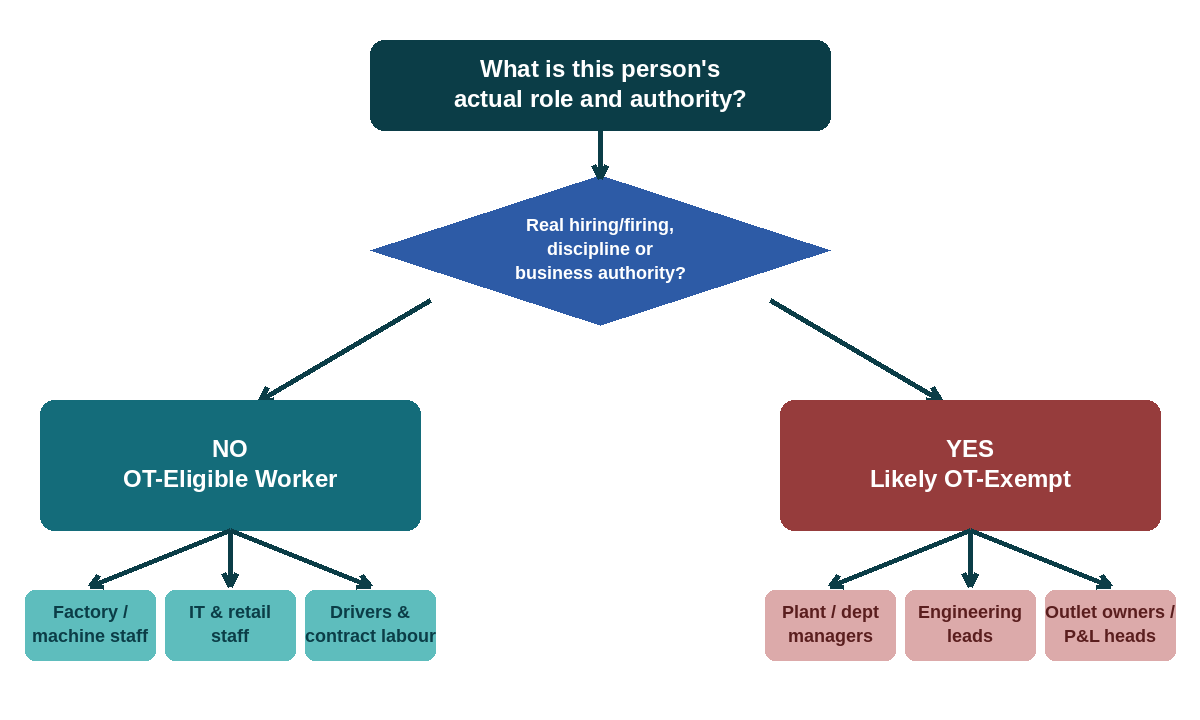
Every major Indian labour statute carves out an exemption for people in genuine supervisory, managerial, or confidential roles. The confusion for HR almost always comes from applying this exemption too liberally. Ask three questions before you exclude anyone from OT eligibility:
- Does this person have the authority to hire, discipline, or terminate other staff — not just recommend it, but actually decide it?
- Does this person set their own working hours and priorities, largely without supervision?
- Is this person’s role predominantly administrative and strategic, rather than operational or technical execution?
If the honest answer to all three is yes, the role is likely exempt. If even one answer is no, the safer legal position is that the person is a worker and is entitled to overtime once they cross the statutory hours threshold — 9 hours/day or 48 hours/week under the Factories Act, or 8 hours/day (for daily-wage workers) and 48 hours/week under the OSH Code.
Industry-by-Industry: Who Actually Qualifies for OT
The honest answer changes depending on which sector your establishment sits in. Here’s how eligibility typically plays out across the industries EZHRM customers operate in:
| Industry | Typically OT-Eligible | Typically Exempt | Governing Law |
|---|---|---|---|
| Manufacturing / Factories | Machine operators, line workers, QC technicians, supervisors without hire/fire power | Plant managers, HR business partners with real authority | Factories Act 1948 / OSH Code |
| IT & Software | Developers, QA engineers, support staff working assigned hours under a reporting manager | Engineering managers and leads with genuine team authority | State Shops & Establishments Act |
| Retail & FMCG | Store staff, cashiers, stock associates | Store managers with full operational control | State Shops & Establishments Act |
| Construction | Site labour, masons, equipment operators — including contract labour | Site engineers in a genuine supervisory role | OSH Code (Contract Labour provisions) |
| Logistics & Transport | Drivers, loaders, warehouse pickers | Fleet/warehouse managers with hiring authority | Motor Transport Workers provisions, OSH Code |
| Restaurants & F&B | Kitchen staff, servers, delivery staff | Outlet managers with P&L and staffing authority | State Shops & Establishments Act |
Notice the IT row. This is where most Indian HR teams get it wrong.
Special Categories HR Managers Often Miss
Piece-Rate Workers
For workers paid by output rather than by the hour, the “ordinary rate” is not a fixed salary — it’s computed as the average daily earnings over the preceding three months, divided by 8 hours. Overtime is then paid at twice that derived hourly figure for every hour beyond the standard shift.
Women on Night Shifts
Women can legally work overtime and night shifts under the OSH Code, but only with their written consent, and the employer must arrange safe transport, adequate lighting on the premises, and CCTV coverage. Skipping the consent paperwork is a compliance gap even if the OT pay itself is correctly calculated.
Contract Labour
Contract workers deployed at your site are owed overtime by the contractor. But under the OSH Code’s single-registration regime, principal employer liability kicks in if the contractor defaults — meaning your factory or site can still be on the hook. This is one of the most commonly missed categories in vendor management.
Interns, Apprentices & Probationers
Apprentices engaged under the Apprentices Act, 1961 receive a stipend, not wages, and generally fall outside statutory overtime. Probationers, however, are not exempt by virtue of being on probation — if the role itself is a “worker” role, probation status changes nothing about OT eligibility.
Once Eligible, How Much Is Owed?
Eligibility answers the “if”; the formula answers the “how much.” For monthly-rated workers:
Hourly rate = (Monthly Basic + DA) ÷ 26 ÷ 8
Overtime pay = Hourly rate × 2 × Overtime hours
A machine operator on ₹18,000 Basic + DA who works 20 OT hours in a month is owed roughly ₹3,462 — full workings and state-wise variations are in our detailed OSH Central Rules overtime guide. Don’t want to do the arithmetic by hand every payroll cycle? EZHRM’s free overtime calculator computes it instantly once you know who’s eligible.
What HR Managers Get Wrong About OT Eligibility
Assuming “salaried” means “exempt.” A fixed monthly salary has nothing to do with OT exemption. Exemption is about the nature of the role — managerial authority — not the payment structure.
Treating IT and software staff as a blanket exemption. Plenty of Indian tech companies operate on the assumption that engineers and support staff simply don’t get overtime. Legally, unless the role is genuinely managerial, that assumption doesn’t hold under most state Shops & Establishments Acts — it’s just rarely enforced, which is a different thing from being compliant.
Forgetting contract labour when auditing OT exposure. If your vendor isn’t paying OT correctly, your establishment can still carry liability. Build OT verification into your contractor audit checklist, not just your own payroll.
Applying the same eligibility test across every state. Shops & Establishments Act provisions — including managerial exemptions — vary by state. What’s exempt in one state’s Act may not be exempt in another’s.
No documented role classification. If you can’t produce a written basis (job description, org chart, sanctioning authority matrix) for why a role is classified as exempt, an inspector will default to treating it as OT-eligible.
Overtime Eligibility Checklist for HR
- List every role in your organisation and classify each as “worker” or “management” based on actual authority, not title.
- Confirm which law applies to each location — Factories Act, OSH Code, or state Shops Act.
- Flag contract labour and verify your vendor’s OT payment practices in writing.
- Document consent and safety arrangements for women working night shifts or overtime.
- Check your state’s specific managerial exemption criteria under its Shops & Establishments Act.
- Run eligible employees’ pay through EZHRM’s overtime calculator before finalising payroll.
- Cross-check OT figures against attendance data using an automated attendance system rather than manual muster rolls.
FAQ: Overtime Eligibility in India
Q: Are IT employees in India legally entitled to overtime pay?
A: Yes, unless their role is genuinely managerial with real authority over hiring, discipline, or business decisions. Being salaried or having “engineer” or “associate” in the title does not, by itself, remove OT entitlement under most state Shops & Establishments Acts.
Q: Can a company classify all its supervisors as exempt from overtime?
A: No. The exemption applies to the actual duties performed, not the designation. A “supervisor” who has no power to hire, discipline, or sanction leave independently is still typically OT-eligible.
Q: Is there a salary threshold above which employees lose OT eligibility?
A: There’s no single national salary cutoff. Some state Shops & Establishments Acts define specific criteria for managerial exemption; check your state’s Act rather than assuming a CTC figure decides eligibility.
Q: Who pays overtime for contract labour — the contractor or the principal employer?
A: The contractor is primarily responsible. But under the OSH Code’s registration framework, the principal employer can carry liability if the contractor fails to pay, so it pays to verify contractor compliance directly.
Q: Do interns get overtime pay in India?
A: Interns and apprentices engaged under the Apprentices Act, 1961 receive a stipend rather than wages and generally fall outside statutory overtime provisions. Interns hired as regular employees under an employment contract, however, may be OT-eligible depending on their actual role.
Q: What happens if I misclassify a worker as OT-exempt?
A: You accrue a wage liability for every unpaid OT hour, which can be claimed retroactively, plus potential penalties under the Factories Act or OSH Code for incorrect wage records. It’s a cheaper problem to fix now than after an inspection.
Overtime eligibility is the question HR teams skip past to get to the arithmetic — and it’s the one that actually creates liability. Before you run this month’s numbers, confirm who on your payroll is genuinely covered. Once that’s settled, EZHRM’s free overtime calculator gets you the exact payable amount in seconds, and if you’d rather have OT computed automatically from punch data every cycle, take a look at what EZHRM’s payroll software does for Indian SMEs.
For more calculators covering bonus, gratuity, PF/ESI and salary structuring, browse the free HR calculators hub, and for more compliance guides, visit the EZHRM blog.