
It’s the 10th of the month, a new hire’s offer letter says ₹18,500 CTC, and payroll is asking you: “Is this employee covered under ESI or not?” You do the math, get pulled into a WhatsApp debate about whether PF should be calculated on the full salary or capped at ₹15,000, and by the time you’ve settled it, three more employees have the same question. If this sounds familiar, you’re not alone — PF and ESI confusion is one of the most common payroll headaches for Indian HR teams, especially in SMEs without a dedicated compliance person.
PF (Provident Fund) and ESI (Employee State Insurance) are two separate, mandatory statutory deductions in India, and getting either one wrong means either short-changing your employees’ retirement savings or exposing your company to EPFO and ESIC penalties. This guide breaks down the exact formulas, current 2026 rates, and the mistakes that get HR managers into trouble — plus a free PF & ESI calculator so you never have to do this math by hand again.
- PF is 12% of Basic + DA from both employee and employer, capped at a ₹15,000/month wage ceiling (mandatory contribution capped at ₹1,800/month per side).
- ESI is 4% total (3.25% employer + 0.75% employee) on gross wages, and applies only if gross wages are ₹21,000/month or less (₹25,000 for employees with disabilities).
- Employer PF cost isn’t just 12% — add 0.5% EDLI and roughly 0.5% admin charges on top.
- Once an employee crosses the ESI wage ceiling mid-contribution-period, they stay covered until the end of that six-month cycle.
What Are PF and ESI, and Who Actually Needs Them?
PF (Provident Fund) is a retirement savings scheme under the Employees’ Provident Funds & Miscellaneous Provisions Act, 1952, administered by the Employees’ Provident Fund Organisation (EPFO). ESI (Employee State Insurance) is a health and social security scheme under the ESI Act, 1948, run by the Employees’ State Insurance Corporation (ESIC), covering medical care, sickness benefit, and maternity benefit.
PF applies to any establishment with 20 or more employees (voluntary coverage is possible below that). ESI applies to establishments with 10 or more employees (20 in a few states) where the employee’s gross monthly wage doesn’t exceed the ceiling. Many SMEs in the 10–500 employee range end up managing both simultaneously, on the same payroll run, for different sets of employees — which is exactly where the confusion starts.
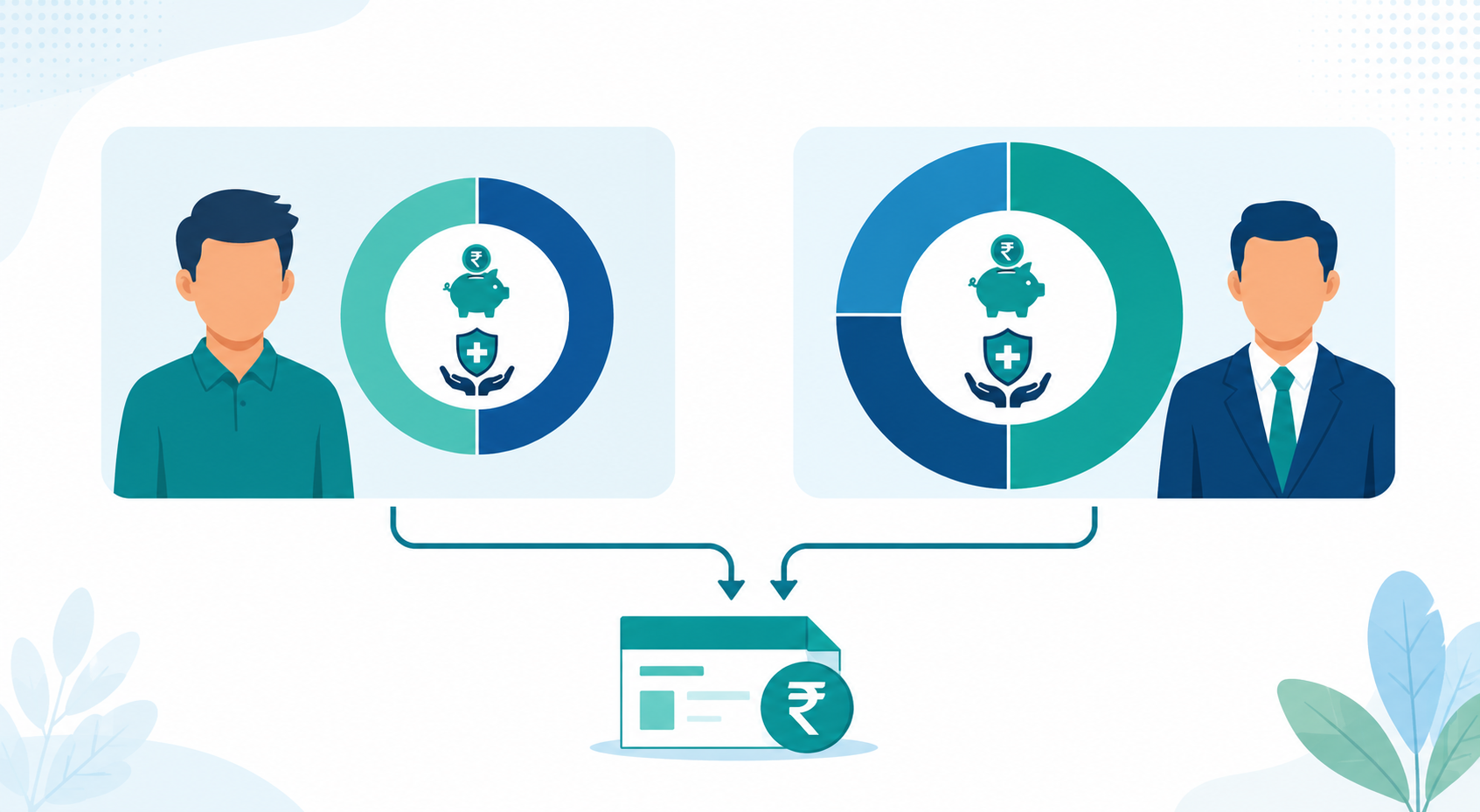
PF Contribution Rate and Formula for 2026
The PF contribution rate is 12% of Basic + Dearness Allowance (DA), matched by the employer. Under the new EPF Scheme 2026, which came into effect on June 29, 2026, this structure was reaffirmed — the statutory wage ceiling stays at ₹15,000/month, so the mandatory PF contribution is capped at ₹1,800/month from each side, regardless of how much higher an employee’s actual Basic+DA is. Anything an employee wants to contribute above that is treated as a voluntary contribution (VPF), and employer matching on the voluntary portion depends on your company policy.
Employee Share
12% of Basic+DA (or 12% of ₹15,000 if Basic+DA exceeds the ceiling and your company caps contributions), deducted from salary and credited entirely to the employee’s EPF account.
Employer Share — Where It Actually Gets Split
This is the part most HR managers get wrong when budgeting payroll cost. The employer’s 12% doesn’t go entirely into the employee’s PF account:
| Component | Rate | Goes To |
|---|---|---|
| EPF (Provident Fund) | 3.67% | Employee’s PF account |
| EPS (Pension Scheme) | 8.33% | Employee’s pension account |
| EDLI (Insurance) | 0.50% | Employee Deposit Linked Insurance |
| Admin charges | ~0.50% | EPFO administration |
| Total employer cost | ~13% | — |
So while the employee sees 12% deducted, your actual employer-side PF cost is closer to 13% of the capped wage — a detail that matters when you’re structuring CTC or explaining salary breakups to candidates. If you’re building out a full pay structure, our CTC salary calculator factors this in automatically.
ESI Contribution Rate and Eligibility for 2026
ESI eligibility is based on gross monthly wages, not just Basic+DA. Any employee earning gross wages up to ₹21,000/month at an ESI-covered establishment is mandatorily covered (₹25,000/month for persons with disabilities). The contribution rates, unchanged since ESIC’s July 2019 revision, remain:
- Employer share: 3.25% of gross wages
- Employee share: 0.75% of gross wages
- Total: 4% of gross wages
One rule that trips up HR teams: if an employee’s wages increase mid-contribution-period (April–September or October–March) and cross ₹21,000, they don’t drop out immediately. ESI coverage continues until the end of that six-month contribution period, per ESIC rules.
PF vs ESI: The Quick Comparison
| Parameter | PF | ESI |
|---|---|---|
| Governing law | EPF & MP Act, 1952 | ESI Act, 1948 |
| Regulator | EPFO | ESIC |
| Applies on | Basic + DA | Gross wages |
| Wage ceiling | ₹15,000/month | ₹21,000/month (₹25,000 for PwD) |
| Employee rate | 12% | 0.75% |
| Employer rate | ~13% (incl. EDLI + admin) | 3.25% |
| Purpose | Retirement savings + pension | Medical, sickness, maternity benefits |
Worked Example: PF & ESI for an ₹18,000 Gross Salary
Say Priya joins your team with a gross monthly salary of ₹18,000, of which Basic+DA is ₹10,000.
- PF: Basic+DA of ₹10,000 is below the ₹15,000 ceiling, so PF applies on the full ₹10,000. Employee deduction = 12% × 10,000 = ₹1,200. Employer cost = ~13% × 10,000 = ₹1,300.
- ESI: Gross wage of ₹18,000 is below the ₹21,000 ceiling, so ESI applies on the full gross. Employee deduction = 0.75% × 18,000 = ₹135. Employer cost = 3.25% × 18,000 = ₹585.
- Total deducted from Priya’s salary: ₹1,200 + ₹135 = ₹1,335.
- Total employer statutory cost on top of gross: ₹1,300 + ₹585 = ₹1,885.
Running this manually for 50+ employees every month, with different Basic+DA splits and mid-year wage revisions, is exactly where errors creep in. Our free PF & ESI calculator does this instantly — plug in the gross salary and Basic+DA, and it returns both deductions and employer cost in one go.
What HR Managers Get Wrong
- Calculating PF on gross salary instead of Basic+DA. This inflates deductions and creates mismatches during audits.
- Forgetting EDLI and admin charges when budgeting CTC. The “employer PF cost” is not 12% — it’s closer to 13%.
- Dropping ESI coverage the moment a hike pushes wages past ₹21,000. Coverage continues till the contribution period ends.
- Missing the ECR filing deadline. Combined PF payment and return (ECR) is due by the 15th of the following month — miss it, and you’re looking at 12% annual interest plus damages up to 25% under Section 14B of the EPF Act. We’ve covered the filing process step-by-step in our PF ECR filing guide.
- Applying PF/ESI ceilings inconsistently across a multi-location payroll — especially when some employees are near the wage thresholds and others aren’t tracked properly.
PF & ESI Compliance Calendar
| Task | Frequency | Due Date |
|---|---|---|
| PF ECR filing & payment | Monthly | 15th of following month |
| ESI contribution payment | Monthly | 15th of following month |
| ESI half-yearly return | Twice a year | 11 May & 11 November |
| PF annual return (Form 3A/6A equivalent, via ECR) | Annual | Rolled into monthly ECR filings |
Frequently Asked Questions
Is PF mandatory for all employees, regardless of salary?
PF is mandatory for employees with Basic+DA up to ₹15,000/month at establishments with 20+ employees. Employees earning above this can still be enrolled voluntarily, or excluded if they were never PF members and cross the ceiling at the time of joining.
Can an employee opt out of ESI once covered?
No. Once covered under ESI, an employee remains covered for the full contribution period (April–September or October–March) even if their wages cross ₹21,000 mid-period. Exit happens only at the start of the next contribution cycle if wages remain above the ceiling.
Does PF apply to gross salary or only Basic+DA?
PF applies only to Basic + Dearness Allowance, not the full gross salary. This is different from ESI, which is calculated on gross wages, including most allowances.
What happens if an employer misses the PF/ESI payment deadline?
Late PF payments attract interest at 12% per annum plus damages up to 25% under Section 14B of the EPF Act. ESIC similarly levies interest and penalties for delayed contribution payments, so both should be treated as non-negotiable monthly deadlines.
Is the ₹15,000 PF wage ceiling likely to increase in 2026?
There has been ongoing discussion about revising the PF wage ceiling, but as of 2026 it remains at ₹15,000/month. HR teams should track EPFO notifications directly rather than assume a change, since applicability planning depends on the current ceiling.
Do all SMEs need to register separately for PF and ESI?
Yes — PF registration (via EPFO) and ESI registration (via ESIC) are separate processes with separate applicability thresholds (20+ employees for PF, 10+ for ESI in most states). A company can be liable for one without the other, depending on headcount.
Get This Off Your Plate
Manually tracking Basic+DA splits, wage ceilings, and contribution periods across a growing team is where most PF/ESI errors happen — not because HR teams don’t know the rules, but because spreadsheets don’t enforce them. Try the free PF & ESI calculator for a quick one-off check, or see how EZHRM’s payroll software applies these rules automatically every pay cycle, backed by built-in statutory compliance management.
For more formulas and free tools, browse our HR tools hub, including the gratuity calculator and professional tax calculator — or head to the EZHRM blog for more HR and payroll guides.