
You’ve just signed the offer letter for a new sales executive who joins next Monday. The recruiter is celebrating, the manager is asking when she’ll start producing pipeline, and you’ve still got eleven documents to collect, a UAN to generate, an ESI registration to verify, and a laptop stuck in transit. Sound familiar?
Onboarding in an Indian SME is rarely the polished process you see on LinkedIn videos. Between statutory paperwork, manager handoffs, and getting someone genuinely productive, the first 90 days decide whether your hire stays or quietly hunts for the next thing. This employee onboarding checklist is the version I wish I had when I started — practical, India-specific, and split into the three real phases of a new hire’s journey.
TL;DR — Quick Answer
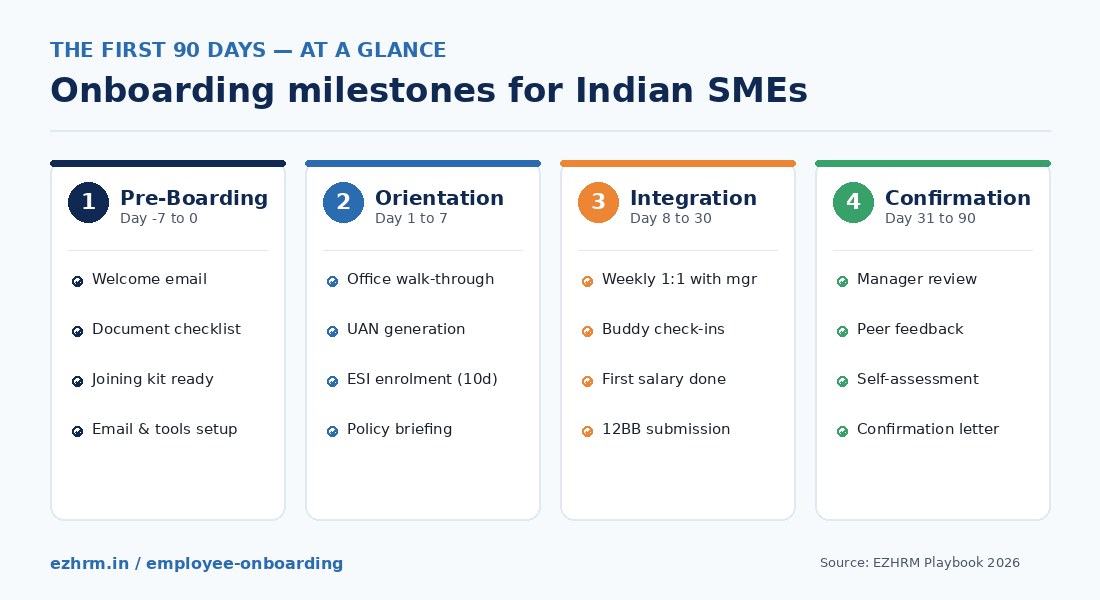
- Day -7 to 0 (Pre-boarding): Collect documents, generate UAN, set up email and access, send a welcome kit.
- Day 1 to 7 (Orientation): Statutory enrolment (PF, ESI, PT), policy briefing, manager intro, first small task.
- Day 8 to 30 (Integration): Role training, first 1:1, payroll cycle confirmation, first PF/ESI deduction verified.
- Day 31 to 90 (Confirmation): Documented performance review, probation feedback, confirmation letter — issued before Day 90.
What is Employee Onboarding (in the Indian Context)?
Employee onboarding is the structured process of bringing a new hire into your organisation — from the day they accept the offer until they’re fully productive in their role. In India, onboarding is also a compliance event: under the EPF Act 1952 and ESI Act 1948, you have hard statutory deadlines to enrol new joiners.
A good Indian onboarding programme covers four buckets:
- Statutory: PF, ESI, Professional Tax, gratuity nominee, Form 16 setup
- Administrative: Documentation, ID card, email, system access, salary account
- Cultural: Team intros, values, peer buddy, vision walkthrough
- Functional: Role training, KPIs, tools, first deliverables
Skip any one of these and you’ll feel it by Day 30.
Pre-Boarding: Day -7 to Day 0 (Before They Walk In)
This is where most Indian SMEs lose the plot. The candidate accepts on a Friday, you go silent for ten days, and on joining day you scramble. Don’t do that.
The pre-boarding checklist
- Send a welcome email within 24 hours of offer acceptance. Include reporting time, dress code, what to bring, and a buddy’s contact number.
- Share the document checklist immediately. Don’t wait till joining day — ask for soft copies first; you’ll re-verify originals on Day 1.
- Get the joining kit ready. Laptop imaged, draft ID card, business cards if applicable, branded notebook, a one-page welcome note from the founder.
- Open the salary account. If your bank has a corporate salary tie-up — HDFC, ICICI, SBI, Kotak — share the form before joining day.
- Set up email and tools. Nothing kills Day 1 momentum like the new hire waiting four hours for a Google Workspace password reset.
- Inform the team. A simple Slack or WhatsApp message with the new joiner’s photo, role, and reporting manager.
Documents you must collect (India-specific)
| Document | Why it’s needed | When |
|---|---|---|
| PAN card | TDS under Section 192 | Pre-boarding |
| Aadhaar card | EPFO KYC, ESI registration | Pre-boarding |
| Bank account details (cancelled cheque) | Salary credit | Pre-boarding |
| Passport-size photographs (4) | ID card, PF nominee form | Day 1 |
| Educational certificates | Background verification | Day 1 |
| Previous company relieving letter | Notice period proof, gratuity continuity | Day 1 |
| Last 3 salary slips + Form 16 | Tax liability calculation | Day 1 |
| EPF UAN (if previously employed) | Service continuity | Day 1 |
| Form 11 (EPF self-declaration) | Mandatory under EPF Act | Day 1 |
| Form 2 (PF nominee) | Family welfare claim | Day 1 |
| Gratuity nominee (Form F) | Payment of Gratuity Act, 1972 | Day 1 |
If your business is below the EPF threshold (less than 20 employees), you can skip the PF documents — but most Indian SMEs hit 20 employees within a year and enrolment then becomes retroactively mandatory. Plan for it now. You can use our free HR templates for ready-to-use Form 11 and joining letter formats.
Day 1 to Day 7: The First Week (Orientation + Statutory Setup)
Day 1 — first impressions stick
The first day is not about productivity. It’s about reducing anxiety so the new hire shows up on Day 2.
- Receive them at reception personally — not via the security guard
- Walk them through the office: pantry, washroom, cafeteria, meeting rooms
- Lunch with the team or buddy
- Verify original documents (don’t keep originals; verify, return, store soft copies)
- Issue ID card, email, laptop with policies pre-installed
- Sign the appointment letter and acknowledge the employee handbook
Days 2–3 — statutory enrolment
This is the real compliance work. Under EPFO rules, you must:
- Generate UAN within 25 days from the end of the month in which the employee joins, via the EPFO Unified Portal
- Seed PAN, Aadhaar, and bank details against the UAN within 30 days
- Activate UAN and share it with the employee within 15 days of generation
For ESI: any employee earning ₹21,000 or less per month in gross wages (₹25,000 for persons with disabilities) must be enrolled within 10 days of joining via the ESIC portal. Miss this window and you owe interest plus damages under Section 85B of the ESI Act.
State-specific items to handle on the same day:
- Professional Tax (PT): Register the employee in your state’s PT system. PT applies in Maharashtra, Karnataka, West Bengal, Tamil Nadu, Gujarat, Telangana, Andhra Pradesh, Madhya Pradesh, Kerala, Odisha, and a few others.
- Labour Welfare Fund (LWF): Applies in 16 states and UTs. Rates vary from ₹6 to ₹50 per employee per month depending on the state.
Days 4–7 — context and tools
- HR policy briefing: leave rules, working hours, attendance, IT policy, code of conduct, POSH (mandatory for any office with 10+ employees under the POSH Act 2013)
- Introduction to all department heads — a 15-minute coffee, not a one-hour PowerPoint
- Tool access: CRM, project management, internal wiki, communication channels
- First small task — something achievable in 2–3 days that gives the new hire a “I shipped something” feeling by end of Week 1
Day 8 to Day 30: Integration and First Salary Cycle
By the end of Week 1, your new hire knows the office. By Day 30, they should be working on real deliverables and have received their first proper salary. This phase is where retention is silently won or lost.
What to track in this phase
- Weekly 1:1 with manager — 30 minutes, fixed slot, non-negotiable
- Buddy check-ins — informal, twice a week
- First salary processed — verify PF (12% of basic up to ₹15,000 ceiling) and ESI deductions are correctly applied
- Investment declaration submitted via Form 12BB — this affects monthly TDS from Day 30 onwards
- Performance milestones agreed — written down, shared over email, both parties sign
What HR Managers Get Wrong in the First 30 Days
I’ve watched the same mistakes repeat across dozens of Indian SMEs. Here are the four that cost the most:
- Treating onboarding as a Day 1 event. It isn’t. Day 30 is when most “quiet quitting” decisions are made — long before resignations land.
- No KPI clarity. The hire is busy doing tasks but doesn’t know what success looks like at Day 90. Confirmation conversations then feel arbitrary.
- First salary issues. Wrong PF deduction, missing reimbursement, salary credited two days late — this single mistake hurts retention more than people realise.
- Skipping Form 11 verification. If the employee was previously a PF member and didn’t declare it, you’ll face a compliance issue when the old PF account is traced during an inspection.
Day 31 to Day 90: The Confirmation Window
Probation under most state Shops & Establishments Acts is 3–6 months. By Day 90, you should know whether to confirm, extend, or part ways — and you should be saying it on paper.
The confirmation review checklist
- Manager review with documented examples — not just “good attitude”
- Peer feedback from at least two colleagues (a 5-minute survey is enough)
- Self-assessment from the employee
- HR’s view on culture fit and policy adherence
- Confirmation letter, extension letter, or termination — issued before Day 90 to avoid auto-confirmation in some states
A note on terminations: even during probation, the Supreme Court has repeatedly held that you cannot terminate for “ulterior motives” (POSH complaints, whistleblowing, union activity). Document performance issues from Week 4 onwards, not just at Day 85.
How HR Software Saves You from This Mess
Doing all this manually for one hire a month is fine. For ten hires a month across multiple offices, it’s the reason your HR team works Saturdays.
A modern HRMS handles the repetitive 80% — UAN generation triggers, document collection portals, e-sign on appointment letters, automated welcome emails, first-payroll readiness checks, and probation review reminders. Your HR team is then free to do the 20% that actually matters: human conversations.
EZHRM’s employee onboarding module is built specifically for Indian SMEs — it ships with document templates aligned to EPF, ESI, and state PT rules, generates UANs through EPFO integration, and runs the whole pre-boarding-to-confirmation flow on autopilot. Pair it with our document management and payroll modules and your first 90 days run without spreadsheet acrobatics.
FAQ — Employee Onboarding in India 2026
Q1. How many days do I have to enrol a new employee in EPF?
You must generate the UAN within 25 days of the end of the month in which the employee joins, and seed PAN, Aadhaar, and bank details within 30 days. Activation should happen within 15 days of UAN generation, with acknowledgement collected from the employee.
Q2. Is Form 11 mandatory for every new hire?
Yes. EPF Form 11 is a self-declaration that every new joiner must submit, even if they don’t have a prior PF account. It records previous EPF/EPS membership and triggers UAN portability. Skipping it creates compliance gaps that surface during PF audits.
Q3. What’s the standard probation period in India for SMEs?
Three to six months is standard for private-sector employees. Your specific obligation is set by your state Shops and Establishments Act and the appointment letter. Always issue a written confirmation, extension, or termination letter before probation ends.
Q4. Do I need to enrol an employee in ESI if their salary is above ₹21,000?
No. ESI applies to employees earning ₹21,000 or less per month in gross wages (₹25,000 for persons with disabilities). Once an employee crosses this threshold mid-cycle, ESI continues till the end of the contribution period (April–September or October–March).
Q5. Can I onboard a new hire fully online?
Yes, with caveats. Aadhaar e-sign, e-KYC, digital appointment letters, and UAN generation are all online. Original document verification is best done in person on Day 1 or via a video call with proper KYC processes. Most reputed Indian HRMS platforms — including EZHRM — now support fully digital onboarding.
Q6. What is POSH compliance and is it required for SMEs?
POSH (Prevention of Sexual Harassment) compliance under the Sexual Harassment of Women at Workplace Act 2013 is mandatory for any organisation with 10 or more employees. You must constitute an Internal Complaints Committee, conduct annual training, and file an annual return. Cover this on Day 1 of onboarding.
The Bottom Line
Onboarding isn’t a Day 1 event — it’s a 90-day system. Get the pre-boarding right, hit the