
Your founder asks you a simple question in the Monday review: “Why should we spend ₹2,500 a month on HR software when Priya in accounts already handles payroll in Excel?” You know the real answer — Priya spends three days every month on it, you spent two evenings last quarter fixing a PF mismatch, and nobody has calculated what any of that actually costs. You just haven’t put a number on it yet.
That’s exactly the gap a payroll ROI calculation is meant to close. It is not a sales gimmick — it’s the same math a CFO would use to evaluate any other business expense, applied to the one function that touches every single employee, every single month. This guide walks you through how to calculate payroll ROI properly, what most HR managers get wrong when they try, and how to build a case your management will actually approve.
TL;DR — Payroll ROI in India, 2026
- Manual payroll for a 50-employee Indian company typically costs ₹5,500–₹9,500/month in HR time alone — before counting errors or penalties
- Payroll software for the same headcount costs ₹1,500–₹3,500/month, so the crossover point usually favours automation once you cross 15–20 employees
- Most Indian SMEs recover their investment in 3–6 months, with time-to-value showing up as early as the first payroll cycle
- The full ROI formula is: (Current monthly cost − Cost with software) × 12 ÷ Setup cost = Payback period
What Is Payroll ROI, Exactly?
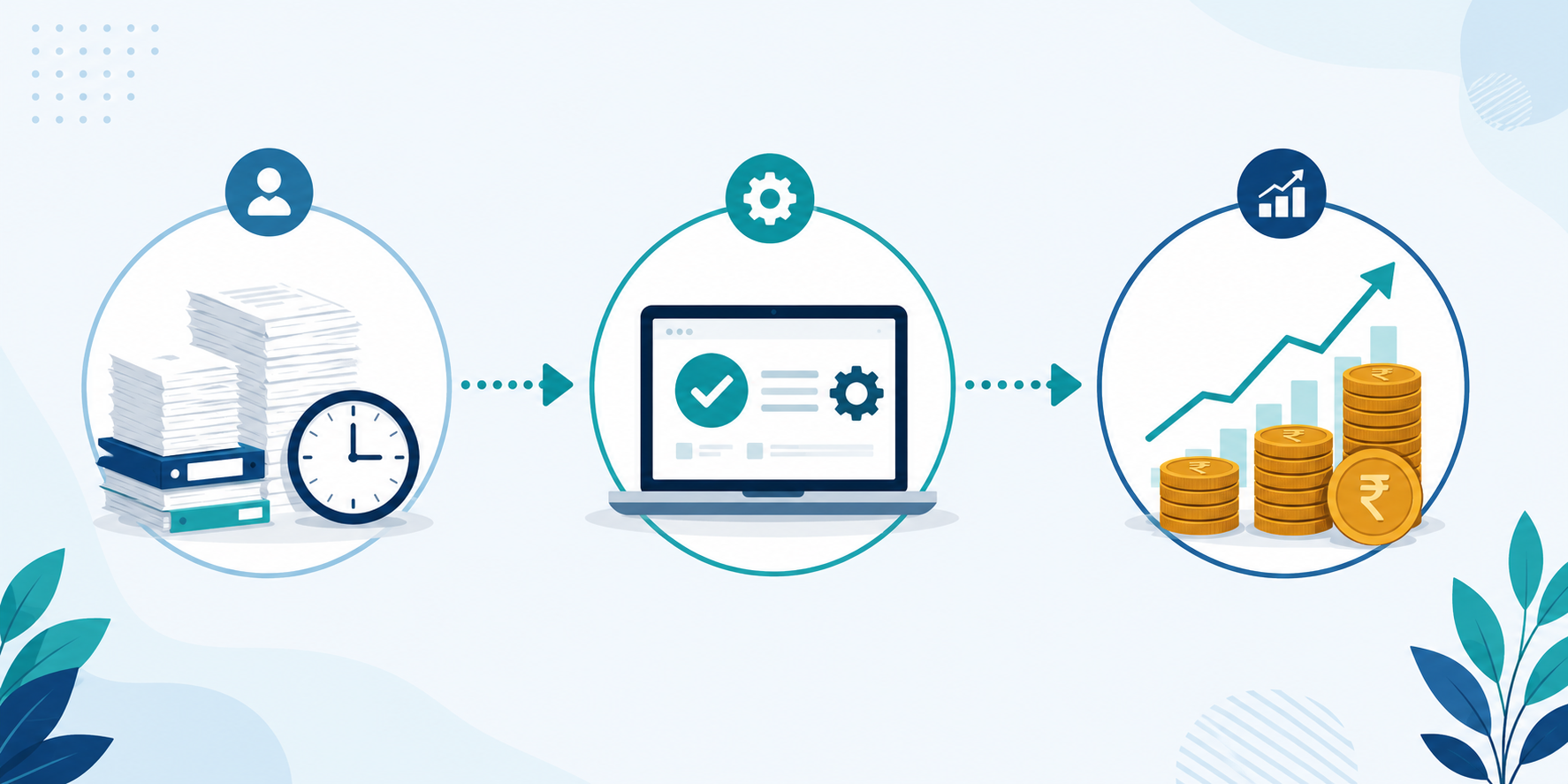
Payroll ROI is the return you get — in money and time — when you compare the true cost of your current payroll process against the cost of running it on dedicated software. It’s a specific application of return on investment: you’re not just comparing subscription price to “doing nothing,” you’re comparing it to what manual payroll is actually costing you today, including the parts that never show up on an invoice.
Most HR managers under-estimate this because manual payroll’s cost is scattered — a bit of HR executive salary here, a few hours of the finance team’s time there, an error correction nobody logged separately. Payroll ROI calculation exists to pull all of that into one number.
The Real Cost of Manual Payroll (It’s Higher Than You Think)
Three cost streams make up the “hidden” price of running payroll manually, and each one is measurable.
1. HR time spent on processing
Across Indian SMEs, HR managers report spending close to two full working days a month reconciling attendance, calculating deductions, and preparing payslips by hand. At a typical HR executive salary of ₹4–8 lakh a year, that time alone is worth real money — even before you touch a spreadsheet formula.
2. Compliance queries and corrections
Employees ask about PF balances, ESI eligibility, or a professional tax deduction that looks wrong. Answering these one by one, and fixing the underlying calculation errors, eats further HR hours every month — on top of the processing time above.
3. Error correction cost
Manual payroll errors are estimated to cost Indian companies 1–3% of monthly payroll value in corrections, rework, and — in the worst cases — compliance penalties. If ignored, non-compliance penalties can compound 15–25% annually. Filing a late or incorrect PF return through the EPFO portal, for instance, isn’t just an admin headache — it carries real financial exposure.
Add these three together and a 50-employee company typically loses ₹5,500–₹9,500 a month to manual payroll — money that never appears as a single line item anywhere, which is exactly why it’s so easy for management to underestimate it.
Manual Payroll vs Payroll Software: Side-by-Side
| Factor | Manual Payroll (Excel/Registers) | Payroll Software (e.g. EZHRM) |
|---|---|---|
| Monthly HR time (50 employees) | 16–20 hours | 3–4 hours (80% reduction) |
| Monthly cost (time + errors) | ₹5,500–₹9,500 | ₹1,500–₹3,500 subscription + reduced HR time |
| Error rate | 1–3% of payroll value | Near-zero — automated statutory logic |
| Compliance updates (PF/ESI/PT rates) | Manual tracking, easy to miss | Auto-updated |
| Payback period | Not applicable | 3–6 months typical |
How to Calculate Your Own Payroll ROI (Step by Step)
- Add up your current monthly cost: HR time on processing + HR time on compliance queries + average monthly error correction cost.
- Estimate your cost with software: subscription fee + the 15–20% of HR time you’ll still spend on review and exceptions.
- Find your monthly savings: current cost minus cost with software.
- Annualise it: monthly savings × 12.
- Calculate payback period: one-time setup/onboarding cost ÷ monthly savings.
You can run all five steps in under a minute using EZHRM’s free Payroll ROI Calculator — enter your headcount, current HR hours, and error rate, and it does the math for you, including the payback period your CFO will want to see first.
Building the Business Case Your CFO Will Approve
A CFO doesn’t want to hear “it’ll make HR’s life easier.” They want three things: the number, the payback period, and the risk you’re removing. Structure your pitch this way:
Lead with the payback period, not the subscription cost
“₹2,500/month” sounds like an expense. “Pays for itself in 4 months, then saves ₹6,000/month after that” sounds like an investment. Same number, different framing — and framing is most of the battle in a budget conversation.
Quantify the compliance risk separately
A missed ESI deadline or an incorrect gratuity calculation isn’t just a rework cost — it’s a potential penalty and, in repeat cases, reputational risk with your workforce. If your company handles statutory deductions manually, tools like EZHRM’s compliance management module remove this risk entirely rather than just reducing it.
Show the opportunity cost
Every hour your HR team spends re-keying attendance data into a payroll sheet is an hour not spent on hiring, onboarding, or retention — all of which have their own measurable cost of inaction.
What HR Managers Get Wrong About Payroll ROI
After looking at how Indian SMEs actually build (or fail to build) this business case, the same mistakes come up again and again.
Mistake 1: Only counting the subscription cost, not the current cost
Comparing “₹0 today” to “₹2,500/month with software” always loses. The honest comparison is “₹7,000/month today, invisible” versus “₹2,500/month with software, visible.” Always calculate your current cost first.
Mistake 2: Ignoring error and penalty costs
HR managers often calculate only the time saved and skip the cost of errors entirely — usually because it’s harder to measure. But a single missed PF contribution deadline or an incorrect CTC breakup that triggers an employee dispute can wipe out months of “savings” from a slower manual process.
Mistake 3: Not accounting for scaling
Manual payroll’s cost doesn’t grow linearly with headcount — it grows faster, because coordination overhead increases too. A process that’s manageable at 15 employees becomes genuinely risky at 50, and the ROI case only gets stronger as you grow, not weaker.
Mistake 4: Treating PF/ESI calculation as a footnote
Contribution errors on PF and ESI are one of the most common sources of manual payroll rework, precisely because the wage ceilings and percentage splits change per employee based on gross pay. Automating this single calculation often accounts for a large share of the total time saved.
Mistake 5: Presenting a one-time snapshot instead of a trend
A single month’s numbers can look unconvincing. Track your HR team’s payroll hours and error corrections over a full quarter before you present the case — a repeated ₹6,000–₹8,000/month drain over three straight months is a far stronger argument than one busy week.
Frequently Asked Questions
How much does manual payroll actually cost a small Indian business?
For a 50-employee company, manual payroll typically costs ₹5,500–₹9,500 per month once you add up HR processing time, compliance query handling, and error correction. This scales roughly with headcount and gets worse — not better — as a company grows without automation.
What is a good payback period for payroll software in India?
Most Indian SMEs see a payback period of 3–6 months after switching to payroll software, with some seeing returns within the first 30–90 days if their manual process was particularly time-heavy or error-prone. Anything under 6 months is generally considered a strong business case.
How do I calculate payroll ROI without expensive consultants?
You need just five inputs: current HR hours on payroll, HR executive salary, monthly errors and their average cost, hours spent on compliance queries, and the cost of the software you’re evaluating. EZHRM’s free Payroll ROI Calculator takes these inputs and returns your monthly savings, annual savings, and payback period instantly.
Is payroll software worth it for a company under 20 employees?
It depends on how much manual time you’re currently spending. Below 15 employees the case is often marginal, but once compliance complexity (PF, ESI, professional tax, gratuity) enters the picture, even smaller teams tend to benefit — because the risk of a compliance error is what really drives the ROI, not just time saved.
What’s the difference between payroll ROI and HRMS ROI?
Payroll ROI narrowly measures savings from automating salary calculation, deductions, and payslips. HRMS ROI is broader — it includes attendance, leave, onboarding, and compliance management savings on top of payroll. Most companies start by calculating payroll ROI alone since it’s the easiest to quantify, then expand the business case to the full HRMS.
Does payroll software reduce compliance penalty risk?
Yes — because rates like PF wage ceilings, ESI thresholds, and state-wise professional tax slabs are updated automatically rather than tracked manually, the risk of filing incorrect statutory returns drops significantly. You can cross-check current rules directly on EPFO or the Ministry of Labour & Employment website if you want to verify what your software is applying.
Putting the Number in Front of Your Management
You don’t need a finance degree to make this case — you need one clear number and the willingness to track your current process honestly for a month before you pitch the change. Once you can say “we’re losing ₹X a month and this pays for itself in Y months,” the conversation stops being about spending and starts being about a decision that’s already made itself.
Run your own numbers on EZHRM’s free Payroll ROI Calculator — it takes under a minute and gives you the exact figures to bring to your next budget conversation. And if payroll is just one piece of the puzzle, browse EZHRM’s full set of free HR calculators covering everything from gratuity to notice period recovery, or head to the EZHRM blog for more HR compliance guides.