
Your company just onboarded a new employee in Bengaluru at ₹28,000 a month gross. Your payroll executive, running on last year’s knowledge, deducts ₹200 Professional Tax like always. Except Karnataka doesn’t work that way anymore — and if your payroll sheet still has the old four-slab structure sitting in a formula somewhere, you’ve been getting this wrong since April 2025 without knowing it.
Professional Tax (PT) looks like the smallest, most boring line item on an Indian payslip — a few hundred rupees a month, capped at ₹2,500 a year. But two states just changed their rules in ways that directly affect how you calculate it, and most HR teams haven’t updated their spreadsheets yet. Here’s what actually changed, and how to get your professional tax calculation right for 2026.
TL;DR — Professional Tax Calculator India 2026
- Professional Tax is a state-level tax on salaried income, capped at ₹2,500/year under Article 276 of the Constitution — deducted monthly by the employer from gross salary.
- Karnataka scrapped its old four-slab structure in April 2025: employees earning below ₹25,000/month gross now pay zero PT, and everyone above pays a flat ₹200/month (₹300 in February).
- Maharashtra moved its PT due date from the last day of the month to the 15th of the following month, effective a February 2026 government notification — a change many payroll calendars still haven’t caught.
- Run any employee’s number instantly on the EZHRM Professional Tax Calculator, updated for the current state slabs, instead of relying on a spreadsheet that quietly went stale.
What Is Professional Tax, and Why Do the Rules Keep Moving?
Professional Tax is a tax levied by state governments — under Entry 60 of the State List in the Constitution — on income earned from employment, trade, or profession. Unlike PF or ESI, there’s no single central law governing it. Each PT state runs its own Act, its own slabs, and its own filing calendar, which is exactly why HR teams managing payroll across more than one state keep tripping over it.
Because PT is state legislation, state governments amend it independently and don’t always publicize the change loudly. Karnataka’s slab overhaul and Maharashtra’s due-date shift both happened through routine government notifications, not major press coverage — the kind of update that’s easy to miss unless you’re actively tracking state labour and finance department circulars.
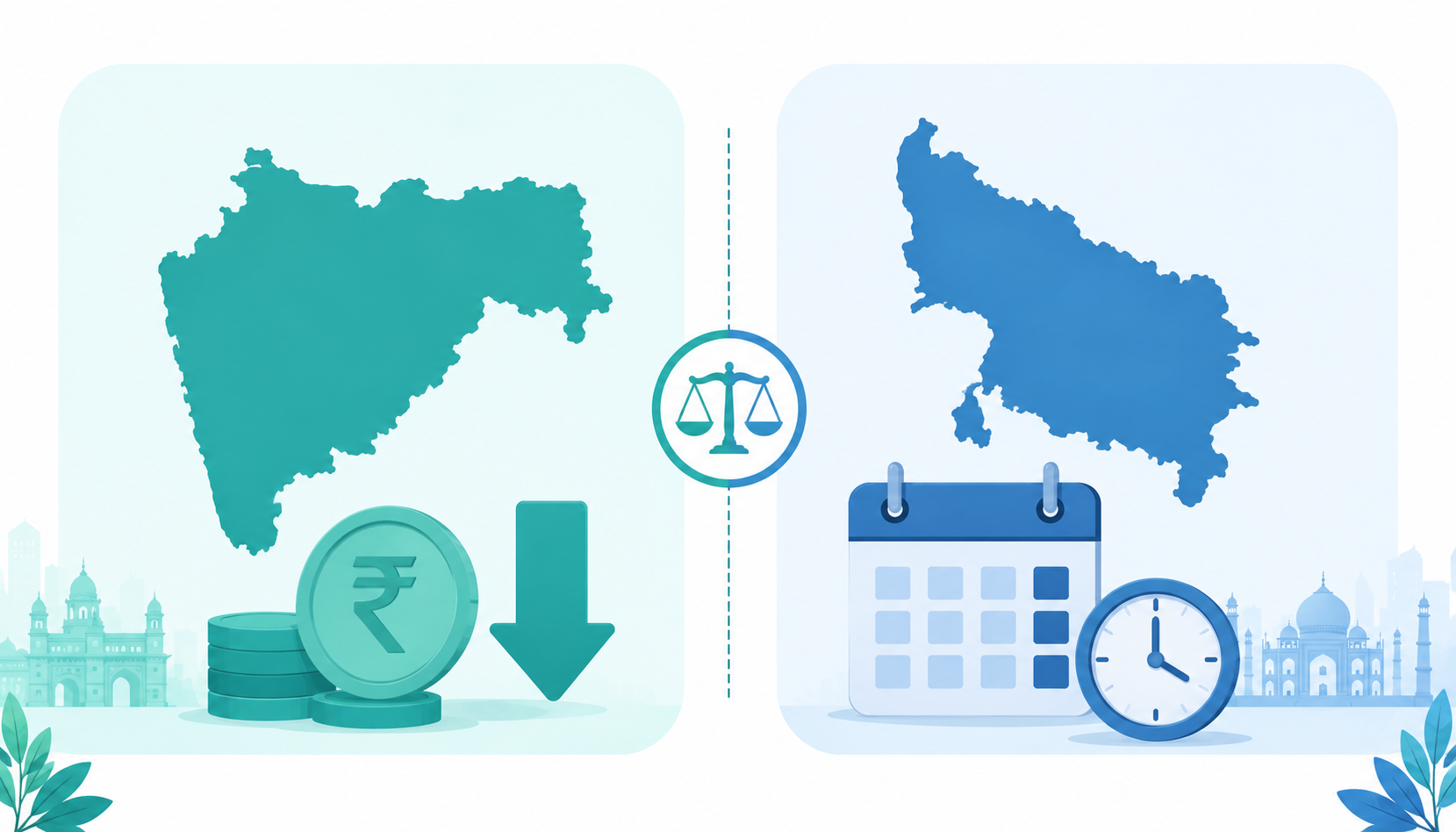
Karnataka’s New PT Slab: The ₹25,000 Threshold
Karnataka replaced its old income-based multi-slab system with a single flat rate, effective April 1, 2025, under the Karnataka Professional Tax (Amendment) Act, 2025. If your payroll formula still reflects the old structure, you’re either over-deducting from lower earners or mis-slabbing everyone in between.
| Monthly Gross Salary | PT Rate — Before April 2025 | PT Rate — From April 2025 |
|---|---|---|
| Up to ₹9,999 | Nil | Nil |
| ₹10,000 – ₹14,999 | ₹100/month | Nil |
| ₹15,000 – ₹24,999 | ₹150/month | Nil |
| ₹25,000 and above | ₹200/month | ₹200/month (₹300 in February) |
In effect, Karnataka raised its PT-exempt threshold from ₹10,000 to ₹25,000 and dropped the middle tiers entirely. An employee earning ₹18,000/month in Bengaluru who was paying ₹150/month in PT until last year now pays nothing. Anyone crossing ₹25,000/month pays a flat ₹200 for eleven months and ₹300 in February — the same “annual maximum ₹2,500” pattern most PT states converge on, just reached differently.
If you’re restructuring salaries this year — especially with the new Labour Codes pushing Basic + DA toward 50% of CTC — it’s worth rerunning every Karnataka employee’s numbers through a CTC salary calculator alongside the PT check, since a revised Basic can nudge gross salary across the ₹25,000 line.
Maharashtra’s New PT Due Date: 15th, Not Last Day
Maharashtra’s Finance Department issued a notification dated February 28, 2026, advancing Professional Tax compliance deadlines under the Maharashtra State Tax on Professions, Trades, Callings and Employments Rules, 1975. The change is procedural but easy to miss if your compliance calendar was set up before this year.
| Filing | Old Due Date | New Due Date (from Feb 2026 notification) |
|---|---|---|
| Monthly PTRC payment & return | Last day of the month | 15th of the following month |
| Annual PTRC return | 31 March | 15 March |
| PTEC (employer’s own annual PT) | 30 June | 15 June |
A late payment now counts as a default from the 16th of the month, not the 1st of the next. For companies used to squeezing PT payment in during the last week of the month alongside PF and ESI deposits, that window just got two weeks shorter. Build this into your payroll close checklist now, not after the first missed deadline notice arrives.
State-Wise Professional Tax Slabs at a Glance — 2026
Here’s where the ten major PT states stand today, factoring in the 2025-26 amendments:
| State | PT Exempt Up To | Standard Monthly PT | Max Annual PT |
|---|---|---|---|
| Maharashtra | ₹7,500 (men) / ₹25,000 (women) | ₹200 (₹300 in Feb) | ₹2,500 |
| Karnataka | ₹25,000 | ₹200 (₹300 in Feb) | ₹2,500 |
| West Bengal | ₹8,500 | ₹90 – ₹200 (8 slabs) | ₹2,500 |
| Andhra Pradesh | ₹15,000 | Up to ₹200 | ₹2,400 |
| Telangana | ₹15,000 | Up to ₹200 | ₹2,400 |
| Gujarat | ₹6,000 (up to ₹12,000 in slabs) | ₹100 – ₹200 | ₹2,400 |
| Madhya Pradesh | ₹1,50,000/year | Up to ₹208 | ₹2,500 |
| Tamil Nadu | ₹21,000 | Nominal, half-yearly slabs | ₹1,200 |
| Delhi / Haryana / UP / Rajasthan / Punjab | Not applicable | No PT levied | ₹0 |
Note that Tamil Nadu and Madhya Pradesh calculate PT on a half-yearly or annual basis rather than a flat monthly figure, which trips up payroll teams used to Maharashtra or Karnataka’s simpler monthly-flat approach. Always confirm the exact current-year notification for the state you’re deducting in — slabs get revised more often than most HR calendars account for.
How to Calculate Professional Tax Correctly in 2026
- Identify the employer’s registered state — PT follows where your establishment is registered, not where a remote employee physically sits.
- Confirm the current-year slab for that state — don’t reuse last year’s number, especially for Karnataka.
- Apply the slab to monthly gross salary — basic, HRA, and regular allowances; exclude one-time bonuses and reimbursements.
- Check for gender-based or February variations — Maharashtra applies different thresholds for men and women, and a higher amount every February.
- Deduct, deposit, and file by the correct current deadline — verify against the latest state notification, not last year’s calendar.
- Reconcile every payroll cycle — salary revisions and increments can push employees across a PT threshold mid-year.
Running this by hand across a multi-state workforce is exactly where errors creep in. The EZHRM Professional Tax Calculator keeps the current slabs built in — enter the gross salary and state, and it returns the correct monthly and annual PT along with the Section 16(iii) tax benefit, without you needing to track every state amendment yourself.
What HR Managers Get Wrong With the 2026 Changes
- Still running Karnataka’s old four-tier slab. If your payroll software or Excel formula hasn’t been touched since before April 2025, every Karnataka employee between ₹10,000 and ₹24,999 is being over-deducted.
- Missing the Maharashtra due-date shift. Payment schedules built around “last day of the month” will now show as late by default from the 16th — a silent penalty trigger.
- Treating PT as a fixed, one-time payroll setting. PT slabs, thresholds, and even filing frequency get revised by state notification, sometimes mid-financial-year, with no central alert system.
- Ignoring the interaction with new Labour Code salary restructuring. As Basic + DA rises toward 50% of CTC under the new wage definition, gross salary for some employees may shift, which can push them across a PT slab even without a headline increment. Cross-check with your PF & ESI calculator numbers when you restructure.
- Not separating PTEC (employer liability) from PTRC (employee deductions) in compliance tracking, which causes teams to miss one filing while diligently making the other.
FAQ: Professional Tax Calculator India 2026
Has the Professional Tax exemption limit changed in Karnataka?
Yes. Since April 1, 2025, Karnataka exempts all monthly gross salaries up to ₹25,000 from PT — up from the earlier ₹10,000 threshold — and charges a flat ₹200/month (₹300 in February) above that.
What is the new Professional Tax due date in Maharashtra?
Following a February 28, 2026 notification, Maharashtra’s monthly PTRC payment and return are now due by the 15th of the following month, moved up from the earlier last-day-of-the-month deadline.
Is Professional Tax the same across all Indian states?
No. PT is levied under separate state Acts, so slabs, exemption thresholds, and filing deadlines differ by state. Delhi, Haryana, Uttar Pradesh, Rajasthan, and Punjab do not levy Professional Tax at all.
What is the maximum Professional Tax an employee can pay in a year?
₹2,500 per year, capped by Article 276 of the Constitution of India — no state can charge more, regardless of income.
Is Professional Tax deducted from gross salary or CTC?
PT is calculated on monthly gross salary — basic, HRA, and regular allowances — not on CTC and not on one-time payments like bonuses or reimbursements.
Can I still claim a tax deduction for Professional Tax paid?
Yes. PT paid is deductible under Section 16(iii) of the Income Tax Act while computing taxable salary income, and this deduction is available under both the old and new tax regimes for FY 2026-27.
Professional Tax is a small number on every payslip, but it’s exactly the kind of state-by-state, notification-driven rule that quietly goes wrong when nobody’s watching for updates. Run today’s numbers through the free EZHRM Professional Tax Calculator before your next payroll cycle, and if you’re managing PT compliance across more than one state by hand, take a look at how EZHRM’s compliance management module tracks state-wise deadlines automatically.
For more free calculators, visit the EZHRM HR tools hub, and for more payroll and compliance guides, browse the EZHRM blog.
Sources: Income Tax Department, Ministry of Labour & Employment.