
Your line supervisor walks in on the 25th. The plant runs three shifts, two of them crossing midnight. Some workers are on ESI, some have crossed the wage ceiling. Contract labour is in the mix. And your payroll needs to go out by the 30th — with the right OT calculation, the right shift allowance, and PF on the right wage base. If this is your Monday morning, you’re not alone.
Manufacturing HR in India is genuinely harder than payroll for an office-based company. You have the Factories Act on one side, the ESI Act on another, state Shops & Establishments Acts for some categories, and the new Labour Codes hovering over all of it. This guide breaks it all down — rates, deadlines, common traps — so you can run a clean payroll every month.
- PF applies at 12% of basic pay; the wage ceiling for the employer’s pension share is ₹15,000/month basic.
- ESI applies to all workers earning ₹21,000 gross or less; employer contributes 3.25%, employee 0.75%.
- Under the Factories Act, OT must be paid at twice the ordinary wage rate; maximum 50 OT hours per quarter.
- Night shift differentials are not mandated centrally — governed by your standing orders or state rules.
- Contract workers’ PF and ESI liability falls on the principal employer if the contractor defaults.
Why Manufacturing Payroll Is Different From Office Payroll
Manufacturing payroll compliance touches at least four separate legal frameworks simultaneously. If your unit employs 10 or more workers using power, or 20 or more without power, the Factories Act 1948 governs your working hours, overtime, leave, and health provisions. On top of that, the PF Act 1952, ESI Act 1948, Payment of Wages Act 1936, state Shops & Establishments Acts, and the Contract Labour (R&A) Act 1970 all apply — often simultaneously. None of these override each other neatly — they stack. Getting one right while getting another wrong is what triggers labour inspections.
PF & ESI: The Numbers That Actually Matter in 2026
| Contribution | Employee Share | Employer Share | Wage Ceiling | Due Date |
|---|---|---|---|---|
| PF (EPF) | 12% of basic + DA | 12% of basic + DA (3.67% EPF + 8.33% EPS) | ₹15,000/month basic for EPS cap | 15th of the following month |
| ESI | 0.75% of gross wages | 3.25% of gross wages | ₹21,000/month gross | 15th of the following month |
| EPS (pension) | Nil | 8.33% of basic, capped at ₹1,250/month | ₹15,000 basic ceiling | Included in PF challan |
| EDLI (insurance) | Nil | 0.5% of basic, capped at ₹75/month | ₹15,000 basic ceiling | Included in PF challan |
What most factory HRs get wrong: Workers whose basic pay exceeds ₹15,000 can opt out of PF only if they were never members of EPF previously. If they were already members when you hired them, PF continues on their actual basic — no cap option.
Overtime Rules Under the Factories Act: What You Owe Your Workers
Section 59 of the Factories Act is unambiguous: a worker who works beyond 9 hours in a day or 48 hours in a week must be paid at double the ordinary rate of wages.
How to Calculate OT for a Factory Worker
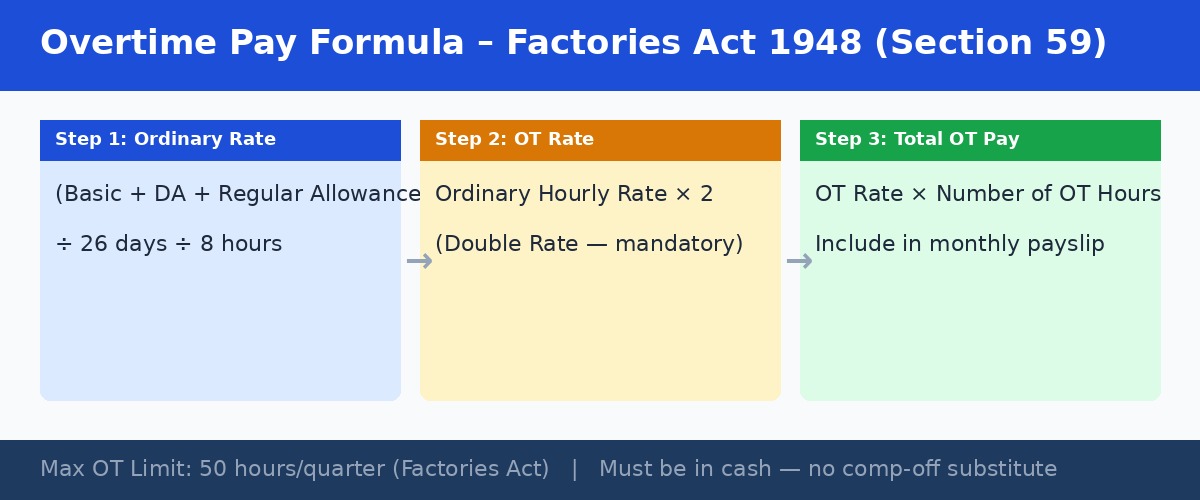
Ordinary rate of wages = (Basic + DA + any other regular allowances) ÷ 26 working days ÷ 8 hours per day. OT pay = Ordinary hourly rate × 2 × number of OT hours.
Example: A worker on ₹18,000 basic + ₹3,000 DA = ₹21,000 total. Daily rate = ₹21,000 ÷ 26 = ₹807.69. Hourly rate = ₹807.69 ÷ 8 = ₹100.96. For 10 OT hours in a month: OT pay = 10 × ₹100.96 × 2 = ₹2,019.
OT Hour Limits
Under the Factories Act, a worker cannot work more than 60 hours a week (including OT) or more than 50 hours of overtime in a quarter. When the OSH Code 2020 is notified in your state, the quarterly OT cap rises to 144 hours, but only with the written consent of the worker. As of November 2026, Haryana and several other states are running parallel compliance — Factories Act rules still apply in most respects.
Shift Pay & Night Shift Allowance in Manufacturing
India has no central law that mandates a specific night shift allowance amount. What you owe depends on your company’s certified Standing Orders (mandatory if you have 100+ workers), state rules for women workers, and collective bargaining agreements. Best practice for factories with ₹10,000–₹30,000 wage bands: a night shift allowance of ₹500–₹1,500 per month is common in Haryana, UP, and Rajasthan. Put this in writing in appointment letters and payslips — it protects you in disputes.
Women Workers in Night Shifts
Section 66 of the Factories Act prohibited women from working between 7 PM and 6 AM. As of 2026, Haryana permits women to work night shifts in factories with adequate safety provisions — safe transport, written consent, adequate lighting. Ensure your compliance checklist covers this if your plant runs women in night shifts.
Contract Labour Payroll: Where Principal Employers Get Caught
Under both the Contract Labour Act and the ESI/PF Acts, if your contractor fails to pay PF or ESI contributions for workers deployed at your site, you — the principal employer — are liable. Build this into your contractor agreements: require monthly PF ECR and ESI challan copies before releasing contractor payment, deduct a security deposit equivalent to 2 months’ anticipated PF/ESI liability, and register yourself as the principal employer with EPFO and ESIC for each contractor code.
Monthly Payroll Compliance Checklist for Factories
- ✅ Update attendance data — separate regular hours, OT hours, and absent days per worker
- ✅ Check which workers crossed ₹21,000 gross mid-month — ESI continues till end of contribution period
- ✅ Calculate OT at double rate under Section 59; don’t fold OT into the basic wage
- ✅ Verify PF wage base — basic + DA only; exclude HRA, travelling allowance, and meal allowance
- ✅ File PF ECR (Electronic Challan cum Return) by the 15th — file at epfindia.gov.in
- ✅ File ESI challan by the 15th — file at esic.gov.in
- ✅ Issue payslips with gross pay, deductions, OT hours, and net pay itemised
- ✅ Collect contractor PF/ESI proofs before contractor payment release
- ✅ Update overtime register (Form 11 under Factories Act) — inspectors check this first
- ✅ Deduct and deposit Professional Tax where applicable (Haryana has no PT)
What HR Managers in Manufacturing Get Wrong
1. Including Allowances in the PF Wage Base
HRA, travelling allowance, meal allowance, and special allowances are typically excluded from the PF wage base — but only if genuinely variable and separately structured. Many factories lump everything into “basic” to simplify payroll, which inflates PF liability significantly.
2. Using CTC Rates for OT
OT must be calculated on the ordinary rate of wages, not on CTC. CTC includes employer PF, EDLI, insurance, and other costs that are not “wages.” Doing it on a flattened number underpays and exposes you to Section 59 violations.
3. Missing the ESI Transition Window
When a worker’s gross salary crosses ₹21,000 during a contribution period (April–September or October–March), ESI contributions continue until the end of that period — not from the month of crossing. Many payroll teams stop ESI immediately when the salary crosses, which triggers ESIC demands.
4. No Overtime Register Maintenance
Form 11 (Overtime Register) under the Factories Act is mandatory. If your factory doesn’t maintain it, you have no defence in an inspection — even if you’ve paid OT correctly.
5. Treating Contractors’ Workers as Exempt from Your ESI Coverage
If a contractor works at your registered factory, those workers are covered under your ESIC code — not the contractor’s (unless a separate ESIC sub-code is registered at your site). Get this sorted with ESIC before the next inspection.
Frequently Asked Questions
Does the Factories Act apply if we have only 15 workers?
Yes, if you use power in your manufacturing process and have 10 or more workers, the Factories Act applies. For non-power units, the threshold is 20 workers. With 15 workers and power, you need a valid factory licence, Form No. 2 registration, and must comply with working hours, OT, and safety provisions.
Our workers earn between ₹18,000 and ₹24,000. How do we handle ESI?
Workers earning ₹21,000 gross or below are covered under ESI. Those earning above ₹21,000 are exempt. For a worker at ₹20,500 gross: employee pays 0.75% = ₹153.75 and employer pays 3.25% = ₹666.25. For a worker at ₹22,000 gross: no ESI — but continue contributions until the half-year period ends if they crossed the ceiling mid-period.
Can we pay OT in compensatory off instead of cash?
Under the Factories Act, OT must be paid in cash at double the ordinary rate. Compensatory off is not a legal substitute for overtime pay under Section 59. Some state amendments allow comp-off in lieu of OT only with the worker’s written consent and within the same wage period.
We have a canteen and transport facility. Do these count as wages for PF?
No. Canteen and transport facilities provided in kind or as reimbursement are not “wages” under the PF Act. However, if you pay a fixed “transport allowance” or “food allowance” as cash, it may attract PF scrutiny. Keep these as reimbursements, not fixed cash allowances.
How do I handle payroll for workers on a piece-rate basis?
Piece-rate workers must receive at least the minimum wage for their category under the state Minimum Wages Act. PF and ESI are calculated on total piece-rate earnings for the month. OT for piece-rate workers is calculated at their average rate of wages — not at the minimum wage rate alone.
What registers are mandatory under the Factories Act?
Key mandatory registers: Register of Adult Workers (Form 12), Register of Accidents (Form 26), Overtime Register (Form 11), Leave Register (Form 15), and the Muster Roll. Factory Inspectors check these on surprise visits — keep them current and accessible at the factory premises.
Manufacturing payroll isn’t just a numbers exercise — it’s a legal discipline. Getting the OT formula right, keeping your contractor liability covered, and filing PF and ESI on time are baseline requirements, not extras. If your current payroll process involves manual Excel sheets across three shifts, you’re one missed entry away from a costly error.
EZHRM’s payroll and attendance modules are built for multi-shift manufacturing environments — with automatic OT calculation, biometric and face-recognition attendance sync, and integrated PF/ESI filing. If you’d like to see how it works for a factory setup, the EZHRM team is happy to walk you through it.