
Notice Period Recovery Calculator India 2026: Formula, Examples & HR Guide
It is Thursday afternoon. You have three resignation letters on your desk — one from a software developer with a 90-day notice, one from a sales manager with 60 days, and one from a junior executive with 30 days. All three want to leave by the end of the month. Your job: calculate exactly how much to recover from each full-and-final settlement, without a single rupee of dispute.
India’s Notice Period Recovery Calculator from EZHRM does the arithmetic in seconds — but knowing what to feed it is what separates a clean FnF from a legal notice three months later. This guide covers the formula, every input you need, five worked examples, and the mistakes that generate 90% of notice period disputes in Indian companies.
- Formula: Recovery = (Gross Monthly Salary ÷ Days Base) × Unserved Days. Default days base: 30 calendar days.
- Salary base: Whatever your appointment letter specifies — usually Gross Salary, sometimes Basic+DA.
- GST in 2026: Zero. CBIC Circular 178/10/2022-GST — no GST on notice pay recovery.
- TDS: Recovered amount reduces gross taxable salary before TDS is computed on Form 16.
What is Notice Period Recovery?
Notice period recovery is the salary amount an employer deducts from an outgoing employee’s full-and-final settlement when the employee resigns but does not serve the complete notice period in their appointment letter. It is also called notice pay recovery, short-notice deduction, or — when proactively paid — a notice period buyout.
If your contract says “serve 60 days or compensate in lieu” and the employee leaves after 20 days, you recover 40 days of salary from their FnF. There is no single Indian statute dedicated to notice periods for managers and IT professionals — enforceability rests on the employment contract under the Indian Contract Act, 1872 (Section 73 on breach of contract). For factory workmen, the Industrial Disputes Act, 1947 applies. For monthly-paid non-managers, the relevant Shops & Establishments Act sets a 30-day default.
The Notice Period Recovery Formula Explained
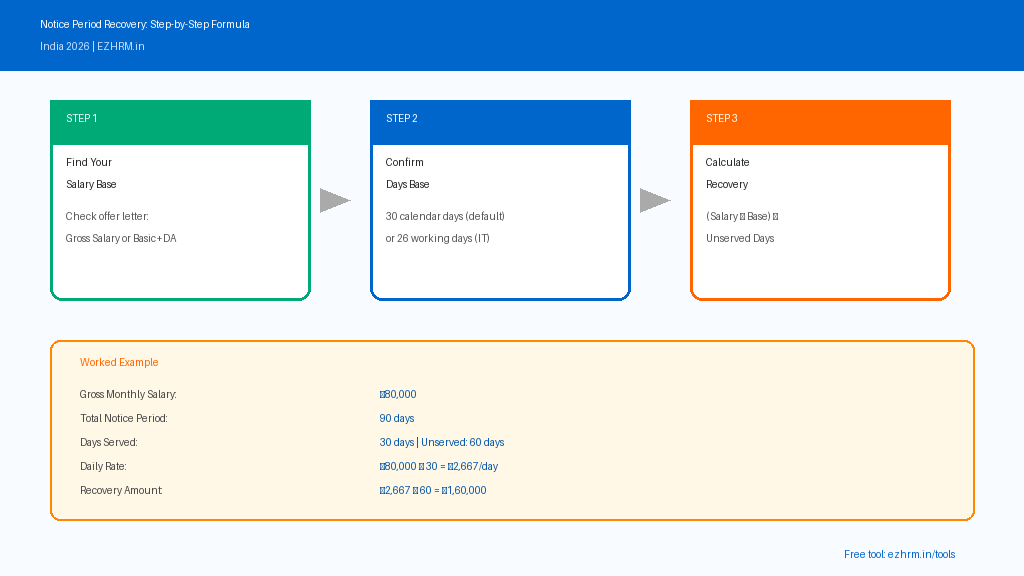
The formula used across Indian payroll teams — and the one behind the EZHRM Notice Period Recovery Calculator — is:
Daily Rate = Monthly Gross Salary ÷ Base Days (30 or 26)
Unserved Days = Total Notice Period − Days Served
Recovery Amount = Daily Rate × Unserved Days
30-Day vs 26-Day Divisor: Which to Use?
The only variable that creates confusion is the “Base Days.” Use 30 calendar days for most Indian companies in manufacturing, retail, FMCG, and services. Use 26 working days for IT companies and MNCs that exclude Sundays. The right answer is always what your appointment letter specifies. If the letter is silent, use 30. Courts have sided with employees when employers used 26 without contractual basis for a calendar-day role.
How to Use the EZHRM Notice Period Recovery Calculator
Open the free Notice Period Recovery Calculator and fill in four fields:
- Monthly Gross Salary (₹) — the gross as shown on the latest salary slip. Do not enter full CTC unless the appointment letter explicitly uses CTC as the notice pay basis.
- Total Notice Period (Days) — contractual notice in calendar days (30, 45, 60, 90, or custom).
- Notice Period Served (Days) — days the employee has served or will serve before relieving. Enter 0 for immediate departure.
- Days Base — select 30 (calendar) or 26 (working days) per company policy.
Click Calculate Notice Recovery. The result shows the recovery amount, daily rate, and unserved days — the exact figure to deduct in your FnF settlement statement.
5 Worked Examples Across Salary Levels and Notice Lengths
Here are five realistic examples covering common Indian salary ranges. All use 30-day base unless noted.
| Employee | Gross/Month | Notice | Served | Daily Rate | Recovery |
|---|---|---|---|---|---|
| Junior HR Executive (Delhi) | ₹35,000 | 30 days | 0 days | ₹1,167 | ₹35,000 |
| Sales Manager (Mumbai) | ₹65,000 | 60 days | 20 days | ₹2,167 | ₹86,667 |
| Software Developer (Bengaluru, 26-day base) | ₹90,000 | 90 days | 30 days | ₹3,462 | ₹2,07,692 |
| Finance Manager (Pune) | ₹1,10,000 | 60 days | 45 days | ₹3,667 | ₹55,000 |
| Factory Supervisor (Haryana) | ₹28,000 | 30 days | 15 days | ₹933 | ₹14,000 |
Try these in the notice period recovery calculator — results should match exactly. A mismatch usually means you are using the wrong salary base or divisor.
Gross Salary vs Basic Salary: Getting the Base Right
This single point causes most disputes. Use gross salary (basic + HRA + all allowances, excluding reimbursements) when your appointment letter says “notice period in lieu of salary” without further qualification — the standard for IT, services, retail, and BFSI sectors. Use Basic + DA only when the letter explicitly says so, or when the employee is a workman under the Industrial Disputes Act in a manufacturing or logistics role.
Never use full CTC as the notice pay base unless the offer letter explicitly states it. CTC includes employer PF, gratuity accrual, and other employer-side costs the employee never receives. Recovering on CTC is a quick route to a labour commissioner complaint — employees win this case routinely.
Notice Recovery Inside Full & Final Settlement
Notice period recovery is one deduction in a larger FnF calculation. Here is where it fits:
| FnF Component | Type | Calculator |
|---|---|---|
| Pro-rated last-month salary | Addition | F&F Settlement Calculator |
| Earned leave encashment | Addition | Leave Encashment Calculator |
| Gratuity (if ≥5 years) | Addition | Gratuity Calculator |
| Notice period recovery | Deduction | Notice Recovery Calculator |
| TDS on FnF | Deduction | TDS & Form 16 Software |
The free HR calculators from EZHRM cover each component individually — bookmark the tools hub for your team so every FnF line item can be calculated without spreadsheets. For more HR compliance guides, visit the EZHRM blog.
What HR Managers Get Wrong on Notice Period Recovery
Four mistakes account for nearly all the disputes we see in Indian SMEs:
- Using the wrong divisor without checking the offer letter. Defaulting to 26 for a non-IT employee, or 30 for someone whose contract specifies 26, is wrong. Read the letter first, every time.
- Recovering on gross CTC instead of gross salary. CTC includes employer PF and gratuity accrual. Employees who face CTC-based recovery approach the labour commissioner — and they win.
- Adding 18% GST on the recovery amount. Dead wrong since CBIC Circular No. 178/10/2022-GST. Notice pay recovery is compensation for breach of contract, not a taxable service. No GST. (See CBIC circulars)
- Taxing the recovered amount as income in Form 16. The ITAT Ahmedabad ruling in Nandinho Rebello vs DCIT is clear: the recovery reduces the employee’s gross taxable salary before TDS. The employee cannot be taxed on income they never received.
Frequently Asked Questions
Q1. My offer letter says “one month’s notice.” How many days is that exactly?
One month means the calendar days in the actual month of departure — 30 for June, 31 for July, 28 or 29 for February. Most companies simplify to a fixed 30-day divisor for consistency, which is acceptable provided it is applied uniformly. If both the offer letter and HR policy are silent, use 30.
Q2. Can I refuse the employee’s notice buyout offer and insist they serve in full?
Yes — if your appointment letter gives you that discretion. Most Indian offer letters say “either party may terminate by giving X days’ notice or salary in lieu,” with the choice resting with the employer. Communicate your decision in writing promptly. For workmen under the Industrial Disputes Act, different rules apply.
Q3. The new employer wants to pay the notice recovery on behalf of the employee. How does this affect Form 16?
When the new employer reimburses notice recovery, that amount is a taxable perquisite for the employee under the new employer’s Form 16. Your (old employer’s) TDS computation is unchanged — you still adjust gross salary on your Form 16. Issue a receipt and a written FnF settlement statement for the employee’s ITR records.
Q4. Can we recover the full 90-day amount if the employee served zero days?
Yes, if the appointment letter specifies 90 days and the employee served none, you can deduct 90 days of salary from FnF. If the FnF dues are less than the recovery amount, the net payable is ₹0. In most Indian courts, enforcement of recovery beyond the FnF amount (demanding a cheque from the employee) is difficult without an explicit debt clause in the contract.
Q5. Do probationary employees also have notice period recovery?
It depends on the offer letter’s probation clause. Many Indian companies specify a shorter notice during probation (typically 15 or 30 days). If the probation clause is silent, apply the general notice clause. Labour tribunals generally take a lenient view on probationers — so keep the policy documented and consistently applied across roles.
Make Notice Recovery Painless at Scale
The formula is simple once you know your salary base and divisor. What makes it painful is doing it manually for every exit. If your team handles more than a handful of FnF settlements per quarter, use EZHRM’s free notice period recovery calculator for spot calculations — and explore the full EZHRM payroll module if you want GST exclusion, Form 16 adjustment, and FnF computation automated end-to-end for your Indian SME.