
It’s a Monday morning and your software engineer Priya walks into the office with a doctor’s certificate and asks how soon she should apply for her maternity leave. You smile and say “Of course, congratulations” — and then your stomach drops because you suddenly realise you haven’t read the Maternity Benefit Act since 2017, the Code on Social Security 2020 came into force last November, and you have no idea whether your 38-person company is required to set up a crèche.
If that’s you right now, this guide is the one to bookmark.
TL;DR — Maternity Leave in India 2026
- 26 weeks of paid leave for the first two children; 12 weeks from the third child onwards.
- Eligibility: at least 80 days of work in the 12 months before the expected delivery date.
- Applies to every establishment with 10 or more employees — factory, shop, office or plantation.
- Crèche facility is mandatory at 50 or more employees, with four daily visits allowed.
- The Code on Social Security, 2020 was notified on 21 November 2025 and now governs maternity benefits, replacing the 1961 Act for covered establishments.
What is Maternity Leave Under Indian Law?
Maternity leave is the paid time off that an Indian woman employee is entitled to before and after the birth of a child. It is a statutory benefit, not a goodwill gesture — the employer must pay her full daily wage during the entire period and cannot terminate her or change her duties to her disadvantage during the leave.
Until last year, this was governed by the Maternity Benefit Act, 1961 (last amended in 2017). From 21 November 2025, the relevant provisions sit inside Chapter VI of the Code on Social Security, 2020 — broadly identical in design but now consolidated with PF, ESI, gratuity and employee insurance under one umbrella Code.
In plain words: the benefit has not shrunk; the source statute has changed.
Who is Eligible for Maternity Leave?
Two filters decide eligibility.
Establishment threshold. The rules apply to every establishment — factory, mine, plantation, shop or office — employing 10 or more persons on any day during the preceding 12 months. Domestic workers are not yet covered.
Employee qualifying period. The woman must have worked with the employer for at least 80 days in the 12 months immediately preceding her expected date of delivery. Days on which she was paid (including paid leave) count. Days of lay-off, lockout or unauthorised absence don’t.
A few quick clarifications HR managers usually ask:
- Probationers are eligible. If a probationer crosses 80 days, you owe her the benefit.
- Contract and fixed-term staff are eligible. Under the Code on Social Security, fixed-term employees get parity of statutory benefits.
- Pre-existing pregnancy doesn’t matter. A woman who joins while already pregnant can still claim, provided she completes 80 days before her expected delivery.
- Adoptive mothers (child under 3 months) are eligible for 12 weeks of leave — and after the Supreme Court’s 2024 ruling, parity protection extends here too.
How Long is the Leave? (Duration Table)
This is where most policy templates floating around HR WhatsApp groups are out of date. Here is the current breakdown.
| Situation | Total Leave | Pre-Delivery Limit | Notes |
|---|---|---|---|
| First or second child | 26 weeks | Up to 8 weeks before EDD | Paid at average daily wage |
| Third child onwards | 12 weeks | Up to 6 weeks before EDD | Paid at average daily wage |
| Adoptive mother (child under 3 months) | 12 weeks | From date of handover | Confirmed by Supreme Court |
| Commissioning mother (surrogacy) | 12 weeks | From child handover | Genetic mother only |
| Miscarriage or medical termination | 6 weeks | Immediately after | On production of proof |
| Illness from pregnancy/birth | +1 month | Over and above leave | Medical certificate required |
| Tubectomy operation | 2 weeks | Immediately after | Paid wages |
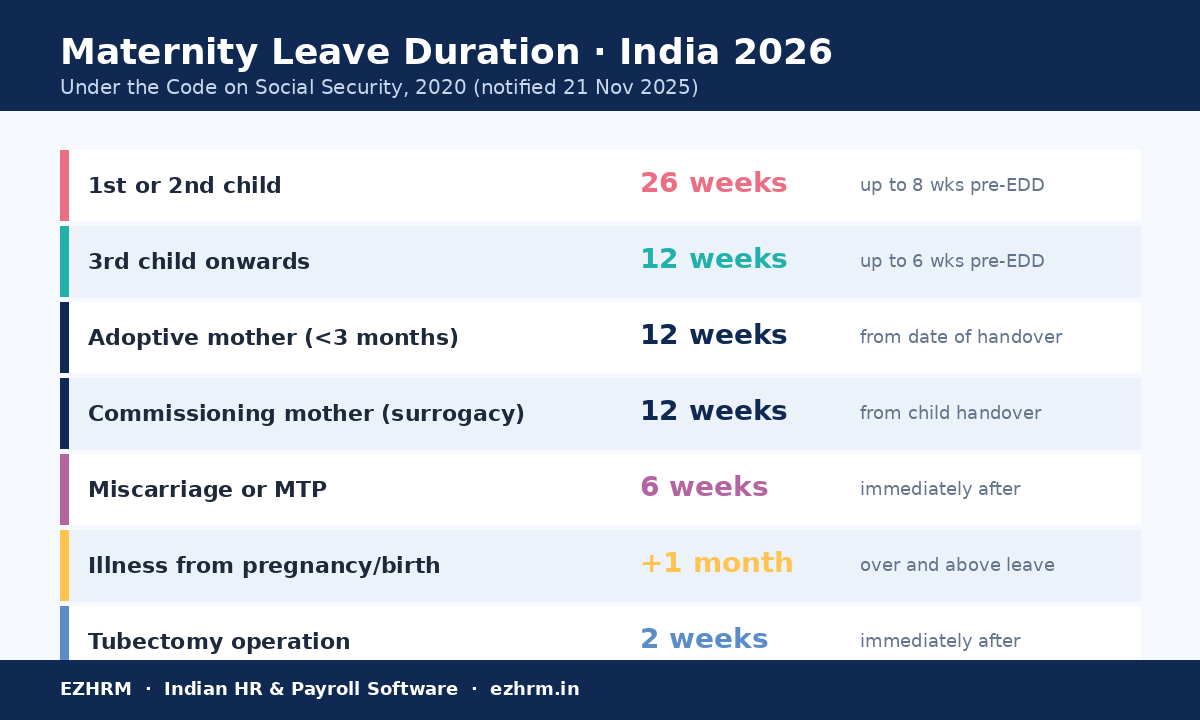
Save this table. It will answer 90% of the questions your team will ask you this year.
How to Calculate Maternity Pay
The Code on Social Security keeps the old formula intact. Maternity benefit is paid at the average daily wage for the period of actual absence.
Average daily wage = the average of the woman’s earnings (basic + DA + retaining allowance, excluding overtime and bonus) over the three calendar months immediately preceding the date she goes on leave, divided by the number of days actually worked in that period.
Worked example. Suppose Priya earned ₹45,000, ₹46,000 and ₹47,000 (basic + DA) in the three months before her leave, and she worked 72, 75 and 70 days respectively. Her average daily wage is:
(45,000 + 46,000 + 47,000) ÷ (72 + 75 + 70) = ₹1,38,000 ÷ 217 = ₹635.94 per day
For 26 weeks (182 days), she is owed ₹635.94 × 182 = ₹1,15,742. Plus a medical bonus of ₹3,500 if your company does not provide free pre- and post-natal care. The full pay is taxable as salary and counts towards her Form 16 for the year. For TDS treatment in your monthly cycle, treat it like normal salary and let your payroll software handle the deduction.
The Crèche Facility Rule — Section 11A
This is the rule most growing SMEs miss. Once your headcount crosses 50 employees on any day during the preceding 12 months, you must provide a crèche — either inside the premises, or within a distance prescribed by the appropriate state government (typically 500 metres).
The Code gives the mother four visits per day to the crèche, including her rest interval. From an HR-policy angle, this means:
- A dedicated, ventilated, safe room — not a corner of the storeroom.
- A trained attendant on duty during all working hours.
- A written notice to every woman employee at the time of joining, listing every benefit under the Code (the Code expressly requires both written and electronic intimation now).
- A pickup and drop arrangement if the crèche is outside the premises.
Most state inspectors check this during their annual Shops & Establishments visit, and penalties under the new Code start at ₹50,000 for repeat default. Don’t wait until you’re audited.
Work From Home, Adoption and Miscarriage Provisions
Three under-used provisions HR managers should actually be using.
Work from home (Section 5(5)). After the 26 weeks end, the employer and employee can mutually agree on a work-from-home arrangement. The law deliberately keeps the duration flexible — many Indian IT and SaaS firms extend it by another 8 to 12 weeks. Document it as a written addendum to the employment contract, not a verbal nod.
Adoption and surrogacy. Adoptive and commissioning mothers get 12 weeks. After the Supreme Court’s 2024 ruling on Section 60(4), employers can no longer deny benefit to a woman who adopts a child below 3 months simply because she already had biological children.
Miscarriage and MTP. Six weeks of paid leave, beginning the date of the miscarriage or medical termination of pregnancy. A medical certificate is enough — you cannot demand further explanation.
For your full leave management policy, add these as separate leave codes so they don’t get clubbed with sick leave or earned leave.
What HR Managers Get Wrong
Six mistakes I still see at SMEs in Delhi NCR, Bengaluru and Pune every quarter:
- Asking for an early-pregnancy declaration. Not permitted, and grounds for a discrimination complaint. You can ask only when she submits the maternity leave application.
- Clubbing maternity leave with earned leave so the employee “uses up” her EL first. The two are separate statutory entitlements. Don’t touch her EL balance.
- Stopping PF contribution during leave. Wrong. PF must continue on the maternity benefit paid — both employer and employee share.
- Refusing the medical bonus of ₹3,500 because “we already gave full salary.” The bonus is on top of pay unless you provide free pre- and post-natal medical care.
- Not informing on Day 1. The Code requires every woman employee to be informed in writing and electronically about her benefits at joining. Add it to your onboarding checklist.
- Forgetting the crèche when you cross 50 staff. It happens — you grow from 47 to 52, the threshold trips, and you discover it during an inspection. Track headcount monthly through your statutory compliance dashboard.
Maternity Leave FAQ for Indian HR Managers
Q1. Is maternity leave 26 weeks for everyone in 2026?
No. The 26-week entitlement applies only for the first two children. From the third child onward, the entitlement is 12 weeks. Adoptive and commissioning mothers are entitled to 12 weeks from the date the child is handed over.
Q2. Does maternity benefit apply to a 12-employee company?
Yes. The threshold is 10 or more employees in any establishment over the preceding 12 months. A 12-person shop, office or factory in Bahadurgarh or Bengaluru is covered.
Q3. Can we terminate or transfer a pregnant employee?
No. Section 12 of the old Act, now mirrored in the Code, makes dismissal during the maternity period void. Transfers that materially worsen her work conditions are also barred.
Q4. Do I deduct ESI contribution during maternity leave?
ESI is not deducted on the maternity benefit because ESIC itself pays maternity benefit for women earning ₹21,000 or less gross. For other women, your company pays — but ESI deduction pauses as no ESIC-defined wages are being earned.
Q5. Is the medical bonus of ₹3,500 still valid in 2026?
Yes. The ₹3,500 medical bonus continues under the Code. You can skip it only if you actually provide free pre-natal and post-natal medical care to the employee, documented in writing.
Q6. Does the Code on Social Security change anything practical for my SME?
For most 10-to-200-person Indian businesses, the formula, duration and crèche threshold are unchanged. What’s new is unified registration on the Shram Suvidha portal, electronic intimation of benefits at joining, and harsher penalties for default.
Get Your Maternity Policy Right — Without the Spreadsheets
Maternity leave is one of those benefits where a missed update or a botched payroll line can cost goodwill that takes years to rebuild. If you’re still tracking 26-week leaves on Excel, look at EZHRM’s leave management module — built for Indian SMEs, with the Code on Social Security rules baked in by default. Pair it with the free HR templates to roll out a clean maternity policy this quarter.