
A new hire joins your company on the 3rd of the month. By the 5th, they’re in your cabin asking why their bank account shows ₹42,500 when their offer letter said ₹6 LPA. You know exactly what happened — PF, Professional Tax, TDS — but explaining it on the spot, without a proper salary breakup in hand, is a mess. Every HR manager has been there.
That’s the real reason your team needs a reliable CTC to in-hand salary calculator. Not just to satisfy curious candidates, but to structure compensation correctly from day one and avoid these conversations entirely.
This guide walks you through how CTC is broken down, how in-hand salary is actually calculated for FY 2026-27, and where most HR teams quietly go wrong.
- CTC is NOT your take-home. It includes Employer PF (12% of Basic) and Gratuity (4.81% of Basic) which you never see in your bank account.
- In-hand salary = Gross Salary minus Employee PF, ESI, Professional Tax, and TDS.
- Under the New Tax Regime FY 2026-27, income up to ₹12 lakh is effectively tax-free due to the ₹60,000 Section 87A rebate.
- The gap between CTC and in-hand can be 15–30% depending on salary level, state, and tax regime chosen.
What Is CTC and What Does It Actually Include?
CTC — Cost to Company — is the total annual expenditure a company incurs to employ you. It is NOT just your salary. CTC is every rupee the company spends on you in a year, including contributions that you never directly receive.
A standard CTC structure in India includes:
- Basic Salary — The foundation. Typically 40–50% of CTC. Everything else is calculated relative to this.
- HRA (House Rent Allowance) — 50% of Basic for metro cities (Delhi, Mumbai, Bangalore, Chennai, Kolkata, Hyderabad), 40% for non-metro.
- Special Allowance — The balancing figure. Whatever remains after Basic, HRA, and statutory components is usually packed here.
- Employer PF contribution — 12% of Basic salary (capped at ₹1,800/month = ₹21,600/year). This is the employer’s mandatory contribution to your EPFO account. It’s in your CTC but not in your monthly payslip gross.
- Gratuity Provision — 4.81% of Basic per year. This is money set aside for your eventual gratuity payout. You only receive it after completing 5 years of service.
- Other benefits — Medical insurance premium, LTA, meal vouchers, and any other perks the company provides.
The first thing any HR manager should do when a candidate compares two offers is ask: “Is this CTC inclusive or exclusive of Gratuity and Employer PF?” The answer can change the effective comparison by ₹80,000–₹1,20,000 per year on a ₹10 LPA package.

CTC vs Gross Salary vs In-Hand Salary — Three Numbers, Three Meanings
Most salary disputes in Indian workplaces trace back to confusion between these three figures.
| Term | What It Is | Example (₹10 LPA CTC, 40% Basic, Metro) |
|---|---|---|
| CTC | Total employer cost including employer PF + gratuity provision | ₹10,00,000/year |
| Gross Salary | CTC minus employer PF and gratuity — what appears in your payslip header | ₹8,60,000/year (₹71,667/month) |
| In-Hand / Net Salary | Gross minus employee deductions (PF, ESI, PT, TDS) | ₹67,309/month |
The gap between CTC and in-hand here is ₹10 LPA on paper vs ₹8.08 LPA actually banked — a difference of nearly ₹2 lakh per year. Nobody tells this to candidates upfront, and that’s where trust erodes.
How to Calculate In-Hand Salary from CTC — The Step-by-Step Formula
This is the methodology Indian payroll teams use, and it’s exactly what EZHRM’s free CTC salary calculator applies instantly.
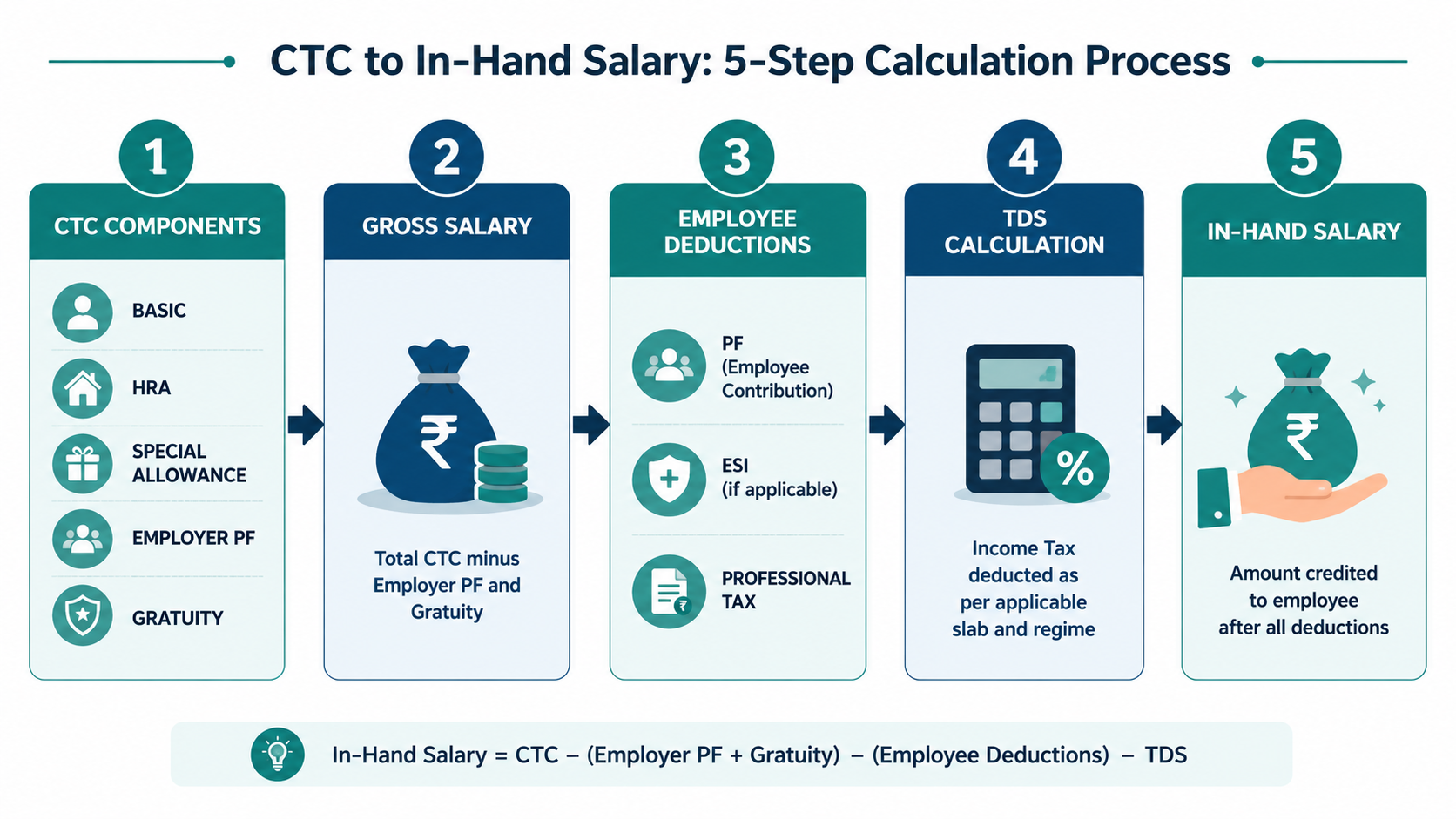
Step 1 — Break down CTC into components
- Annual Basic = CTC × 40% (or as per offer letter)
- Annual HRA = Basic × 50% (metro) or 40% (non-metro)
- Employer PF = 12% of Basic, capped at ₹21,600/year
- Gratuity provision = Basic × 4.81%
- Special Allowance = CTC − Basic − HRA − Employer PF − Gratuity
Step 2 — Calculate Gross Salary
Gross Salary = Basic + HRA + Special Allowance (Employer PF and Gratuity are removed — these are not paid as salary)
Step 3 — Calculate Employee-side deductions
- Employee PF: 12% of Basic, maximum ₹1,800/month
- Employee ESI: 0.75% of Gross — only applies if Gross ≤ ₹21,000/month
- Professional Tax: State-dependent. Maharashtra charges up to ₹200/month (₹2,500/year cap). Delhi, Haryana, UP charge nil.
Step 4 — Calculate TDS (New Regime, FY 2026-27)
Taxable Income = Annual Gross − ₹75,000 standard deduction. Apply slab rates: 0–₹4L = 0% | ₹4–8L = 5% | ₹8–12L = 10% | ₹12–16L = 15% | ₹16–20L = 20% | ₹20–24L = 25% | above ₹24L = 30%. Add 4% Health and Education Cess. Section 87A rebate: If net taxable income ≤ ₹12 lakh, tax is zero. Monthly TDS = Total annual tax ÷ 12.
Step 5 — In-Hand Salary
Monthly In-Hand = (Annual Gross ÷ 12) − Employee PF − ESI − Professional Tax − Monthly TDS
New Tax Regime vs Old Tax Regime: Which Puts More Money in Hand?
This is the question every employee asks HR in April. Here’s a practical answer for FY 2026-27:
| Annual CTC | Monthly In-Hand (New Regime) | Monthly In-Hand (Old Regime, 80C ₹1.5L + 80D ₹25K) | Better Regime |
|---|---|---|---|
| ₹6 LPA | ₹40,583 | ₹40,583 | Either (both zero tax under 87A) |
| ₹10 LPA | ₹67,309 | ₹66,250 (approx.) | New Regime |
| ₹15 LPA | ₹95,642 | ₹98,200 (approx.) | Old Regime (if deductions maxed) |
| ₹20 LPA | ₹1,21,475 | ₹1,24,800 (approx.) | Old Regime (if metro + significant deductions) |
For most employees earning under ₹12 lakh, New Regime wins because the 87A rebate makes income effectively tax-free. For incomes above ₹15 lakh with maxed-out deductions and significant HRA, Old Regime may still be better. The Income Tax Department’s official guidance recommends computing both before choosing. Always verify with your actual numbers using the CTC to in-hand salary calculator.
Real CTC-to-In-Hand Examples for FY 2026-27
| Annual CTC | Monthly Gross | Emp. PF | Prof. Tax | Monthly TDS | Monthly In-Hand |
|---|---|---|---|---|---|
| ₹4 LPA | ₹27,983 | ₹1,600 | ₹200 | ₹0 | ₹26,183 |
| ₹6 LPA | ₹42,583 | ₹1,800 | ₹200 | ₹0 | ₹40,583 |
| ₹10 LPA | ₹71,667 | ₹1,800 | ₹200 | ₹2,358 | ₹67,309 |
| ₹15 LPA | ₹1,07,500 | ₹1,800 | ₹200 | ₹9,858 | ₹95,642 |
| ₹20 LPA | ₹1,43,333 | ₹1,800 | ₹200 | ₹19,858 | ₹1,21,475 |
Assumes 40% Basic, metro HRA, Maharashtra PT, New Tax Regime FY 2026-27. Employees earning up to ₹6 LPA pay zero income tax — entirely due to the Section 87A rebate of ₹60,000.
What HR Managers Get Wrong with CTC Structuring
1. Keeping Basic salary too low to reduce PF liability
Some companies set Basic at 25–30% of CTC to reduce employer PF contributions. EPFO audits increasingly scrutinise minimum Basic wage compliance, and low Basic hurts employees’ long-term PF corpus and EPS pension entitlement.
2. Quoting CTC inclusive of Gratuity without disclosing it
Gratuity provision (4.81% of Basic) is yours only after 5 years of service. If an employee leaves in year 3, they don’t get it. Always disclose whether Gratuity is included in the CTC figure — it builds trust and prevents disputes.
3. Not updating tax regime election in payroll before April
Employers must collect employee regime declarations at the start of the financial year. Many HR teams forget, leading to incorrect TDS and a sudden large deduction in February or March. EZHRM’s TDS & Form 16 module handles this automatically with employee-wise regime selection.
4. Applying ESI incorrectly after an increment
ESI applies to employees with Gross salary ≤ ₹21,000/month. When an employee crosses this threshold after an increment, ESI should stop immediately from the next contribution period. Use a dedicated PF/ESI calculator to track this at every increment cycle.
5. Forgetting Professional Tax compliance for multi-state workforces
PT slabs and filing deadlines differ by state. Use the Professional Tax Calculator and maintain state-wise PT registers to stay compliant across Maharashtra, Karnataka, West Bengal, and other PT states.
6. Not giving employees a written salary breakup at onboarding
Hand every new employee a written CTC breakup showing Basic, HRA, deductions, and expected in-hand. This takes 3 minutes and saves hours of HR confusion later.
HR Onboarding Salary Breakup Checklist
- Share the CTC letter with a line-by-line breakdown — Basic, HRA, Special Allowance, Employer PF, Gratuity clearly labelled.
- Collect the tax regime declaration — Use Form 12BB or your internal declaration form. Store it in the employee’s digital file.
- Show a computed payslip estimate — Use the CTC salary calculator to generate expected first payslip — no surprises on payday.
- Explain PF and ESI contributions — Most new joiners don’t know their PF goes into a retirement corpus. A quick explanation reduces resentment about the deduction.
For more payroll compliance guides, visit the EZHRM HR & Payroll Blog. For full and final settlement calculations, use the Full & Final Settlement Calculator and Leave Encashment Calculator, both free under the free HR calculators hub.
Frequently Asked Questions
What is the formula to calculate in-hand salary from CTC in India?
In-hand salary = (Annual CTC − Employer PF − Gratuity) ÷ 12 − Employee PF − ESI − Professional Tax − Monthly TDS. Gross salary is CTC minus employer costs; in-hand is Gross minus employee deductions. Use EZHRM’s free CTC to in-hand salary calculator for instant, accurate results.
How much in-hand do you get on ₹6 LPA CTC in 2026?
On a ₹6 LPA CTC under the New Tax Regime FY 2026-27 (40% Basic, metro city, Maharashtra PT), the monthly in-hand salary is approximately ₹40,583. There is zero TDS because taxable income falls under the ₹12 lakh Section 87A rebate threshold. Actual figures vary by salary structure and state.
Is CTC the same as gross salary?
No. CTC includes Employer PF (12% of Basic, up to ₹21,600/year) and Gratuity provision (4.81% of Basic). Gross Salary is CTC minus those employer-side costs — it’s what appears on your payslip before employee deductions. In-hand is what you receive after all deductions.
What percentage of CTC do employees typically take home?
For employees earning ₹4–12 LPA, take-home is typically 75–85% of CTC. At higher levels (₹15–25 LPA), the take-home drops to 65–75% due to income tax. The exact figure depends on Basic %, tax regime, Professional Tax state, and deductions claimed.
Does Employer PF count in CTC?
Yes, most Indian companies include Employer PF in CTC. The employer contributes 12% of Basic salary to the employee’s EPF account. This goes into your EPFO account, not your bank account. Always confirm whether CTC in an offer letter includes or excludes Employer PF and Gratuity before comparing offers.
How is TDS deducted from salary every month?
Your employer estimates your full-year taxable income at the start of the financial year, calculates the total annual tax, then divides by 12 to get the monthly TDS amount. If you switch tax regimes or miss investment declarations, your employer adjusts TDS in remaining months to ensure correct total deduction.
If your team is still computing CTC breakups manually in Excel, try the free CTC to in-hand salary calculator — it handles PF, ESI, Professional Tax, and TDS for both tax regimes in under a minute. And if you’d like payroll to run this way automatically for every employee every month, EZHRM’s payroll software does exactly that — with payslips dispatched in 18 minutes flat.