
A candidate accepts your offer at ₹6 LPA, walks in on Day 1, and by the first payslip she’s messaging HR asking where ₹8,000 went. Nobody lied to her — the offer letter said ₹50,000 a month CTC, and the payslip says ₹42,500 in-hand. But nobody ran the numbers with her either, and now you’re spending your morning explaining PF, gratuity provision and professional tax to someone who’s already decided your company “hides things” in the offer letter.
This happens at almost every SME in India that quotes CTC without breaking it down, and it’s one of the most avoidable sources of early attrition. A CTC salary calculator fixes this at the one moment it actually matters — before the offer letter goes out, not after the first payslip lands. Use the CTC salary calculator to show every candidate their real number before they sign.
TL;DR
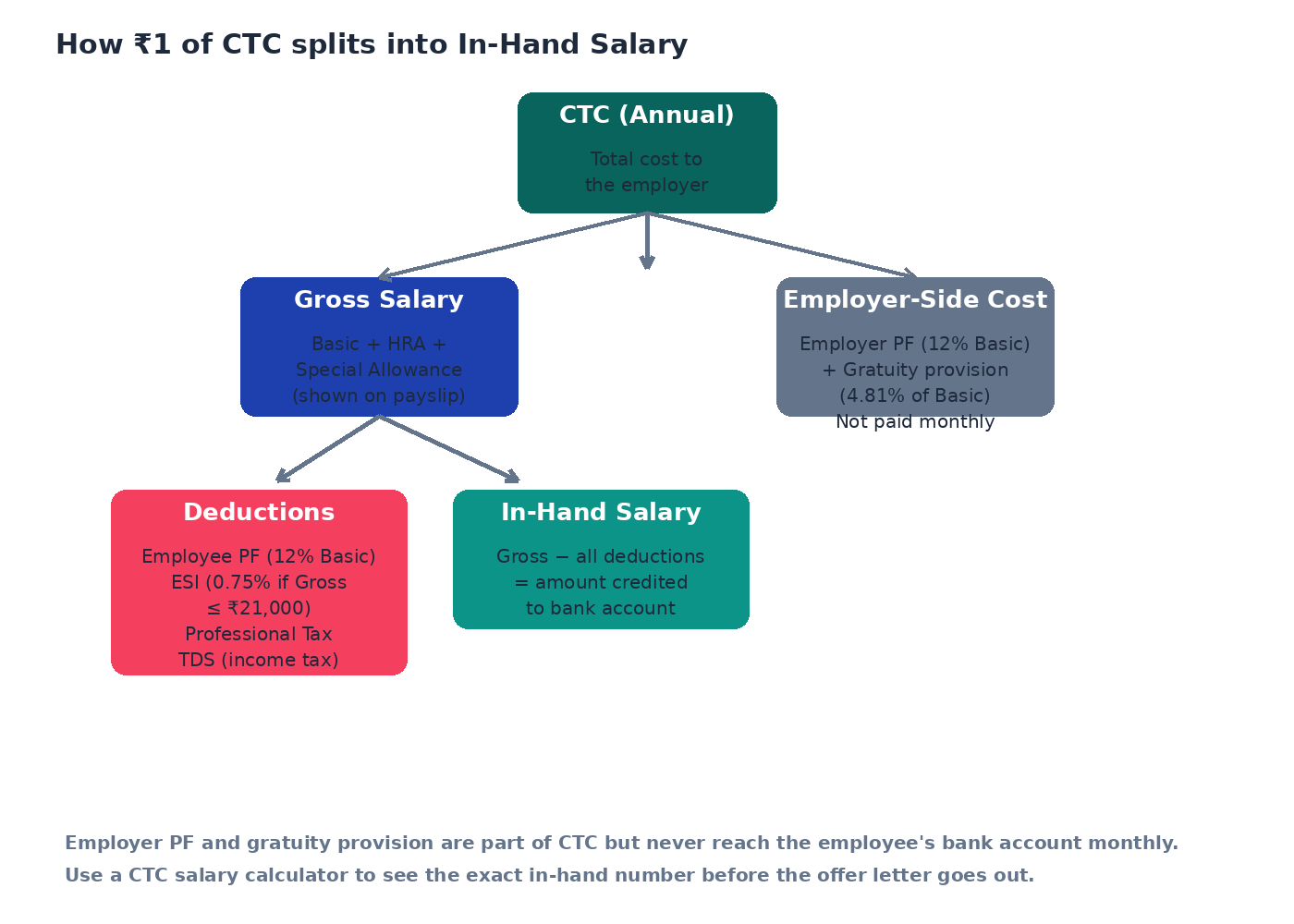
- CTC includes employer costs the employee never sees in hand — Employer PF (12% of Basic), gratuity provision (4.81% of Basic), and sometimes insurance premiums.
- On a typical ₹50,000 CTC with 40% Basic, in-hand salary lands around ₹42,500–₹43,500/month depending on tax regime and city — a gap of ₹6,500–₹7,500 that surprises candidates who don’t know how to read a breakup.
- Quoting CTC as one round number without a component-wise breakup is the single biggest driver of “you promised more” complaints during onboarding.
- A five-minute CTC salary calculator walkthrough during offer negotiation removes almost all of this friction, and it costs you nothing.
What CTC Actually Is (And Why Candidates Get It Wrong)
CTC, or Cost to Company, is the total amount an employer spends on an employee in a year — not what lands in their bank account every month. It includes the employee’s gross salary plus employer-side statutory costs: Employer Provident Fund (12% of Basic, capped at ₹1,800/month under the current ₹15,000 wage ceiling), gratuity provision (4.81% of Basic per year), and often group medical insurance or other benefits the company pays for but the employee never touches directly.
Most first-time jobseekers — and a good number of experienced ones — assume CTC divided by 12 is their monthly salary. It isn’t, and the gap between the two numbers is exactly where offer-stage disputes come from. Your job as HR isn’t to make CTC smaller; it’s to make the breakup visible before the candidate signs.
The components that quietly reduce take-home
Four line items sit between CTC and in-hand pay, and candidates rarely know to ask about any of them:
- Employer PF — part of CTC, never paid to the employee monthly, goes into their retirement account instead.
- Gratuity provision — part of CTC, paid only after 5 years of continuous service, and only on exit.
- Employee PF, ESI and Professional Tax — deducted from gross salary, reducing what actually hits the account.
- TDS — income tax withheld monthly based on the employee’s estimated annual tax liability.
Running the Numbers: What a ₹50,000 CTC Actually Pays
Here’s the same offer, shown three ways — as most offer letters present it, and as it actually resolves for the employee under both tax regimes. This is the exact table worth walking a candidate through, and it takes under two minutes on the CTC salary calculator.
| Component (monthly) | Amount | Employee sees it? |
|---|---|---|
| Basic (40% of CTC) | ₹16,667 | Yes — on payslip |
| HRA (metro, 50% of Basic) | ₹8,333 | Yes — on payslip |
| Special allowance | ₹18,278 | Yes — on payslip |
| Employer PF (12% of Basic) | ₹1,800 | No — goes to EPFO, not the bank account |
| Gratuity provision (4.81%) | ₹802 | No — paid only after 5 years, on exit |
| Gross salary (payslip figure) | ₹43,278 | Yes |
| (–) Employee PF | ₹1,800 | Deducted |
| (–) Professional Tax | ₹200 | Deducted (state-dependent) |
| (–) TDS | ₹0 (New Regime, under 87A rebate) | Deducted |
| In-hand salary | ~₹41,278 | Actually paid |
That’s a gap of nearly ₹8,700 between the quoted ₹50,000 CTC and the ₹41,278 that shows up in the account — roughly 17%. None of it is hidden or improper. All of it is invisible to a candidate reading a one-line offer letter. Run your own bands through the CTC salary calculator before your next offer round; the gap moves depending on Basic %, city, and tax regime, and it’s worth knowing the exact number rather than a rough estimate.
Old Regime vs New Regime — Which Number Do You Show?
For FY 2026-27, the New Tax Regime is the default and gives most employees under ₹12.75 lakh annual income a near-zero TDS, thanks to the ₹75,000 standard deduction and the Section 87A rebate. The slabs are unchanged from last year: nil up to ₹4 lakh, 5% from ₹4–8 lakh, 10% from ₹8–12 lakh, 15% from ₹12–16 lakh, 20% from ₹16–20 lakh, 25% from ₹20–24 lakh, and 30% above ₹24 lakh. Under the Old Regime, HRA exemption and 80C/80D deductions can bring taxable income down further for employees with high rent or investments — but most candidates below ₹12 lakh CTC won’t beat the New Regime’s rebate. When you show an offer, default to New Regime numbers unless the candidate specifically has heavy 80C commitments or pays significant rent in a metro. Showing the wrong regime’s number is a smaller version of the same problem — a number that doesn’t match the first payslip.
How to Use the Calculator During Offer Negotiation
- Enter the CTC you’re about to offer in the CTC salary calculator, along with the Basic % from your standard structure (check it isn’t below the 50% wage-code floor — see below).
- Select the candidate’s city type. HRA exemption differs between metro (50% of Basic) and non-metro (40% of Basic), and it changes the in-hand number under the Old Regime.
- Toggle both tax regimes and note which one gives a better take-home for this specific CTC band — then quote that regime’s number as the “expect to receive” figure, with a note that it depends on their declarations.
- Screenshot or print the breakup table and attach it to the offer letter, or walk through it live on a call. Either beats a single CTC number with no explanation.
- Repeat for every band before a hiring drive, not just for the one candidate who asks. If you’re hiring at scale, your payroll software should be generating this automatically per offer.
Where the 50% Wage Rule Changes Your Starting Point
Since the Code on Wages definition took effect on 21 November 2025, with central rules notified on 8 May 2026, Basic pay plus DA must equal at least 50% of total remuneration for it to hold up under inspection. If your standard offer template still uses 30–35% Basic, the CTC calculator will show a healthier in-hand number today — but it’s calculating against a structure that’s now non-compliant. Fix the template before you fix the messaging. It’s easier to explain a correct 50%-Basic structure once than to explain a second pay cut a year later when payroll finally catches up to the rule.
Common Mistakes HR Teams Make With CTC Offers
- Quoting CTC with no breakup at all. A single number in an offer letter is an invitation for the candidate to assume it’s their monthly take-home.
- Never mentioning gratuity provision. It’s part of CTC, it’s real money, but it’s paid only after 5 years — candidates should know this isn’t spendable cash from day one.
- Quoting Old Regime numbers to New Regime employees. If the employee doesn’t plan to invest in 80C or pay high rent, showing an Old Regime take-home figure overstates what they’ll actually receive.
- Assuming Basic % is fixed company-wide. Many SMEs still run legacy offer templates at 30% Basic for old bands and 50% for new ones — inconsistent, and now non-compliant for the lower band.
- Not revisiting the number after probation confirmation. If variable pay or a hike kicks in post-probation, the candidate’s first three payslips look nothing like month four — flag this upfront.
Frequently Asked Questions
What is the difference between CTC and in-hand salary?
CTC is the total yearly cost to the employer, including components the employee never receives monthly — Employer PF and gratuity provision. In-hand salary is what actually lands in the bank account after Employee PF, ESI, Professional Tax and TDS are deducted from gross pay. The gap is typically 12–18% of CTC depending on Basic % and tax regime.
Why does my in-hand salary seem lower than my offer letter suggested?
Most offer letters quote CTC, not take-home. CTC includes Employer PF and gratuity provision, which never reach your account monthly, plus your own deductions (PF, ESI, Professional Tax, TDS) are subtracted from gross pay. Use a CTC salary calculator with your exact Basic % and city to see the real number before you accept.
How much of CTC should be Basic salary in 2026?
At least 50%, following the Code on Wages definition of wages that took effect on 21 November 2025 and was finalised in central rules on 8 May 2026. Structures below 50% Basic risk reclassification and arrears during a labour inspection, regardless of what the offer letter calls the remaining allowances.
Should I show candidates the Old Regime or New Regime take-home number?
Default to the New Tax Regime figure for most candidates under ₹12–12.75 lakh CTC, since the ₹75,000 standard deduction and Section 87A rebate usually make it tax-free at that level. Only lead with Old Regime numbers if the candidate has confirmed heavy 80C investments or pays substantial metro rent.
Does a higher CTC always mean higher in-hand salary?
Not proportionally. Two offers with the same CTC but different Basic % can produce different take-home numbers — higher Basic means higher PF deduction (lower take-home, higher retirement savings) while lower Basic means the reverse, within the 50% wage-code floor. Always compare via a calculator, not by CTC alone.
Is gratuity part of my monthly salary?
No. Gratuity provision is included in CTC as a future liability — roughly 4.81% of Basic per year — but it is paid out only when you complete 5 years of continuous service and leave the company, per the Payment of Gratuity Act. Check your exact entitlement on the gratuity calculator.
Build the Breakup Into Every Offer, Not Just the Difficult Ones
The fix here isn’t complicated — it’s a habit. Run every offer through the CTC salary calculator before it goes out, attach the breakup table, and default to the tax regime that actually applies to the candidate. Pair it with the Professional Tax calculator for state-specific deductions and the PF & ESI calculator when you need employer-cost numbers for budgeting. Browse the rest of our free HR calculators for the other numbers you’ll need before offer day, and check the EZHRM blog for more HR compliance guides. If you’d rather have offer letters, payslips and statutory deductions generated automatically and consistently for every hire, that’s what EZHRM’s payroll software does in the background.
Official references: labour codes and wage definitions are published by the Ministry of Labour & Employment; PF wage ceiling and contribution rules by EPFO.