
Your dispatch lead worked the entire Sunday to close month-end. Monday morning he is at your desk asking, “Ma’am, comp off mil jayega na?” You say yes — but then comes the harder part: how many days, by when, does it lapse, do you owe him double pay instead, and does any of it show up correctly in payroll? This is where most Indian HR teams get the comp off policy wrong, and it quietly turns into a dispute six months later when the employee resigns and asks for encashment. Here is your complete reference on comp off rules, the math, the legal backing, and the policy template you can adapt.
- Comp off is a paid day off given when an employee works on a weekly off, a national holiday, or a company-declared holiday.
- Under Section 53 of the Factories Act, 1948, the comp off must be allowed within the same month or within the next 2 months.
- Comp off is NOT a substitute for overtime pay. Section 59 still mandates 2x wages for over 9 hours/day or 48 hours/week.
- Most state Shops & Establishments Acts allow either comp off OR overtime — pick one and document it in the appointment letter.
What is a Comp Off (Compensatory Off) in India?
A compensatory off, or comp off, is a paid leave day granted to an employee in exchange for working on a day they were otherwise entitled to rest — usually a weekly off (Sunday), a national holiday (26 January, 15 August, 2 October), or a company-declared festival holiday. It is not accrued monthly like Casual Leave or Earned Leave. It is earned only when work is performed on a rest day, and it expires if not used within a defined window.
The concept exists because Indian labour law treats rest days as a statutory right. If your team gives that right up to help the business, the law expects you to give it back.
The Legal Backing: Which Act Says What
India does not have a single comp off statute. The rules come from a stack of laws depending on what kind of establishment you run:
1. The Factories Act, 1948 — for manufacturing units
Section 52 requires every adult worker to get one full day of rest in a week, and no worker can be made to work for more than 10 consecutive days without a rest day. Section 53 then says: if a worker loses their weekly off, you must give them a compensatory holiday of equal number, within the same month or within the two months immediately following.
2. State Shops & Establishments Acts — for offices, IT, retail, F&B
If you run a software company in Bangalore, a retail chain in Delhi, or a CA firm in Mumbai, you fall under your state’s S&E Act. Most state Acts (Karnataka, Maharashtra, Delhi, Tamil Nadu, Haryana) carry similar comp off provisions but the time window varies — typically 30 to 90 days from the day worked.
3. The OSH Code, 2020
The Occupational Safety, Health and Working Conditions Code, 2020 — now in force — consolidates 13 older labour laws including the Factories Act. Core comp off and rest day provisions carry forward.
4. Section 59 of the Factories Act — overtime is separate
This is where most HR managers slip up. If a worker puts in more than 9 hours in a day or 48 hours in a week, you owe overtime at twice the ordinary wage rate. Comp off does NOT cancel this out. You can give comp off for the Sunday AND owe overtime for the extra hours on top.
Comp Off vs Overtime vs Leave Encashment: The Difference
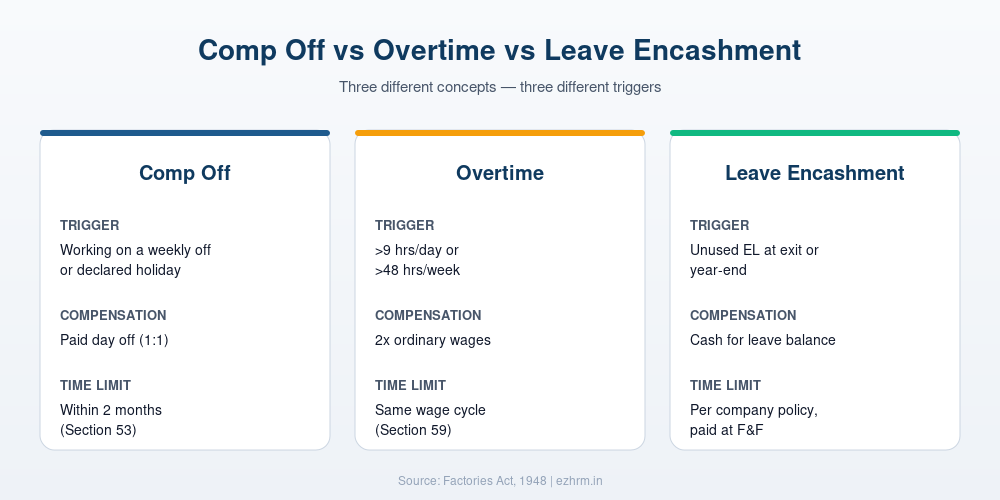
HR managers, employees, and even payroll vendors mix these three up constantly. Here is how they differ:
| Concept | Trigger | Form of compensation | Time limit |
|---|---|---|---|
| Comp Off | Working on a weekly off or holiday | Paid day off | Within 2 months (Factories Act); 30–90 days (S&E Acts) |
| Overtime | Working >9 hrs/day or >48 hrs/week | 2x ordinary wages | Paid in the same wage cycle |
| Leave Encashment | Unused Earned Leave at exit or year-end | Cash equivalent of leave balance | As per company policy, paid at F&F |
Practical rule: if your appointment letters say “comp off in lieu of overtime”, get them re-vetted. That clause is not enforceable against the Factories Act, and a labour inspector can hold you up on it.
How to Calculate Comp Off: The Formula Most Teams Use
There is no universal formula prescribed by statute, but the working standard in Indian SMEs is:
1 full day worked on a weekly off or holiday = 1 day of comp off
Many companies extend this with a tiered structure that rewards longer shifts:
- 4 to 6 hours worked on a rest day: 0.5 day comp off
- More than 6 hours worked on a rest day: 1 full day comp off
- National holiday work (26 Jan, 15 Aug, 2 Oct): 1 day comp off + festival pay as per policy
For a worker on ₹30,000 gross, one day of comp off is approximately ₹1,000 of paid time. If you fail to grant it in the window and the employee exits, that day can convert into a cash claim at full and final settlement.
Sample Calculation
Priya, a payroll executive in your Gurgaon office, worked 3 Sundays in May 2026 to close FY 2025-26 books. Two were 9-hour days, one was 11 hours.
- Comp off earned: 3 days (one per Sunday)
- Overtime owed on the 11-hour Sunday: 2 hours × 2x ordinary wage
- Deadline to grant comp off: 31 July 2026 (2 months from May)
Drafting a Comp Off Policy: 7 Clauses You Cannot Skip
A clean, defensible comp off policy needs these seven sections. Use them as your checklist:
- Eligibility: Who can earn comp off — typically all full-time employees below a designation level. Senior management on fixed salary is usually excluded.
- Approval before working: Comp off is earned only if working on the rest day was pre-approved in writing by the reporting manager. This stops “I came in voluntarily” disputes.
- Earning ratio: State your formula clearly — 1:1, or the tiered 0.5/1 day structure above.
- Validity period: Specify whether comp off must be taken in 30, 60, or 90 days. For factories, default to 60 days to stay inside Section 53.
- No carry-forward, no encashment: Most policies state that unused comp off lapses and is not encashed. This is legally permitted if documented.
- Application process: Comp off is applied through your HRMS, like any other leave, with manager approval before the day is taken.
- Interaction with overtime: Make clear when an employee is eligible for comp off, when for overtime, and when for both.
Common Mistakes HR Managers Make with Comp Off
From conversations with HR teams across Indian SMEs, four mistakes show up again and again:
- Letting comp off pile up indefinitely. Without a validity period, employees hold 15–20 days at exit — an F&F liability nobody budgeted for.
- Tracking comp off in Excel. Spreadsheets break past 50 employees. Approvals are not auditable, expiry dates are missed, and labour inspectors do not accept ad-hoc records.
- Confusing comp off with overtime. Giving a comp off but not paying overtime when the workday crossed 9 hours is a Factories Act violation.
- No written approval before the day. Without pre-approval, you cannot refuse comp off claims from anyone who simply showed up on a Sunday.
How an HRMS Handles Comp Off Automatically
On a modern HRMS, comp off becomes a background task instead of a monthly headache. Attendance logs from biometric or face-recognition devices flag any work on a declared holiday or weekly off, a comp off credit gets created in the employee’s leave balance with the 60-day expiry, and the reporting manager is notified. When the employee applies for leave, the system consumes from the comp off bucket first, and expiry alerts fire at the 45-day and 55-day mark so credits do not silently lapse.
Frequently Asked Questions
Is comp off mandatory under Indian labour law?
Comp off is mandatory under Section 53 of the Factories Act, 1948 for factory workers who lose their weekly off. For employees covered under state Shops & Establishments Acts, most states also mandate it, though the time window for granting it varies. Private companies in IT or services typically follow these rules through their own policies.
Can comp off be encashed in India?
Most company policies state that comp off cannot be encashed and lapses if not used in the validity period. This is legal if clearly documented in the appointment letter and HR policy. But if your policy is silent and the employee earned but could not use the comp off for business reasons, you may have to settle it in cash at exit.
What is the maximum validity of a comp off?
Under Section 53 of the Factories Act, the comp off must be granted within the same month or within the two months immediately following the month it was earned. State Shops & Establishments Acts typically allow 30 to 90 days. Most Indian SMEs standardise on a 60-day validity to stay compliant with the strictest reading of the law.
Is comp off the same as overtime pay?
No. Comp off is for working on a rest day. Overtime under Section 59 of the Factories Act is for working more than 9 hours in a day or 48 hours in a week, paid at twice the ordinary wage rate. You can owe both at the same time — for example, an employee who works 11 hours on a Sunday is entitled to a comp off plus 2 hours of overtime pay.
How many comp offs can an employee earn in a month?
There is no statutory cap, but the Factories Act prohibits any worker from working more than 10 consecutive days without a rest day. In practice, capping comp off earning at 4 days per month is a sensible HR control and is what most well-run Indian SMEs use.
Do comp offs reset every year?
Comp offs are earned per incident and expire as per your policy validity window — they are not part of an annual leave balance. So there is nothing to “reset” on 1 April or 1 January. Each comp off credit has its own expiry tied to the date it was earned.
Getting comp off right is one of those quiet HR wins — employees feel respected, your audit file is clean, and F&F stops dragging into long email chains. EZHRM’s leave and attendance module takes care of accrual, expiry, and approvals automatically, so your team can spend its time on people, not pivot tables.