
An engineer in your Bengaluru office resigns on a Monday. Her offer letter says 90 days’ notice. She serves 25 and stops showing up. Your payroll team dutifully calculates 65 days of recovery against her full and final settlement — and three weeks later you get a legal notice saying the recovery is unenforceable. Who is right?
This is where most Indian HR teams discover that notice period recovery is not a payroll question at all. It is a state law question wearing a payroll costume. The number in your offer letter is a starting point, not a ceiling, and in several states it is not even the operative rule.
TL;DR
- Notice period recovery is the amount an employer deducts from an exiting employee’s final settlement when the employee serves less notice than their contract requires.
- State Shops & Establishments Acts survived the four Labour Codes that came into force on 21 November 2025 — they still govern notice in most commercial establishments.
- Several state Acts cap what an employee owes. Under Section 30 of the Delhi Shops and Establishments Act, 1954, an employee who fails to give notice is released on payment of one month’s pay — regardless of a 90-day clause in the offer letter.
- There is no GST on notice pay recovery (CBIC Circular 178/10/2022-GST, dated 3 August 2022), and the recovery reduces taxable salary only if you handle it correctly in Form 24Q.
What notice period recovery actually means
Notice period recovery is the sum an employer withholds or deducts from an employee’s full and final settlement when that employee resigns and leaves before completing the contractual notice period. It is compensation for breach of a contractual term — not a penalty, not a fee, and not payment for any service rendered. That distinction matters enormously for tax, and we will come back to it.
Do not confuse it with a notice period buyout. In a buyout, the employer agrees to release the employee early and accepts payment. In a recovery, the employee simply leaves and you claw back the shortfall. Same arithmetic, very different legal footing. You can run either scenario through our free notice period recovery calculator in about thirty seconds.
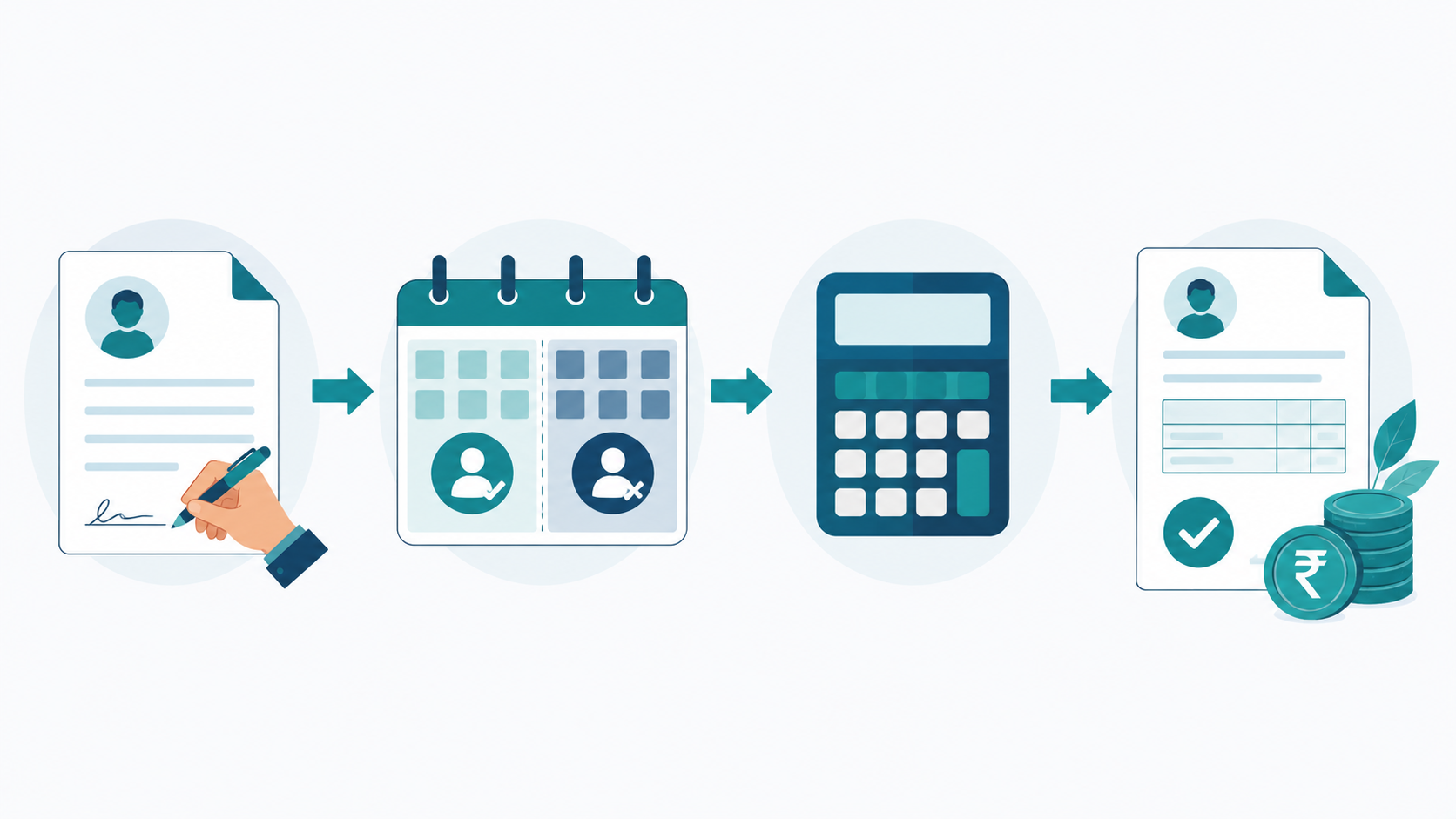
Your offer letter is not the last word — the state Act is
Here is the part that catches out even experienced HR managers. India has no single national notice period law. What applies to your employee depends on two things: whether they qualify as a “worker” under the Industrial Relations Code, 2020, and which state Shops & Establishments Act covers your establishment.
When the four Labour Codes were brought into force on 21 November 2025, a lot of HR teams assumed the state Shops Acts had been swept away. They have not. The Codes consolidated 29 central labour laws. State Shops & Establishments Acts are state legislation, and they continue to operate — subject to a careful reading where a subject overlaps with a Code provision, such as working hours or leave.
So for a software company in Bengaluru, a retail chain in Pune, or a clinic in Chennai, the Shops Act of that state is still the document that decides how much notice is owed and by whom.
The Delhi example every HR manager should know
Section 30 of the Delhi Shops and Establishments Act, 1954 is worth reading in full, because it does two separate things:
- Employer side: an employer cannot dispense with the services of an employee who has completed three months’ continuous service without at least one month’s written notice, or wages in lieu. Misconduct, after a hearing, is the exception.
- Employee side: an employee with three months’ continuous service must give at least one month’s written notice. If they do not, they are released from employment on payment of an amount equal to one month’s pay.
Read that second limb again. The statute fixes the employee’s exposure at one month’s pay. If your Delhi offer letter demands 90 days and you try to recover three months from an exiting employee, you are on shaky ground the moment someone reads the Act. Courts have also been willing to strike down unreasonably long notice clauses for junior and mid-level staff as an unreasonable restraint under Section 27 of the Indian Contract Act, 1872.
State-wise notice period rules: the working table
The table below is the position commonly applied by payroll teams across the major state Shops & Establishments Acts. Treat it as a starting point for your own state, not a substitute for the current bare Act — several states, including Haryana, amended their Shops Acts during 2025.
| State | Service threshold | Notice commonly required | Practical note for recovery |
|---|---|---|---|
| Delhi | 3 months’ continuous service | 1 month (both sides) | Employee released on payment of one month’s pay — statutory cap |
| Maharashtra | Over 1 year | 30 days | 14 days for 3–12 months of service |
| Karnataka | Over 6 months | 30 days | Shorter notice typically applies on probation |
| Tamil Nadu | Over 6 months | 30 days | Applies to continuous service only |
| Telangana & Andhra Pradesh | 6 months | 1 month | Check the state’s own amendments |
| West Bengal | No tenure condition | 30 days | Applies broadly across establishments |
If you run establishments in more than one state — and most growing SMEs do by the time they cross 100 employees — you cannot maintain one notice policy and assume it holds everywhere. This is exactly the kind of thing our compliance management module is built to track, so your Bengaluru and Gurugram exits do not get processed on the same rule by accident.
The formula, and the two decisions that change the answer
The arithmetic is simple. The inputs are where teams disagree.
Notice Pay Recovery = (Applicable monthly salary ÷ Day base) × Days of notice not served
Two choices decide the outcome, and both must be written into the appointment letter:
- Which salary? Gross, or Basic + DA. This single choice can double or halve the recovery.
- Which day base? 30 days, 26 days, or actual calendar days in the month. A 26-day base produces a higher per-day rate than 30.
Worked example
Priya works in your Bengaluru office. Gross salary ₹60,000 per month; Basic + DA ₹30,000. Her contract requires 60 days’ notice. She serves 25 days, so 35 days are unserved.
| Basis used | Per-day rate | Recovery for 35 days |
|---|---|---|
| Gross, 30-day base | ₹2,000 | ₹70,000 |
| Gross, 26-day base | ₹2,308 | ₹80,780 |
| Basic + DA, 30-day base | ₹1,000 | ₹35,000 |
Same employee, same 35 days, and a ₹45,780 spread between the highest and lowest figure. If your appointment letter is silent on the basis, expect the employee’s lawyer to argue for the lowest one. Run your own numbers on the notice period recovery calculator before you commit anything to the settlement letter.
The recovery then sits inside the wider exit computation alongside earned leave encashment, gratuity and pending reimbursements. Our full & final settlement calculator and leave encashment calculator handle those adjacent pieces, and the CTC salary calculator is useful when you need to establish what “Basic + DA” actually was.
GST and TDS on notice pay recovery
There is no GST on notice pay recovery. CBIC Circular No. 178/10/2022-GST dated 3 August 2022 settled this: the employer is not “tolerating an act” — the employer would much rather the employee served the notice. The recovery is compensation for breach of contract, not consideration for a supply. If your finance team is still raising a GST invoice for notice pay, stop.
TDS is less tidy. The safest and most widely followed treatment is to deduct the recovery from the salary actually paid and report the net figure, so TDS under Section 192 is computed on what the employee genuinely received. Problems start when one employer reports gross salary in Form 16 and the next employer computes fresh — the employee ends up taxed on money they never got. Flag the treatment in the relieving documentation so the employee’s return preparer knows what happened.
What HR managers get wrong
- Treating the offer letter as the ceiling. In states with a statutory cap on employee-side notice, a 90-day clause does not automatically give you 90 days of recovery.
- Leaving the salary basis undefined. “Salary in lieu of notice” without specifying gross or Basic + DA is an invitation to dispute.
- Withholding the relieving letter as leverage. Recovering money is a contractual claim. Blocking a person’s next job to force payment is a separate risk, and tribunals do not look kindly on it.
- Applying one policy across states. A Mumbai policy applied to a Delhi employee is not compliance, it is a coin toss.
- Charging GST. Four years after Circular 178, some payroll teams still do.
- Recovering more than the F&F payable. If the shortfall exceeds the dues, you cannot simply create a negative settlement. That becomes a recovery claim, and needs a written, signed acknowledgement.
Frequently asked questions
Is notice period recovery legal in India?
Yes. Recovering pay for an unserved notice period is a valid contractual remedy where the appointment letter provides for notice or salary in lieu. However, the amount must be consistent with the applicable state Shops & Establishments Act, and excessively long notice clauses for junior staff can be challenged under Section 27 of the Indian Contract Act, 1872.
Can an employer recover notice pay on gross salary?
Only if the appointment letter says so explicitly. Where the contract is silent, the conservative and more defensible position is to recover on Basic + DA. Employers who apply gross salary without contractual backing frequently end up refunding the difference after a grievance or a legal notice.
Do the new Labour Codes change notice period recovery?
Not directly for resignations. The four Labour Codes effective 21 November 2025 tightened termination and retrenchment notice on the employer side and shortened final settlement timelines. State Shops & Establishments Acts continue to govern employee-side notice, so your existing state-wise mapping still applies.
Is GST payable on notice pay recovery in 2026?
No. CBIC Circular No. 178/10/2022-GST dated 3 August 2022 confirms notice pay recovery is not a supply and attracts no GST. Employers who paid GST on such recoveries earlier have, in several cases, been permitted to claim refunds under Section 54 within the applicable limitation period.
What if the recovery is more than the final settlement amount?
You can offset the recovery against dues payable, but you cannot manufacture a negative settlement. Any balance becomes a civil claim against the employee. In practice, most employers either waive the excess or agree a written repayment schedule before issuing relieving documents.
Does notice period recovery apply during probation?
Usually at a reduced rate. Most state Shops Acts and most appointment letters prescribe a shorter probation notice — commonly 7 to 15 days. Recovery is calculated on the probation notice period, not the confirmed-employee notice period, unless the contract states otherwise.
Get the number right the first time
Exits are the one payroll moment where a wrong number becomes a legal notice instead of a correction next month. Run the figure through the free notice period recovery calculator, cross-check it against your state’s Shops Act, and keep the basis documented — or let EZHRM’s payroll software apply the right state rule automatically at every exit.
Explore all our free HR calculators, or browse more HR guides for Indian payroll teams. Official sources referenced: Delhi Labour Department — Delhi Shops Act, 1954 and the Ministry of Labour & Employment.
This article is general guidance for HR and payroll teams, not legal advice. Verify the current text of your state’s Shops & Establishments Act, or take professional advice, before applying a recovery in an individual case.