
A production supervisor at a Bahadurgarh unit walks into HR in May and asks why his salary dropped by ₹1,700 when nobody told him about a pay cut. His CTC is exactly the same as last month. His basic went from ₹9,000 to ₹15,000 because payroll finally applied the 50% wage rule — and his PF deduction went up with it.
That conversation is happening across Indian SMEs right now, and most HR teams are having it after the payslip goes out instead of before. The CTC salary calculator exists precisely so you can run the new structure, see the take-home dip, and warn people first.
TL;DR
- Basic pay + DA must now be at least 50% of total CTC. Allowances excluded from “wages” cannot exceed the other 50% — the excess gets counted as wages anyway.
- On a ₹30,000 monthly CTC, moving basic from 30% to 50% cuts in-hand pay by roughly ₹1,729 a month while CTC stays identical.
- Employer statutory outgo per employee rises about ₹1,009 a month (PF + gratuity provision) unless CTC is renegotiated.
- Gratuity liability on a 5-year employee in this example jumps from ₹25,962 to ₹43,269 — a 67% increase you should be provisioning for today.
What the 50% Wage Rule Actually Says
The 50% wage rule means basic pay, dearness allowance and retaining allowance together must equal at least half of an employee’s total remuneration. It comes from the definition of “wages” in the Code on Wages, 2019, which replaced twelve different definitions scattered across the old Acts with one. The four labour codes were brought into force by central notification on 21 November 2025, and the final central rules were notified on 8 May 2026.
The mechanism is a proviso, not a cap. HRA, conveyance, special allowance, overtime and most bonuses are listed as exclusions. If those exclusions add up to more than 50% of total remuneration, the excess is deemed to be wages regardless of what you called it on the payslip. So a structure with 30% basic and a fat special allowance does not escape PF — it just gets reclassified during an inspection, with arrears.
Why SMEs are more exposed than large firms
Big companies restructured in 2021-22 when the codes were first passed. Most businesses in the 20–200 employee range did not, because the codes kept getting deferred. Those firms are the ones now sitting on structures where basic is 30–35% of CTC, and they are the ones an inspector can assess for back contributions on PF, ESI, bonus and gratuity.
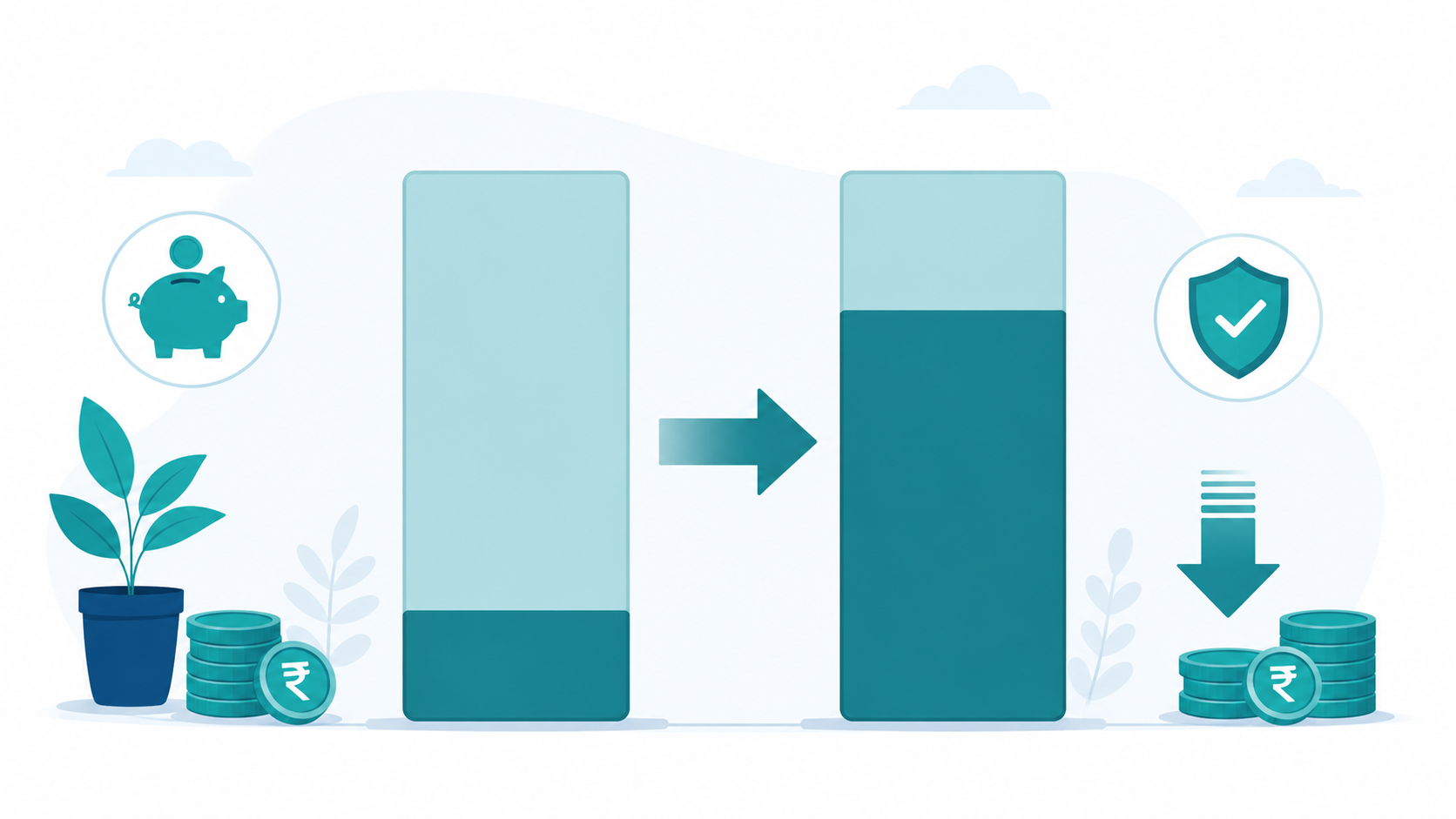
The Restructuring Math on a ₹30,000 CTC
Here is the same employee, same cost to company, before and after. HRA taken at 40% of basic (non-metro), employer PF at 12%, gratuity provision at 4.81% of basic, professional tax at ₹200.
| Component (monthly) | Old structure (30% basic) | New structure (50% basic) | Change |
|---|---|---|---|
| Basic pay | ₹9,000 | ₹15,000 | +₹6,000 |
| HRA | ₹3,600 | ₹6,000 | +₹2,400 |
| Special allowance | ₹15,887 | ₹6,478 | −₹9,409 |
| Employer PF (12%) | ₹1,080 | ₹1,800 | +₹720 |
| Gratuity provision (4.81%) | ₹433 | ₹722 | +₹289 |
| Total CTC | ₹30,000 | ₹30,000 | — |
| Gross salary (payslip) | ₹28,487 | ₹27,478 | −₹1,009 |
| Employee PF deduction | ₹1,080 | ₹1,800 | +₹720 |
| Professional tax | ₹200 | ₹200 | — |
| In-hand salary | ₹27,207 | ₹25,478 | −₹1,729 |
Nothing was taken away. The employee’s retirement corpus grew by ₹1,440 a month (both PF shares) and his gratuity entitlement grew too. But the number in his bank account went down 6.4%, and if you don’t explain that in advance you will spend a week fielding grievances. Run the numbers for your own bands on the CTC salary calculator before you touch the payroll master.
Everything That Moves When Basic Moves
Basic pay is the base for five separate statutory calculations. Raising it does not affect them equally, and this is where HR teams get caught out.
| Statutory head | Base used | Effect of higher basic |
|---|---|---|
| Provident fund | Basic + DA, capped at ₹15,000 wage ceiling | Rises until basic hits ₹15,000, then flat if you apply the ceiling |
| Gratuity | Last drawn basic + DA | Rises proportionally — biggest long-term cost |
| Leave encashment | Basic + DA | Rises proportionally |
| Overtime | Ordinary rate of wages | Rises proportionally, at twice the rate |
| Statutory bonus | Basic + DA, capped at ₹7,000 or minimum wage, whichever is higher | Usually no change — the cap bites first |
| ESI | Gross wages up to ₹21,000 | No change if gross is unchanged |
The gratuity line is the one people underestimate. In the example above, a five-year employee’s gratuity goes from ₹25,962 to ₹43,269 — 15/26 × last basic × years of service, applied to a basic that is now 67% higher. Multiply that across a 60-person workforce and check whether your provision on the balance sheet still holds. Our gratuity calculator will give you the per-employee number in about ten seconds.
The PF wage ceiling is worth a note. It has stayed at ₹15,000 a month since 2014. Proposals to raise it to ₹21,000 and then ₹25,000 have been circulating, and in January 2026 the Supreme Court directed the Centre and EPFO to decide on a revision within four months. As of now the ceiling is still ₹15,000, so if you cap PF at the ceiling, the increase in basic stops costing you once basic crosses that line. If the ceiling moves, it will not stop. Model both scenarios with the PF & ESI calculator.
Three Ways to Restructure — and What Each Costs
- Hold CTC constant. Simplest. Employer cost unchanged, take-home falls by 5–8% for most bands. Works only if you communicate it properly and, ideally, only at the annual increment cycle so the raise absorbs the dip.
- Hold take-home constant, raise CTC. Cleanest for employee relations, most expensive for you — roughly ₹12,000 per employee per year on a ₹30,000 CTC in our example, before gratuity catch-up. Sensible for critical roles and anyone earning under ₹25,000 a month where the cash matters most.
- Phase it over two cycles. Move basic to 40% now, 50% at the next increment, and let the increment cover the gap. Legally you are exposed in the interim, so document the timeline and get it signed off. Most SMEs I speak to are choosing this, with mixed comfort.
Whichever route you take, do the calculation employee-by-employee, not on an average. The impact is very different at ₹18,000 CTC than at ₹1,50,000 CTC, because the PF ceiling and the tax slabs behave differently at each end.
What happens to income tax
Under the new regime for FY 2026-27, the slabs are unchanged: nil up to ₹4 lakh, 5% to ₹8 lakh, 10% to ₹12 lakh, 15% to ₹16 lakh, 20% to ₹20 lakh, 25% to ₹24 lakh, and 30% above that. With the ₹75,000 standard deduction and the ₹60,000 rebate under Section 87A, income up to ₹12.75 lakh remains effectively tax-free. Restructuring moves money from taxable special allowance into PF, which reduces taxable income slightly for employees on the old regime and does almost nothing for those on the new regime, since HRA exemption isn’t available there anyway. Don’t sell restructuring as a tax benefit to new-regime employees. It isn’t one.
What HR Managers Get Wrong
- Restructuring only new joiners. Fixing offer letters while leaving 80 existing employees on 30% basic gives you two structures, two liabilities, and one very awkward conversation when somebody compares payslips.
- Forgetting the gratuity provision. The monthly cost is visible; the balance sheet liability is not. If you provision at 4.81% of basic, that number just went up 67% and nobody told finance.
- Assuming bonus goes up too. It usually doesn’t. Statutory bonus is calculated on basic + DA subject to the ₹7,000 or minimum wage ceiling, so most employees see no change. Verify with the bonus calculator rather than budgeting for an increase that never comes.
- Not recalculating notice period recovery. If your appointment letter says recovery is on “gross salary” and you’ve now changed what gross means, your F&F numbers shift. Check the wording, then check the math on the notice period recovery calculator.
- Announcing it in the payslip. Send a one-page explainer a full cycle before the change lands, with the before/after breakup for that specific employee. This costs you an afternoon and saves a month of grievances.
Your Pre-Payroll Checklist
- Export your current salary master and calculate basic as a percentage of CTC for every employee.
- Flag everyone below 50% — that’s your restructuring list.
- Run each flagged employee through a CTC calculator at 50% basic and record the take-home delta.
- Recompute gratuity provision at the new basic and share the revised figure with finance.
- Decide your route: hold CTC, hold take-home, or phase it. Document the decision.
- Issue revised salary annexures and get acknowledgements on file.
- Update the payroll system before the cut-off, not on the 30th.
Frequently Asked Questions
Is the 50% wage rule mandatory in 2026?
Yes. The Code on Wages definition of wages is in force following the central notification of 21 November 2025 and the final central rules of 8 May 2026. State rules are being notified separately, so check your state’s position, but the definition itself applies. Structures with basic below 50% risk reassessment and arrears.
Will my employees’ take-home salary reduce?
If you keep CTC constant, yes — typically by 5–8%. Higher basic means a higher employee PF deduction. In our ₹30,000 CTC example the drop is ₹1,729 a month. The money isn’t lost; it moves into the employee’s EPF corpus and increases their eventual gratuity, but it stops being spendable cash.
Does the ₹15,000 PF ceiling still apply?
Yes. The EPF wage ceiling remains ₹15,000 per month as of August 2026. Employers may restrict PF contributions to ₹1,800 per month even when basic exceeds ₹15,000, subject to their own policy. Proposals to raise the ceiling to ₹21,000 or ₹25,000 are pending, with the Supreme Court having directed a decision in January 2026.
Does raising basic increase our statutory bonus liability?
Usually not. Statutory bonus under the Payment of Bonus Act is computed on basic + DA capped at ₹7,000 per month or the applicable minimum wage, whichever is higher. Since most employees already earn basic above that cap, the bonus payable stays the same. Eligibility is still limited to those earning up to ₹21,000 a month.
How much extra will this cost the employer?
If you hold CTC constant, nothing changes in cash terms — the composition shifts. If you protect take-home by raising CTC, budget roughly ₹1,000 per employee per month on a ₹30,000 CTC, plus a one-time increase in your gratuity provision of around 60–70%.
Do I need to revise existing appointment letters?
You should issue a revised salary annexure rather than a fresh appointment letter, and take written acknowledgement. Since total CTC is often unchanged, this is a restatement of components rather than a variation of contract — but keeping the acknowledgement on file protects you if someone later claims a unilateral pay cut.
Get the Numbers Before the Payslip Does
Restructuring is not hard; doing it for 80 people in a spreadsheet three days before payroll is. Run your bands through the free CTC salary calculator and the rest of our free HR calculators to see exactly where each employee lands, and if you’d rather have your payroll software apply the new wage definition and flag non-compliant structures automatically, that’s what EZHRM does. More guides on wage code compliance are on the EZHRM blog.
Official references: the labour codes and rules are published by the Ministry of Labour & Employment, and PF wage ceiling notifications by EPFO.