
An employee walks into your cabin, hands in a resignation letter, and asks one question before anything else: “Kitna leave encashment milega?” You pull up the leave balance, do some quick mental maths on basic salary, and quote a number — only to have Finance flag it during the F&F run because you calculated the tax exemption wrong. This happens in HR teams across India every single week, and it usually comes down to one confusion: treating leave encashment during service the same as leave encashment at exit. They are not the same thing, and the Income Tax Act treats them very differently.
This guide walks through the leave encashment formula, the ₹25 lakh tax exemption rule under Section 10(10AA), and the mistakes that get HR managers into trouble — with a free leave encashment calculator you can use right away.
TL;DR
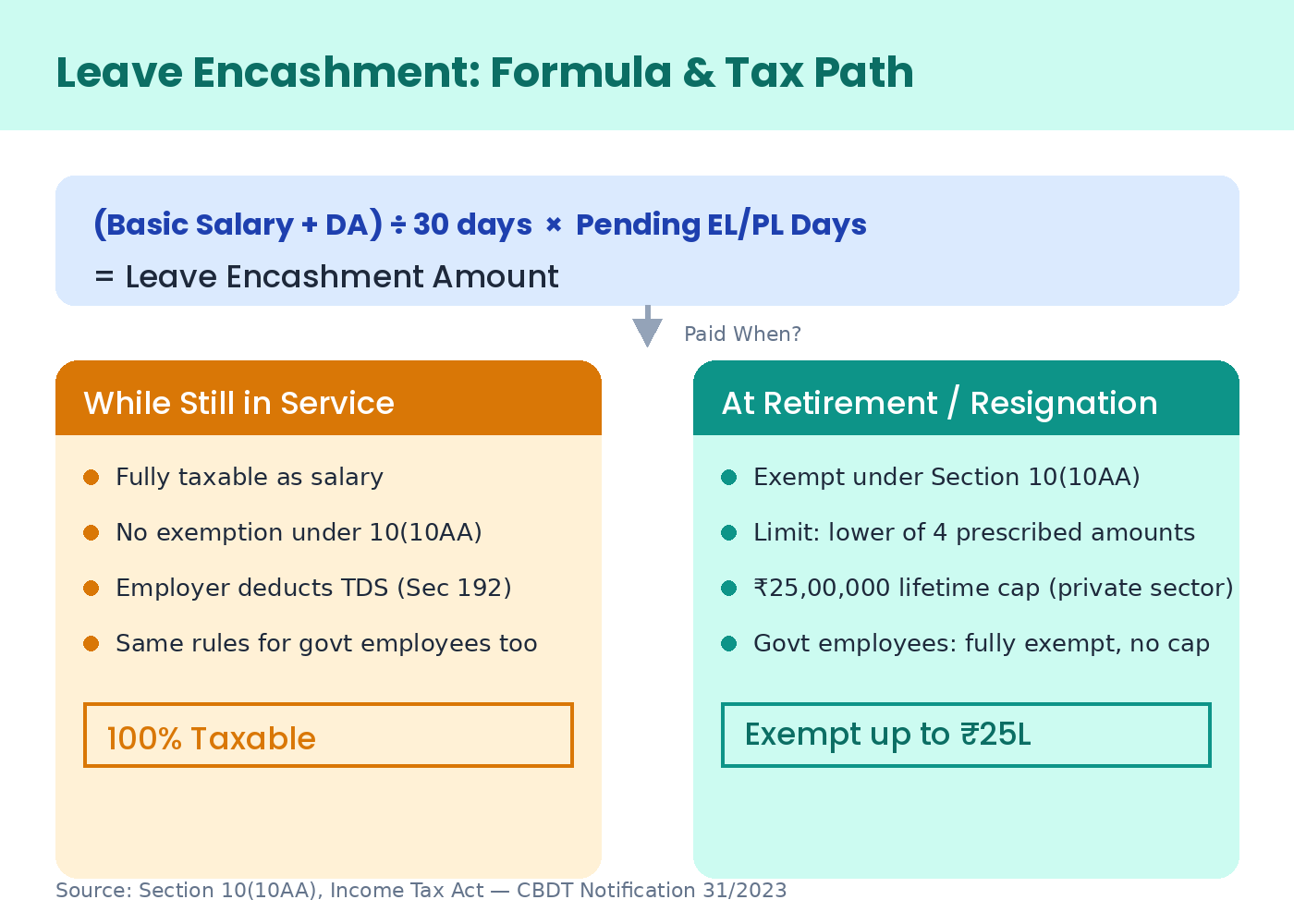
- Leave encashment = (Basic Salary + DA ÷ 26 or 30 days) × number of pending earned/privilege leave days. Casual and sick leave usually can’t be encashed.
- Leave encashed while still employed is fully taxable as salary — no exemption applies, no matter the amount.
- Leave encashed at retirement, resignation, or death is exempt up to ₹25,00,000 (lifetime limit) for private-sector employees under Section 10(10AA), following CBDT Notification 31/2023.
- Government employees get full exemption on leave encashment at retirement — no ceiling applies to them.
What Is Leave Encashment?
Leave encashment is the cash payment an employee receives for earned leave (EL) or privilege leave (PL) that they’ve accumulated but not used. Instead of letting leave days lapse or carry forward indefinitely, most Indian employers let staff convert unused EL/PL into money — either once a year, at resignation, at retirement, or as part of a full and final settlement.
It shows up in three common scenarios for an HR manager: an annual encashment window while the employee is still working, a one-time payout when someone resigns or retires, and as a line item inside the full and final settlement after the last working day.
The Leave Encashment Formula HR Teams Actually Use
The standard formula is straightforward:
Leave Encashment Amount = (Basic Salary + DA) ÷ Days in a Month × Number of Pending EL/PL Days
Two things trip people up here. First, the divisor — some companies use 30 (calendar days), others use 26 (working days in a 6-day week). Both conventions exist in Indian payroll; what matters is that you apply the same divisor consistently across the company and mention it in your leave policy. Second, the base — encashment is calculated on Basic + DA only, never on gross salary or CTC. HRA, special allowance, and other components don’t enter the calculation.
A quick example: an employee with a basic salary of ₹40,000 and 18 pending earned leave days, using a 30-day divisor, gets (₹40,000 ÷ 30) × 18 = ₹24,000. Change the divisor to 26 and the same leaves are worth ₹27,692 instead — which is exactly why the divisor needs to be documented, not decided case by case.
In-Service Encashment vs Encashment at Exit — Why the Difference Matters
This is the distinction that catches most HR managers out. The amount can be calculated the same way in both cases, but the tax treatment is completely different.
| Aspect | Encashment While in Service | Encashment at Retirement/Resignation |
|---|---|---|
| Tax treatment | Fully taxable as “Income from Salary” | Exempt up to prescribed limits under Sec 10(10AA) |
| Exemption ceiling | None — 100% taxable | ₹25,00,000 lifetime limit (private sector) |
| Who typically avails it | Employees under annual encashment policies | Employees resigning, retiring, or exiting via F&F |
| TDS obligation | Employer deducts TDS under Section 192 like regular salary | Employer deducts TDS only on the amount exceeding the exempt limit |
| Government employees | Taxable if encashed in service | Fully exempt, no ceiling |
In plain terms: if your company allows employees to encash a portion of earned leave every year while they’re still on the rolls, that money is added to salary and taxed at the employee’s slab rate — full stop. It only becomes eligible for exemption when it’s paid out because the employment relationship is ending.
Tax on Leave Encashment: Section 10(10AA) and the ₹25 Lakh Rule
For non-government (private-sector) employees, leave encashment received on retirement or resignation is exempt up to the least of these four amounts:
- The actual leave encashment amount received
- ₹25,00,000 (raised from ₹3,00,000 vide CBDT Notification No. 31/2023, effective retrospectively from 1 April 2023)
- 10 months’ average salary (Basic + DA) drawn in the last 10 months before retirement/resignation
- Cash equivalent of leave standing to the employee’s credit, calculated on 10 months’ average salary, subject to a maximum of 30 days of leave for every completed year of service
The ₹25 lakh ceiling is a lifetime aggregate — it applies across every employer an individual has worked for, not per job. If someone already claimed ₹8 lakh of exemption at their first company, only ₹17 lakh of headroom is left for the rest of their career. Central and state government employees don’t have this ceiling at all — their leave encashment on retirement is fully exempt, per the Income Tax Department (incometax.gov.in).
This is also the exact calculation your payroll team needs to get right before processing a gratuity payout and F&F together — both have separate exemption rules and it’s easy to mix them up when they land in the same settlement cycle.
Which Leaves Can Actually Be Encashed?
Not every leave type is encashable, and this is a policy detail that gets glossed over in offer letters more often than it should.
- Earned Leave / Privilege Leave (EL/PL): Encashable. This is the leave category the entire formula above applies to.
- Casual Leave (CL): Not encashable in almost all Indian companies. CL typically lapses at year-end and is meant for short, unplanned absences.
- Sick Leave (SL): Generally not encashable either, though a few employers carry forward and encash it as a goodwill gesture — check your Standing Orders or company leave policy before assuming.
Under the Factories Act, 1948, workers earn one day of leave for every 20 days worked (roughly 15 days a year), while state Shops and Establishments Acts typically grant 15–21 days of EL annually to clerical and commercial staff, per the Ministry of Labour and Employment (labour.gov.in).
State-wise Earned Leave Accumulation Caps
How much EL an employee can bank before it either lapses or must be encashed depends on the state your establishment is registered in:
| State | Maximum EL Accumulation |
|---|---|
| Maharashtra, Karnataka, Delhi | 30 days |
| West Bengal | 42 days |
| Uttarakhand | 45 days |
| Haryana (Shops & Commercial Establishments) | 45 days (varies by category) |
If your company operates across multiple states — common for retail, logistics, and manufacturing businesses — this is exactly the kind of detail that’s easy to get wrong in a single, one-size-fits-all leave policy. It’s worth checking this against your leave management configuration rather than assuming one cap applies everywhere.
What HR Managers Get Wrong
- Applying the ₹25 lakh exemption to in-service encashment. It only applies at retirement, resignation, or death — never while the employee continues working.
- Calculating on gross salary instead of Basic + DA. This inflates both the encashment amount and the TDS liability, and it’s a common audit flag.
- Forgetting the lifetime ₹25 lakh cap is cumulative across employers. A mid-career hire who already used part of their exemption at a previous company won’t get a fresh ₹25 lakh at your company.
- Mixing up leave encashment with gratuity exemption rules. They’re both under different sub-sections of Section 10, with different formulas and different ceilings — don’t apply gratuity logic to leave encashment or vice versa.
- Not documenting the divisor (26 vs 30 days) in the leave policy. This creates inconsistent payouts and disputes at exit, especially when different HR executives process different employees.
Frequently Asked Questions
Is leave encashment received during employment taxable?
Yes. Leave encashment received while an employee is still working is fully added to salary income and taxed at their applicable slab rate. Section 10(10AA) exemption applies only at retirement, resignation, or death, not during active service.
What is the maximum tax-free leave encashment for private-sector employees in 2026?
₹25,00,000, as a lifetime aggregate across all employers, per CBDT Notification 31/2023 effective from 1 April 2023. The actual exempt amount is the lowest of four calculated limits, not a flat ₹25 lakh for everyone.
Can casual leave or sick leave be encashed?
Generally no. Only earned leave (EL) or privilege leave (PL) is encashable under most Indian company policies. Casual and sick leave typically lapse at the end of the leave year unless your Standing Orders specifically state otherwise.
Do government employees have a leave encashment exemption limit?
No. Central and state government employees get full tax exemption on leave encashment received at retirement, with no ₹25 lakh ceiling. The limit applies only to non-government (private-sector) employees.
How is leave encashment shown in Full and Final settlement?
It’s listed as a separate line item alongside notice pay, gratuity, and any bonus dues. Since it’s paid at the time of exit, it typically qualifies for the Section 10(10AA) exemption rather than being fully taxable.
Which divisor should I use — 26 or 30 days?
Both are used across Indian payroll practice. 30 treats it as calendar days; 26 assumes a 6-day working week. Pick one, write it into your leave policy, and apply it consistently to avoid disputes at the time of separation.
Get the Number Right, Every Time
Manually tracking basic salary changes, leave balances, state-wise EL caps, and the lifetime ₹25 lakh exemption across dozens or hundreds of employees is where most encashment errors creep in. EZHRM’s payroll engine tracks leave balances and encashment eligibility automatically, so your HR team isn’t reconciling this by hand every time someone resigns. Try the free leave encashment calculator for your next exit calculation, and browse the rest of our free HR calculators for gratuity, F&F, and notice period recovery. For more guides like this one, visit the EZHRM blog.