
Your HR executive just spent three evenings before the 7th of the month reconciling attendance data from three different registers, cross-checking it against a shared Excel sheet, and then manually keying salary figures into a TDS calculator. At least two employees got incorrect in-hand amounts. One noticed. Guess who had to explain it to the MD next morning?
If this sounds like your last payroll cycle, you already know the cost — you just haven’t put a number to it yet. That’s exactly what the EZHRM Payroll ROI Calculator does. It takes your actual payroll situation and shows you, in rupees, what manual payroll is costing your business every month. This guide walks you through the methodology so you can walk into your CFO’s cabin with a real number, not a pitch.
TL;DR — Key Takeaways
- Payroll automation ROI for Indian SMEs typically ranges from 3x to 8x the software cost annually.
- Manual payroll for 50 employees costs ₹6,000–₹10,000/month in HR time alone — before counting errors and compliance penalties.
- The free EZHRM Payroll ROI Calculator calculates your exact savings based on your employee count, error rate, and HR salary.
- Most SMEs break even on payroll software within 3–6 months of switching.
What Is Payroll Automation ROI?
Payroll automation ROI (Return on Investment) is the financial gain your business earns by replacing manual or semi-manual payroll processes with software — expressed as a ratio of savings to software cost. It is calculated by adding up all the hidden costs of your current process (HR time, error correction, compliance query handling) and comparing them to what you’d pay for a payroll software subscription.
The formula is:
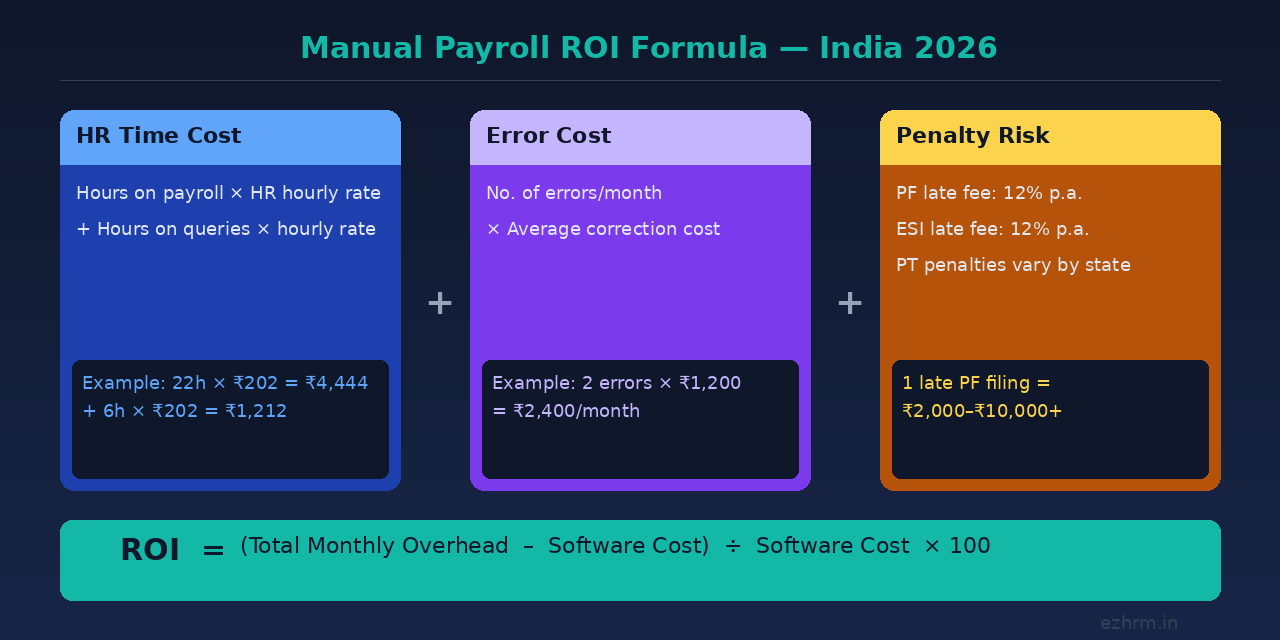
ROI (%) = [(Total Annual Savings – Annual Software Cost) ÷ Annual Software Cost] × 100
For most Indian SMEs with 20–200 employees, this number lands between 300% and 700%, with a payback period of under six months. The real question isn’t whether payroll software pays for itself — it almost always does. The question is how fast.
The True Cost of Manual Payroll in India: Breaking It Down
When HR managers think about payroll costs, they think about the software subscription fee they’re avoiding. What they rarely calculate is the sum of everything else they’re paying for the manual alternative.
1. HR Executive Time Cost
In Indian SMEs, a mid-level HR executive earns between ₹25,000 and ₹50,000 per month (CTC ₹3.5–₹7 lakh annually). If payroll processing — including attendance compilation, salary calculation, payslip generation, and TDS working — takes 15–20 hours per month, you’re burning roughly:
| Employee Count | Avg Hours/Month | HR Cost/Hour (₹35K salary) | Monthly Time Cost |
|---|---|---|---|
| 10–25 employees | 8–12 hours | ₹202 | ₹1,616–₹2,424 |
| 25–50 employees | 15–20 hours | ₹202 | ₹3,030–₹4,040 |
| 50–100 employees | 25–35 hours | ₹202 | ₹5,050–₹7,070 |
| 100–200 employees | 45–60 hours | ₹202 | ₹9,090–₹12,120 |
That’s just processing time. Add another 5–8 hours for compliance queries — employees asking about PF deductions, PT slabs, or TDS — and the number climbs significantly.
2. Payroll Error Correction Cost
Manual payroll produces errors in 1–3% of pay transactions. For a company of 50 employees, that’s 0.5–1.5 errors per cycle. Each error requires investigation and verification (1–2 hours of HR time), a corrective salary disbursement, employee communication, manager escalation, and potentially TDS re-filing if the error affects taxable income. A conservative estimate puts the cost of each payroll error at ₹800–₹2,000, including HR time and rework. At two errors per month for a 50-person team, that’s ₹1,600–₹4,000/month in error costs alone.
3. Compliance Penalty Risk
This is the one that’s hardest to quantify but most painful. Late or incorrect PF filings attract interest at 12% per annum under EPFO rules, plus damages under Section 14B of the EPF Act — which can reach 100% of the arrear amount for delays over a year. ESI late filing attracts 12% simple interest from the ESIC. Professional Tax filing deadlines vary by state, but Karnataka charges ₹500/month for late returns and Maharashtra can penalise up to ₹5,000. Most small businesses don’t get hit every month — but when they do, one penalty can wipe out 3–4 months of “savings” from not paying for software.
How to Use the Payroll ROI Calculator
The EZHRM Payroll ROI Calculator is free and takes under two minutes to complete. Here’s what it asks and why each input matters.
Inputs You’ll Need
- Number of employees: The calculator uses this to estimate EZHRM’s subscription cost on your behalf.
- Hours spent on payroll per month: Be honest here. Include attendance compilation, salary working, payslip generation, and statutory filing time — not just the final calculation step.
- HR executive monthly salary (₹): Used to calculate the cost per hour of your HR team’s time.
- Payroll errors per month (est.): If you’re not sure, start with 1–2 for a 20–50 person team and scale up.
- Average cost per payroll error (₹): ₹1,000–₹1,500 is a reasonable baseline for most SMEs.
- Hours spent on compliance queries/month: Count every time an employee asks about their payslip, PF balance, or tax deduction.
The calculator then outputs: your total monthly payroll overhead, what EZHRM would cost in comparison, your monthly and annual savings, and the payback period in months. You can also use the other free HR calculators on EZHRM to get accurate inputs — for instance, the PF & ESI Calculator will help you verify current statutory deduction accuracy, and the CTC Salary Calculator can help you benchmark your HR executive’s actual cost per hour.
A Worked Example: 50-Employee Manufacturing Company, Haryana
Let’s put real numbers to this. Consider a manufacturing unit in Bahadurgarh with 50 workers — mix of contract and full-time — using Excel and a CA for payroll. The HR manager earns ₹35,000/month.
- Payroll hours/month: 22 hours (attendance from biometric + salary working + CTC calculations + PF/ESI working + payslips)
- Compliance query hours/month: 6 hours
- Estimated errors/month: 2
- Error cost per incident: ₹1,200
Monthly cost calculation: HR time on payroll: 22 hrs × ₹202/hr = ₹4,444. HR time on compliance queries: 6 hrs × ₹202/hr = ₹1,212. Error correction: 2 × ₹1,200 = ₹2,400. Total monthly overhead: ₹8,056.
An EZHRM subscription for 50 employees runs approximately ₹2,500–₹3,500/month. Even in the worst case, the business saves over ₹4,500/month — that’s ₹54,000+ annually. The ROI breaks even in under 4 months. Use the Payroll ROI Calculator to run the same calculation with your own numbers.
What HR Managers Get Wrong When Evaluating Payroll Software
Mistake 1: Comparing software cost to zero
Manual payroll is not free. The HR executive’s time has a cost. Errors have a cost. Late-night payroll runs before the 7th of the month have a cost (in morale, if nothing else). The ROI calculation only makes sense when you compare software cost to your total current cost — not to ₹0.
Mistake 2: Not counting compliance query time
When employees ask HR about their PF deductions, TDS, or leave balance, that time is a payroll cost. With a proper compliance management system, employees can access their own payslips, Form 16, and statutory deduction details via a self-service portal — eliminating most of these queries.
Mistake 3: Underestimating payroll errors
Most HR managers say “we rarely make errors” — and then you ask when they last checked whether the bonus payments were correctly calculated under the Payment of Bonus Act 1965, or whether the overtime amounts matched Factories Act rates. The errors exist; they’re just not always visible until they become a grievance.
Mistake 4: Forgetting the opportunity cost
Every hour your HR executive spends on payroll processing is an hour not spent on hiring, onboarding, employee engagement, or performance management. For a growing business, this opportunity cost is often larger than the direct cost savings.
What Changes After Switching to Payroll Software
Based on feedback from EZHRM customers across manufacturing, retail, and services SMEs in Haryana and Delhi NCR, here’s what typically changes within the first three months:
| Area | Before (Manual) | After (EZHRM) |
|---|---|---|
| Payroll processing time | 15–30 hrs/month | 3–5 hrs/month |
| Payslip distribution | 2–3 days after salary | Same day (WhatsApp) |
| PF/ESI filing | Manual, prone to delay | Auto-calculated, deadline alerts |
| Employee salary queries | 5–8 hrs/month | Near zero (self-service) |
| Payroll errors | 1–3/month | Near zero |
| Compliance penalty risk | Moderate to high | Minimal |
The 80% time reduction figure reflects the actual change when you go from manual attendance-to-payslip workflows to an integrated system. For more context on what that looks like in practice, see more HR guides on the EZHRM blog.
Frequently Asked Questions About Payroll ROI
Is payroll software ROI relevant for very small teams (10–20 employees)?
Yes — in fact, the ROI is often higher for small teams because the business is run by a founder or office manager who is doing payroll themselves. That person’s time is the most expensive time in the company, even if they don’t put a cost to it. A 10-person business where the founder spends 8 hours on payroll every month is losing significant productive time that could go toward sales or operations. Use the Payroll ROI Calculator with the founder’s effective hourly rate — the numbers often surprise people.
What’s the typical payback period for payroll software in India?
For most Indian SMEs, the payback period — the point at which cumulative savings exceed the total software cost paid — is 3 to 6 months. Companies with frequent compliance issues or high error rates tend to see payback within the first 2–3 months. The EZHRM ROI calculator estimates this automatically based on your inputs.
Does the ROI include savings on statutory compliance?
The calculator focuses on HR time and error costs. Compliance penalty savings are harder to calculate precisely but add significantly to the ROI. If your team has had even one late PF filing in the past year, the penalty cost alone may exceed a full month’s software subscription. EPFO charges interest at 12% p.a. plus Section 14B damages for delays.
How do I estimate payroll errors if I don’t track them?
Start with 1–2 errors per month for a 20–50 person team. Check your last 3 months of payslips for common issues: wrong loss-of-pay deductions, missed arrear adjustments, incorrect HRA for employees who moved cities, bonus paid to ineligible employees. If you find any of these, you’re in the 2+ errors/month bucket. The CTC Salary Calculator can help you verify salary components manually to spot discrepancies.
What if my finance team argues payroll software is too expensive?
Run the Payroll ROI Calculator with them in the room. The number it produces — your current monthly payroll overhead vs. the software subscription cost — is usually the argument-ender. The comparison is hard to dispute when it’s based on your own data. You can also point out that the free HR calculators on EZHRM are available at no cost as a starting point before you commit to anything.
Is the ROI different for manufacturing vs. services companies?
Manufacturing companies typically see higher ROI because of the complexity added by contract workers, shift-based attendance, overtime compliance under the Factories Act, and ESI applicability for all employees earning under ₹21,000/month. The more moving parts in your payroll, the more value software adds. Services companies with simpler, fixed-salary structures still see strong ROI — just driven more by time savings than error reduction.
Making the Case to Your Finance Team
If you’re the HR manager and need to justify payroll software to your CFO or MD, the structure is simple: show the current cost, show the alternative cost, and show the payback period. The EZHRM Payroll ROI Calculator generates all three in under two minutes. You don’t need to build a 10-slide deck. A one-page printout of the calculator output, with your actual inputs filled in, is typically enough. Finance teams understand ROI language — what they resist is vague promises of “efficiency gains.”
Pair the ROI calculator output with a quick check using the PF & ESI Calculator to show how much compliance risk your current process carries, and the conversation usually moves fast. If your business is growing and you want to see how payroll software fits into a broader HR system — attendance, leave, compliance, payslips — take a look at EZHRM’s payroll management features. The trial is free for 14 days, no credit card required.