
Overtime Calculator India 2026: Factories Act Double Pay Guide
Your production supervisor calls at 6 PM — the order needs three more hours to ship on time. You approve the overtime without hesitation. But when payroll week arrives, does your team know exactly what those three hours cost? Most HR managers in Indian SMEs are still dividing salary by 30, using gross pay instead of the correct wage base, and ignoring a landmark Supreme Court judgment from January 2026 that changed what “ordinary rate of wages” means. This guide sets the record straight.
- Under Section 59 of the Factories Act, 1948, overtime must be paid at 2× the ordinary rate of wages — no exceptions.
- A January 2026 Supreme Court ruling held that “ordinary rate” includes basic wages plus ALL allowances (not just basic+DA) — barring only bonus and OT wages.
- Workers cannot legally work more than 50 hours of overtime per quarter (Section 64) without a state government exemption.
- Use EZHRM’s free overtime calculator to get the exact OT amount in under 10 seconds.
What Is Overtime Under Indian Labour Law?
Overtime (OT) is any work performed beyond the normal daily or weekly hours prescribed under the applicable labour statute. In India, overtime is governed by two primary frameworks:
- Factories Act, 1948 — applies to all registered factories and manufacturing units employing 10 or more workers with power, or 20 or more without power.
- Shops & Commercial Establishments Acts — state-specific legislation covering offices, retail stores, hospitals, hotels, restaurants, and service businesses not covered by the Factories Act.
The Factories Act sets a firm 2× rate for OT. Shops Acts vary — most states prescribe 1.5× to 2×. Knowing which law applies to your establishment is the first step to getting overtime right.
Normal Working Hours Under the Factories Act
- Daily limit: 9 hours per day (Section 54)
- Weekly limit: 48 hours per week (Section 51)
- Spread over: Total working period — including intervals and overtime — cannot exceed 10½ hours in a day (Section 56)
Any work beyond 9 hours/day or 48 hours/week is legally overtime and must be compensated at double rate.
Section 59 Factories Act: The Double Wages Rule
Section 59 of the Factories Act, 1948 is the governing provision. It says:
“Where a worker works in a factory for more than nine hours in any day or for more than forty-eight hours in any week, he shall, in respect of such overtime work, be entitled to wages at the rate of twice his ordinary rate of wages.”
There is no discretion here. No “can the employer offer comp-off instead?” No “what if it’s just 30 minutes extra?” Once the threshold is crossed, 2× kicks in — full stop.
The January 2026 Supreme Court Update: All Allowances Count
This is the most important overtime ruling in years. On January 19, 2026, the Supreme Court of India delivered its judgment in Union of India & Others v. Heavy Vehicles Factory Employees’ Union & Another, settling a long-running debate about what “ordinary rate of wages” actually means.
The Court held: the ordinary rate of wages includes basic wages plus all allowances to which the worker is entitled — the only exclusions are bonus and overtime wages themselves.
In plain HR language: HRA, special allowance, conveyance allowance, and similar components that are part of the worker’s regular entitlement must be included in the OT calculation base — not just basic+DA as many payroll teams have been doing. If your payroll software hasn’t been updated to reflect this ruling, you may be underpaying OT.
What Goes Into the OT Base Now?
| Wage Component | Included in OT Base? | Remarks |
|---|---|---|
| Basic Salary | ✅ Yes | Always included |
| Dearness Allowance (DA) | ✅ Yes | Always included |
| House Rent Allowance (HRA) | ✅ Yes (post-SC 2026) | Included per Jan 2026 SC ruling if part of regular entitlement |
| Special Allowance | ✅ Yes (post-SC 2026) | Included if part of regular entitlement |
| Conveyance Allowance | ✅ Yes (post-SC 2026) | Included if part of regular entitlement |
| Statutory Bonus | ❌ No | Explicitly excluded by Section 59 |
| Overtime Wages (previous) | ❌ No | Explicitly excluded by Section 59 |
Practical note: For SMEs where employees receive a single “Basic + DA” component without separate named allowances, the impact is minimal. For establishments with itemised salary structures — manufacturing plants, hospitals, large factories — this ruling significantly increases the OT base. Use EZHRM’s free overtime calculator to compute correctly with your actual salary structure.
How to Calculate Overtime Pay in India — Formula & Example
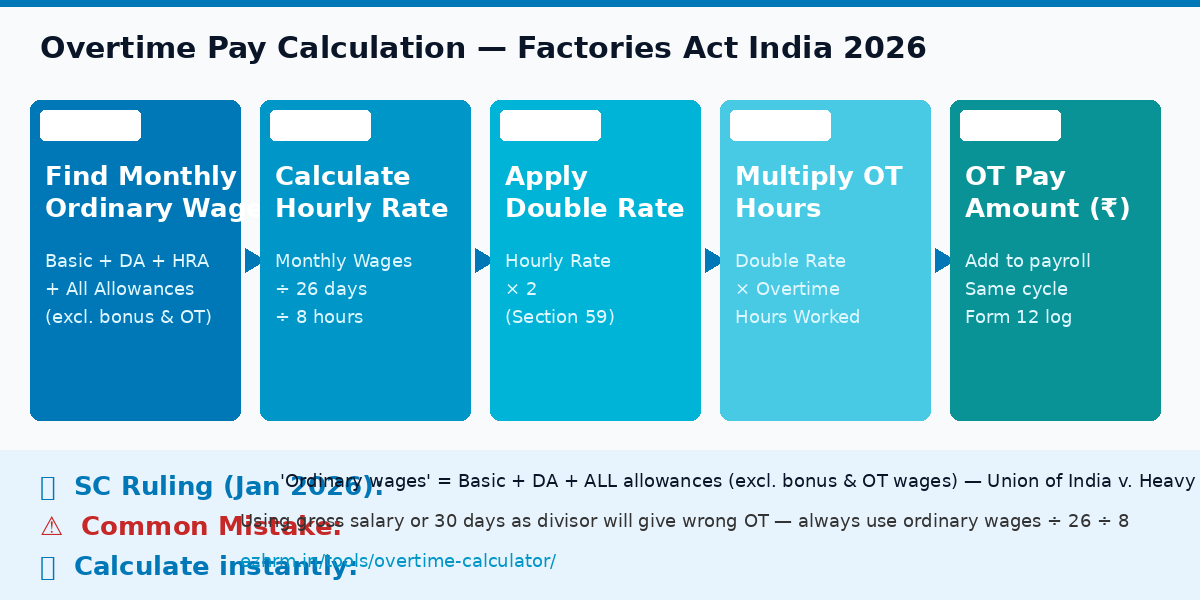
The standard overtime formula for monthly-rated workers is:
OT Amount = (Monthly Ordinary Wages ÷ 26 ÷ 8) × 2 × OT Hours
Why 26? The Factories Act uses 26 working days per month as the standard (deducting 4 weekly rest days). Why 8? Because 8 hours is the standard workday. Using 30 or gross salary in this formula — two common mistakes — will give you a wrong figure every time.
Worked Example
Ramesh works at a garment factory in Faridabad. His monthly salary structure:
- Basic: ₹15,000
- DA: ₹2,000
- HRA: ₹4,000
- Special Allowance: ₹3,000
- Total “ordinary wages” (post-SC 2026): ₹24,000/month
He works 14 hours of overtime in October.
Step 1 — Hourly ordinary rate:
₹24,000 ÷ 26 ÷ 8 = ₹24,000 ÷ 208 = ₹115.38 per hour
Step 2 — Apply double rate:
₹115.38 × 2 = ₹230.77 per OT hour
Step 3 — Total OT pay:
₹230.77 × 14 = ₹3,230.77 ≈ ₹3,231
Before the SC ruling, if you’d only used Basic+DA (₹17,000), the hourly rate would have been ₹81.73 — and Ramesh would have received ₹2,288 instead of ₹3,231. That’s a ₹943 underpayment per worker per month — and a labour law liability.
Don’t want to run this math manually? EZHRM’s overtime calculator handles the entire calculation — just enter the wage components and OT hours.
Shops & Establishments Act: State-Wise OT Rules
If your establishment is an office, retail outlet, restaurant, or service business, the Factories Act doesn’t apply. You’re under your state’s Shops & Commercial Establishments Act. Here’s how major states compare:
| State | Normal Hours/Day | OT Rate | Max OT |
|---|---|---|---|
| Maharashtra | 9 hours | 2× ordinary rate | 125 hrs/year |
| Delhi | 9 hours | 1.5× ordinary rate | Not specified |
| Karnataka | 10 hours | 2× ordinary rate | Not specified |
| Tamil Nadu | 9 hours | 2× ordinary rate | Employer discretion |
| Haryana | 9 hours | 2× ordinary rate | Not specified |
| Gujarat | 9 hours | 1.5× ordinary rate | Not specified |
| Uttar Pradesh | 9 hours | 2× ordinary rate | Not specified |
Important: The four Labour Codes — including the Occupational Safety, Health and Working Conditions Code, 2020 — would consolidate these rules nationally, but as of June 2026, most states have not yet notified the Codes. The Factories Act 1948 and individual Shops Acts continue to apply.
Quarterly OT Limits and the Section 64 Cap
Under Section 64 of the Factories Act, 1948, a factory worker cannot work overtime exceeding 50 hours in a quarter (January–March, April–June, July–September, October–December) without special exemption from the state government. With a state exemption, the cap can extend to 75 hours per quarter. Some states — Maharashtra and Telangana notably — have amended their rules to allow up to 144 hours per quarter for specific industries.
What this means in practice:
- On average, a factory worker can do roughly 4 OT hours per week before hitting the quarterly cap
- Running your factory on sustained heavy OT without state approval is a compliance violation
- Your attendance management system should flag when a worker approaches their OT cap
OT Compliance Checklist for Factory HR Managers
- Confirm which law applies — Factories Act or state Shops Act
- Verify your salary structure is updated to reflect the January 2026 SC ruling
- Ensure all OT hours are pre-approved and logged digitally
- Track cumulative OT per worker per quarter against the 50-hour cap
- Maintain Form 12 (overtime muster roll) — mandatory under Factories Act
- Pay OT in the same payroll cycle — not the following month
- Obtain state government exemption if your operations regularly exceed 50 hours/quarter
What HR Managers Get Wrong About Overtime
Using gross salary or CTC as the OT base. The legal base is “ordinary rate of wages” — which now (post SC ruling) means all regular allowances, still not CTC or gross including variable components. CTC includes employer PF, gratuity provision, and other costs that have nothing to do with wages.
Dividing by 30 instead of 26. Monthly salary ÷ 30 underestimates the hourly rate by about 13%. The Factories Act framework uses 26 working days. This mistake compounds every pay cycle.
Offering comp-off instead of OT pay. The Factories Act does not allow substituting compensatory leave for double wages unless: (a) the worker agrees and (b) your state’s Shops Act explicitly permits it. For factories, comp-off in lieu of OT pay is not a compliant practice.
Not paying OT in the same cycle. Under the Payment of Wages Act, 1936, overtime wages must be paid within the regular wage period — not carried to next month. Delayed OT payments attract fines up to ₹7,500 per worker.
Forgetting contract workers. Contract workers deployed at your premises who work overtime must receive OT pay from the contractor. Under the Contract Labour (Regulation and Abolition) Act, your principal employer liability kicks in if the contractor defaults. This is one HR teams routinely miss.
No digital OT register. The Factories Act requires maintaining an overtime muster roll (Form 12). Verbal approvals don’t satisfy this. A connected payroll software that links attendance data to OT computation is the safest way to maintain an audit-ready OT record.
Need to also calculate what this means for your employees’ full-and-final settlement when they resign? Check the F&F settlement calculator — OT arrears, if any, form part of the F&F computation. And to understand how OT interacts with the bonus calculation, the statutory bonus calculator is a useful companion.
FAQ: Overtime Pay in India
Q: Is overtime mandatory under the Factories Act, or can employers refuse to give OT work?
A: Employers are not obligated to offer overtime work. But once a worker is made to work beyond the statutory limits — 9 hours/day or 48 hours/week — paying at 2× the ordinary rate becomes mandatory. You cannot escape this obligation even if the worker “agreed” to a lower rate. Any contractual clause that reduces OT pay below 2× is void under Section 59.
Q: Does the January 2026 SC ruling apply to all factories across India?
A: Yes. The Supreme Court’s interpretation of Section 59(2) is binding on all establishments covered by the Factories Act, 1948 across India. If your payroll was previously calculating OT on basic+DA alone, you should review your compliance position, particularly for the recent past.
Q: Can a salaried employee earning above ₹25,000/month be denied overtime?
A: There is no salary threshold exemption under the Factories Act for overtime. If an employee is classified as a “worker” under Section 2(l) — which is broadly interpreted — they are entitled to OT at 2× regardless of their salary level. Managerial roles defined in the factory’s own rules may be exempt, but this requires careful documentation.
Q: How is overtime calculated for piece-rate workers?
A: For piece-rate workers, the “ordinary rate” is computed as the average daily earnings over the preceding three months, divided by 8 hours. OT is then paid at twice that derived hourly rate. Use EZHRM’s overtime calculator and select the piece-rate option for this computation.
Q: Does OT affect PF or ESI contributions?
A: No. PF (12% on basic+DA, capped at ₹15,000 wage ceiling) and ESI (0.75% employee + 3.25% employer, applicable up to ₹21,000 gross) are calculated on regular wages — not on overtime pay. OT is a separate payment and does not increase the contributory wage base. Use EZHRM’s PF & ESI calculator to verify your deductions. For more on all free HR calculators, visit our tools hub.
Q: What penalty does an employer face for not paying OT correctly?
A: Under Sections 92 and 94 of the Factories Act, violations related to hours and wages attract fines up to ₹2 lakh for the first offence and can include imprisonment up to 2 years. The Payment of Wages Act adds a separate fine of up to ₹7,500 per worker for delayed payment of wages, including OT. Labour department inspectors can audit records going back several years.
Overtime compliance in India got meaningfully tighter after the January 2026 Supreme Court ruling — and it was already strict. If you’re running a factory or managing shift workers, the time to audit your OT calculation methodology is now, not when you get an inspection notice. EZHRM’s free overtime calculator gives you the correct figure every time, already updated for the latest ruling. And if you want attendance-linked OT tracking, automatic payslip generation, and compliance alerts built into one system, take a look at what EZHRM’s payroll software does for Indian SMEs.
For more HR and payroll guides, browse the EZHRM blog or explore all our free HR calculators.