
It’s the last week of the financial year, three people on your team have resigned in the same month, and each of them is asking the same question: “How much will I get for my unused leave?” If you’ve ever pulled out Excel at 7 pm to work that out manually — and then redone it because Accounts used 26 days instead of 30 — this guide is for you.
TL;DR
- Leave encashment = (Basic + DA) ÷ 30 × unutilised earned leave days. Some companies use 26 as the divisor — your policy must say which.
- On retirement or resignation, encashment is tax-exempt up to ₹25 lakh under Section 10(10AA) — raised from ₹3 lakh by CBDT in May 2023.
- Encashment received during service is fully taxable. No exemption, both regimes.
- The free EZHRM Leave Encashment Calculator does the maths in under a minute.
What Is Leave Encashment?
Leave encashment is the cash payment an employee receives for earned leave (EL) they did not use — either during service, at resignation, or at retirement. The amount is based on the employee’s Basic salary plus Dearness Allowance, not the full CTC. That last point alone is where half the disputes start.
Under the Factories Act, 1948 (Section 79), workers earn 1 day of EL for every 20 days worked, and most states allow carrying forward up to 30 days. State Shops & Establishments Acts have their own caps — Karnataka allows 45 days of carry-forward, Maharashtra 42. Anything above the cap typically lapses or must be encashed, which is exactly why encashment lands on your desk every January.
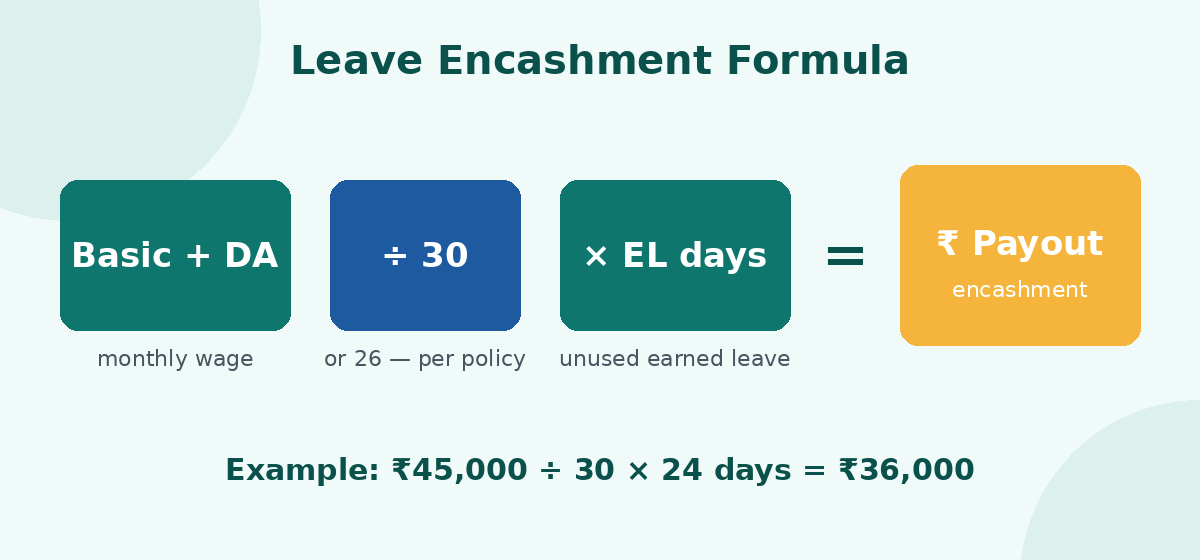
The Leave Encashment Formula (With a Worked Example)
The standard formula is: Leave encashment = (Basic + DA) ÷ 30 × number of unutilised EL days.
Take Sunita, a quality manager in a Gurugram manufacturing unit. Her Basic + DA is ₹45,000 per month and she has 24 days of unused earned leave at resignation.
- Per-day wage: ₹45,000 ÷ 30 = ₹1,500
- Encashment: ₹1,500 × 24 = ₹36,000
Simple enough for one employee. Now do it for 14 exits in a quarter, each with a different Basic, different leave balance, and two of them mid-month joiners. This is where a tool earns its keep — the leave encashment calculator takes Basic + DA, leave days, and your divisor, and gives you the figure instantly, every time, the same way.
30 Days or 26 Days? Pick One and Write It Down
The single most common inconsistency we see in audits is the divisor. Both are defensible — but they give different numbers, and your leave policy must state which one you use.
| Basis | Divisor 30 (calendar days) | Divisor 26 (working days) |
|---|---|---|
| Per-day wage on ₹45,000 | ₹1,500 | ₹1,731 |
| Encashment for 24 days | ₹36,000 | ₹41,538 |
| Common in | IT, services, most SME policies | Factories, units following the gratuity convention |
| Risk if unstated | Employee disputes, inconsistent F&F payouts, audit queries | |
Whichever you choose, apply it uniformly. Paying one exiting employee on 26 and the next on 30 is how grievances — and labour department complaints — get written.
Tax on Leave Encashment: The ₹25 Lakh Rule
Leave encashment received at retirement or resignation is exempt under Section 10(10AA) of the Income-tax Act up to ₹25 lakh for non-government employees. CBDT raised this limit from ₹3 lakh via Notification No. 31/2023, effective 1 April 2023 — the first revision since 2002. Government employees get full exemption. You can verify the provisions on the Income Tax Department portal.
The “least of four” test
For a private-sector employee, the exempt amount is the least of:
- Actual leave encashment received
- ₹25,00,000 (lifetime aggregate, across employers)
- 10 months’ average salary (Basic + DA, last 10 months before exit)
- Cash equivalent of leave at credit, capped at 30 days per completed year of service
Anything above the least of these is taxable as salary, and you must deduct TDS on it in the final settlement — the same settlement where you’re also computing gratuity and notice recovery, which is why our Full & Final Settlement Calculator and Gratuity Calculator sit next to this one.
During service vs at exit — the part HR gets asked about most
Encashment paid while the employee is still in service — say, your annual December encashment window — is fully taxable in the employee’s hands. No Section 10(10AA) exemption applies. The exemption is only for encashment at retirement or separation. The good news: the exemption at exit works under both the old and new tax regimes, so regime choice doesn’t change the exempt amount, only the tax rate on whatever residue is taxable.
Where Encashment Shows Up in Your Payroll Year
Leave encashment is not a once-a-year event. It appears in at least three places:
- Year-end lapse encashment (Dec–Jan): EL above the carry-forward cap is encashed in bulk. Budget for it — for a 100-person unit with an average of 6 lapsing days, that’s easily ₹8–10 lakh in one payroll cycle.
- Every F&F: Unused EL must be paid out at separation. Under the new Labour Codes, wage settlement timelines are tightening — you don’t have weeks to compute this.
- Retirements: The big-ticket cases, where the ₹25 lakh exemption and the least-of-four test actually bite.
If your leave balances live in a register or a spreadsheet, every one of these becomes a reconciliation project. A proper leave management system that tracks accruals, carry-forward caps, and balances in real time — feeding directly into payroll — removes the manual step entirely.
What HR Managers Get Wrong About Leave Encashment
- Encashing on gross instead of Basic + DA. Encashment is computed on Basic + DA unless your policy explicitly says otherwise. Paying on gross inflates the payout — and once you’ve done it for one employee, you’ve set a precedent.
- Encashing casual and sick leave. CL and SL are use-it-or-lose-it in nearly every state. Only earned/privilege leave is encashable. Check your state’s Shops & Establishments Act before promising anything.
- Forgetting TDS on in-service encashment. It’s fully taxable salary in the month paid. Miss the TDS and your Form 24Q reconciliation will catch it later, painfully.
- Ignoring the lifetime ₹25 lakh aggregate. If an employee claimed exemption at a previous employer, the remaining headroom shrinks. Ask for the declaration.
- No divisor in the policy. See the table above. Write it down.
- Leave balances that don’t match attendance. If your attendance and leave records disagree, the encashment figure is wrong before you start. Reconcile monthly, not at exit.
The labour law framework behind all this — Factories Act leave provisions and the new Labour Codes — is published by the Ministry of Labour & Employment.
FAQ: Leave Encashment in India
Is leave encashment taxable on resignation?
Encashment received on resignation qualifies for the Section 10(10AA) exemption, computed as the least of four amounts including the ₹25 lakh cap. It is not restricted to retirement — resignation counts as separation for this purpose. Any amount above the exempt figure is taxed as salary.
Which salary is used for leave encashment calculation?
Basic salary plus Dearness Allowance, averaged over the last 10 months for the tax computation. HRA, conveyance, special allowance and other CTC components are excluded unless your company policy specifically includes them — most don’t.
Can casual leave or sick leave be encashed?
Generally no. Casual and sick leave lapse if unused in almost all states. Only earned leave (also called privilege leave) is encashable, subject to state-specific carry-forward caps — typically 30 to 45 days.
Is leave encashment exempt under the new tax regime?
Yes. The Section 10(10AA) exemption on encashment at retirement or resignation applies under both old and new regimes. Encashment received during service, however, is fully taxable in both regimes — there is no exemption while you remain employed.
How many days of leave can be encashed?
Company policy decides the encashable balance, but for the tax exemption, the law caps the reckonable leave at 30 days per completed year of service. State Acts cap carry-forward — Factories Act allows 30 days, Karnataka 45, Maharashtra 42 — so balances above the cap usually get encashed annually.
What is the formula for leave encashment?
(Basic + DA) ÷ 30 × unutilised earned leave days. Some employers use 26 as the divisor, which produces a higher per-day rate. The divisor must be stated in your leave policy and applied consistently to every employee.
Work It Out in 60 Seconds
Next time an exiting employee asks “how much for my leave?”, don’t open Excel — run the numbers on the free EZHRM Leave Encashment Calculator, and browse the full set of free HR calculators for everything from CTC breakups to bonus. For more practical guides like this, the EZHRM blog has a new one most days of the week.