
It’s 4:30 pm on a Friday and your best operations executive has just put in her papers. By Monday, your MD wants one number: “What do we owe her?” Under the new Labour Codes, you now have roughly two working days after her exit to get that number right — not the comfortable 45 days your old HR manual assumed.
A full and final settlement calculator takes the panic out of that Monday. This guide walks you through what goes into an F&F, the new 2-day rule, the tax angles, and the mistakes that get HR teams dragged to the Labour Commissioner.
TL;DR
- F&F settlement = pro-rated salary + leave encashment + gratuity (if 5+ years) + bonus − notice recovery − other deductions.
- The Labour Codes (in force since 21 November 2025) require F&F payment within 2 working days of the employee’s last day — for resignation, termination and retrenchment alike.
- Gratuity stays tax-exempt up to ₹20 lakh; leave encashment at exit is exempt up to ₹25 lakh (lifetime) for private-sector employees.
- Use EZHRM’s free F&F settlement calculator to get the complete breakup in under a minute.
What is full and final settlement?
Full and final settlement (F&F) is the process of clearing every rupee owed between an employer and a departing employee — earned salary, leave encashment, gratuity, bonus and reimbursements on one side, and notice period shortfall, advances and asset recoveries on the other. The net of these two columns is the F&F amount paid with the relieving letter.
It sounds like simple arithmetic. In practice, it pulls data from four different places — attendance, leave balances, payroll and the employment contract — which is exactly why F&F disputes are among the most common complaints Indian labour offices receive. If your attendance and leave records live in spreadsheets, the F&F is only as accurate as the last person who updated them.
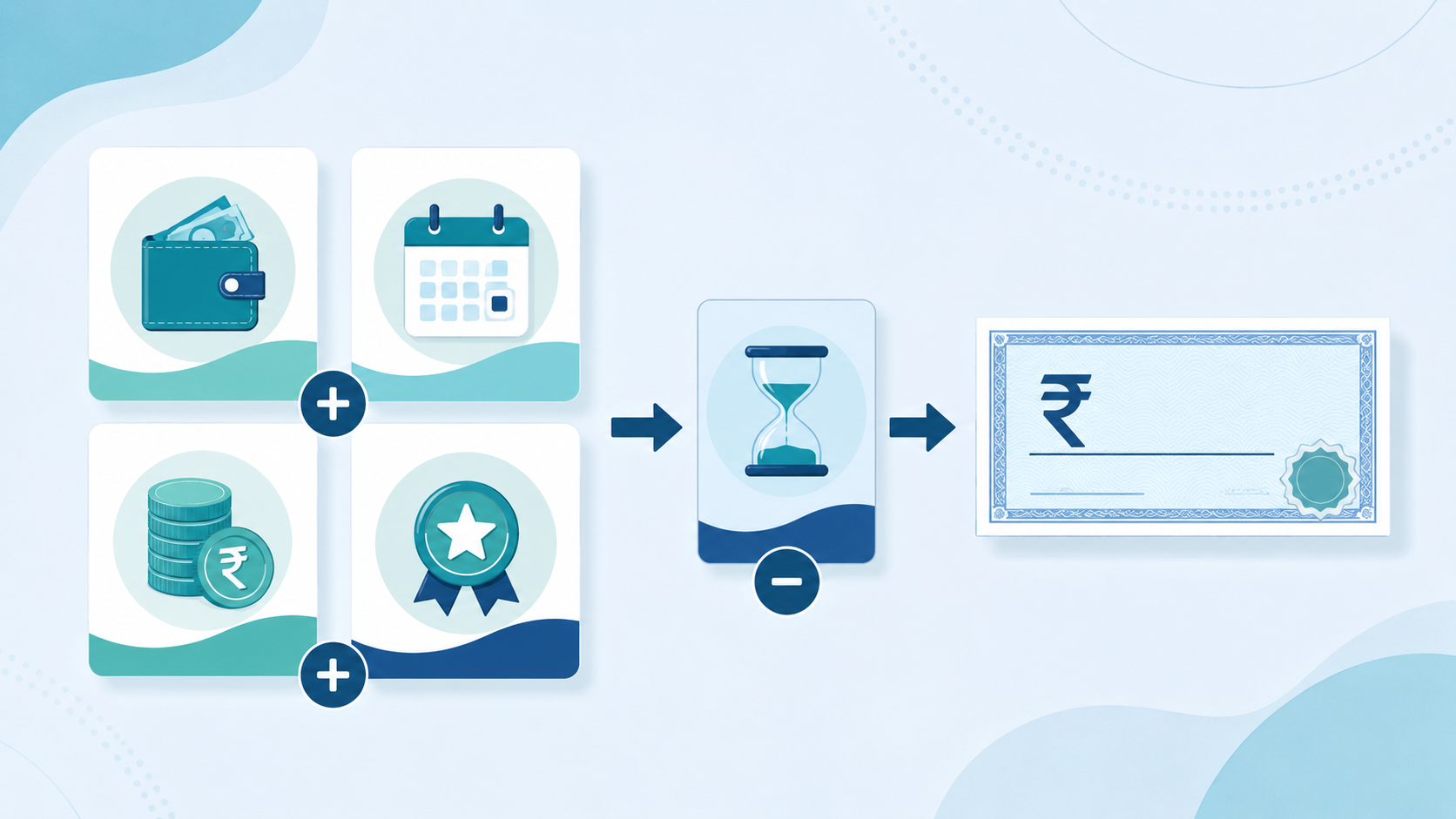
The 2-day rule: F&F timelines under the new Labour Codes
Since the four Labour Codes came into force on 21 November 2025, employers must settle all wages and dues within two working days of an employee’s removal, retrenchment, resignation or termination. This comes from Section 17(2) of the Code on Wages, 2019 — you can read the Code itself on the Ministry of Labour & Employment website.
Three things your team should note:
- It applies to resignations, not just retrenchment. The older Payment of Wages Act timeline was widely read as applying to termination cases. The Code on Wages extends the 2-day settlement to all exits, including voluntary resignation.
- Gratuity has its own clock. The Payment of Gratuity Act, 1972 allows 30 days from the date gratuity becomes payable. Most companies now pay it along with the F&F anyway — splitting payments creates more reconciliation work, not less.
- Clearances can’t be an excuse. If your IT asset recovery or finance sign-off takes three weeks, that’s an internal process problem. The statutory clock doesn’t pause for your no-dues certificate.
For a deeper look at the rule itself, we’ve covered it in our guide to the 2-day F&F rule.
What goes into an F&F settlement: components and formula
The net F&F amount is calculated as: pro-rated salary + leave encashment + gratuity + bonus − notice period recovery − other deductions. Here is each piece, with the formula our F&F calculator uses:
| Component | Formula | Notes |
|---|---|---|
| Pro-rated salary | (Gross ÷ 26) × days worked | Salary for days worked in the final month |
| Leave encashment | (Basic ÷ 26) × pending earned leaves | Earned/privilege leave only; CL and SL usually lapse |
| Gratuity | (Basic + DA) × 15/26 × years of service | Only if 5+ years of continuous service; capped at ₹20 lakh |
| Bonus / incentive | As accrued | Statutory bonus under the Payment of Bonus Act, plus any contractual incentive due |
| Notice recovery (−) | (Gross ÷ 30) × shortfall days | Deducted when notice period isn’t fully served |
| Other deductions (−) | Actuals | Salary advances, loans, unreturned assets |
Two formula details trip people up. First, the divisor: most companies use 26 working days for earned components (matching the Gratuity Act convention) but 30 calendar days for notice recovery — check what your appointment letter says and stay consistent. Second, leave encashment is computed on basic salary (plus DA where it exists), not gross. Encashing on gross is a generous mistake that’s hard to walk back once two or three exits have been settled that way.
If you want to sanity-check the individual pieces, the gratuity calculator and leave encashment calculator let you test each component on its own, and the notice period recovery calculator handles the deduction side.
A worked example: Priya resigns after 6 years
Say Priya, a senior executive in a Gurugram logistics firm, resigns with these numbers: gross salary ₹80,000/month, basic ₹32,000, 6 years of service, 20 days of earned leave, 25 days worked in her last month, full notice served, and ₹10,000 incentive due.
- Pro-rated salary: (80,000 ÷ 26) × 25 = ₹76,923
- Leave encashment: (32,000 ÷ 26) × 20 = ₹24,615
- Gratuity: 32,000 × 15/26 × 6 = ₹1,10,769
- Incentive due: ₹10,000
- Notice recovery: ₹0 (fully served)
- Net F&F: ₹2,32,307 (before TDS)
Doing this by hand for one Priya is fine. Doing it for six exits in a quarter, each with different leave balances and notice positions, is where errors creep in — which is why we built the free F&F settlement calculator alongside our other free HR calculators.
Tax on F&F: what’s exempt and what’s not
F&F components are taxed differently, and TDS under Section 192 must be worked out before you pay — not at year-end:
- Pro-rated salary and bonus: fully taxable as salary income.
- Gratuity: tax-exempt up to ₹20 lakh (lifetime) under Section 10(10) for employees covered by the Gratuity Act.
- Leave encashment at exit: exempt up to ₹25 lakh (lifetime) for non-government employees under Section 10(10AA), subject to the least-of-four computation. Encashment during service is fully taxable. The exemption applies under both old and new tax regimes — details on the Income Tax Department portal.
- Notice recovery: reduces the gross payout; whether it reduces taxable salary is a grey area your CA should call, since tribunal rulings have gone both ways.
Remember to factor the F&F month into Form 16 and your Form 24Q filing for that quarter. A mid-year exit with a large leave encashment can swing the employee’s annual TDS computation noticeably.
What HR managers get wrong in F&F
- Treating the 2-day rule as optional. “We’ll pay after the no-dues certificate” was defensible in 2024. It isn’t now.
- Encashing leave on gross instead of basic. Costs real money and sets a precedent.
- Forgetting pro-rata statutory bonus. An employee eligible under the Payment of Bonus Act who worked 30+ days in the financial year is owed pro-rata bonus in the F&F.
- Mismatched divisors. Using ÷30 for earnings but ÷26 for recovery (or vice versa) without contractual backing invites disputes.
- No written breakup. Always issue an F&F statement showing every component. Most Labour Commissioner complaints start with “they never showed me the calculation.”
- Holding gratuity past 30 days. Delayed gratuity attracts interest, and the delay itself needs justifying.
Frequently asked questions
What is the time limit for full and final settlement in India in 2026?
Two working days from the employee’s last day, under Section 17(2) of the Code on Wages, 2019, which took effect with the Labour Codes on 21 November 2025. It covers resignation, termination, retrenchment and closure. Gratuity has a separate 30-day window under the Gratuity Act.
Is gratuity part of the F&F settlement?
Yes, if the employee has completed 5 years of continuous service. It’s calculated as (Basic + DA) × 15/26 × completed years, with anything above ₹20 lakh taxable. Many employers pay it with the F&F even though the law allows 30 days.
How is leave encashment calculated in F&F?
The standard formula is (Basic ÷ 26) × pending earned leave days. Only earned or privilege leave is encashed; casual and sick leave typically lapse. At exit, encashment is tax-exempt up to ₹25 lakh (lifetime) for private-sector employees under Section 10(10AA).
Can an employer deduct notice period shortfall from F&F?
Yes, if the appointment letter provides for it. The usual formula is (Gross ÷ 30) × shortfall days. The deduction must be shown clearly in the F&F statement, and any buyout arrangement should be documented before the last working day.
Is TDS deducted on the F&F amount?
Yes. Taxable components — pro-rated salary, bonus, leave encashment beyond the exempt limit, gratuity beyond ₹20 lakh — attract TDS under Section 192. The employer must compute tax on the full year’s income including the F&F month before releasing payment.
What can an employee do if F&F is not paid?
The employee can file a claim with the Labour Commissioner or pursue recovery under the Code on Wages. Most disputes settle once a written demand cites the 2-day requirement — which is a good reason to pay correctly and on time in the first place.
Settle it right, settle it fast
Run your next exit through the free F&F settlement calculator before the MD asks — and if month-end exits are eating your team’s time, EZHRM’s payroll software computes F&F, TDS and statutory compliance automatically. More guides like this on the EZHRM blog.