
Your new HR executive joins, processes the first payroll, and proudly hands you the salary register. Everything looks right — PF, ESI, TDS all deducted correctly. But then your auditor flags it: Professional Tax is missing. And the company is registered in Karnataka. That ₹200 per employee per month is small on its own, but the penalty for non-compliance adds up fast — and nobody wants to explain to the MD why there’s a state government notice sitting in the mail.
Professional Tax is one of those compliance items that trips up HR managers precisely because it feels trivial. It isn’t. Here’s everything you need to know about PT slabs, deductions, exemptions, and filing deadlines for FY 2026–27 — and a free tool to calculate it in 10 seconds.
- PT is a state-level tax, capped at ₹2,500 per year (Article 276 of the Constitution)
- Currently levied by ~16 states and UTs — Delhi, Haryana, UP, and Rajasthan do NOT levy PT
- Employers must deduct PT from salary and deposit it with the state government monthly or quarterly
- PT paid is fully deductible under Section 16(iii) of the Income Tax Act — under both old and new tax regimes
What Is Professional Tax in India?
Professional Tax (PT) is a state-level tax levied on income earned from employment, professions, trades, and callings. It is governed by individual state enactments — there is no central Professional Tax Act. The constitutional authority comes from Entry 60 of List II (State List) and Article 276 of the Constitution of India, which caps the maximum PT at ₹2,500 per year.
In practice, employers deduct PT from their employees’ monthly gross salaries based on the applicable state slab and deposit the amount with the state government. Employers also typically pay a small annual Employer PT (Enrolment Certificate) separately — usually ₹2,500 per year for the company itself.
Confused about how PT fits into the full salary picture? Use our CTC to In-Hand Salary Calculator to see exactly what lands in your employees’ bank accounts after PT, PF, ESI, and TDS.
Which States Levy Professional Tax in 2026?
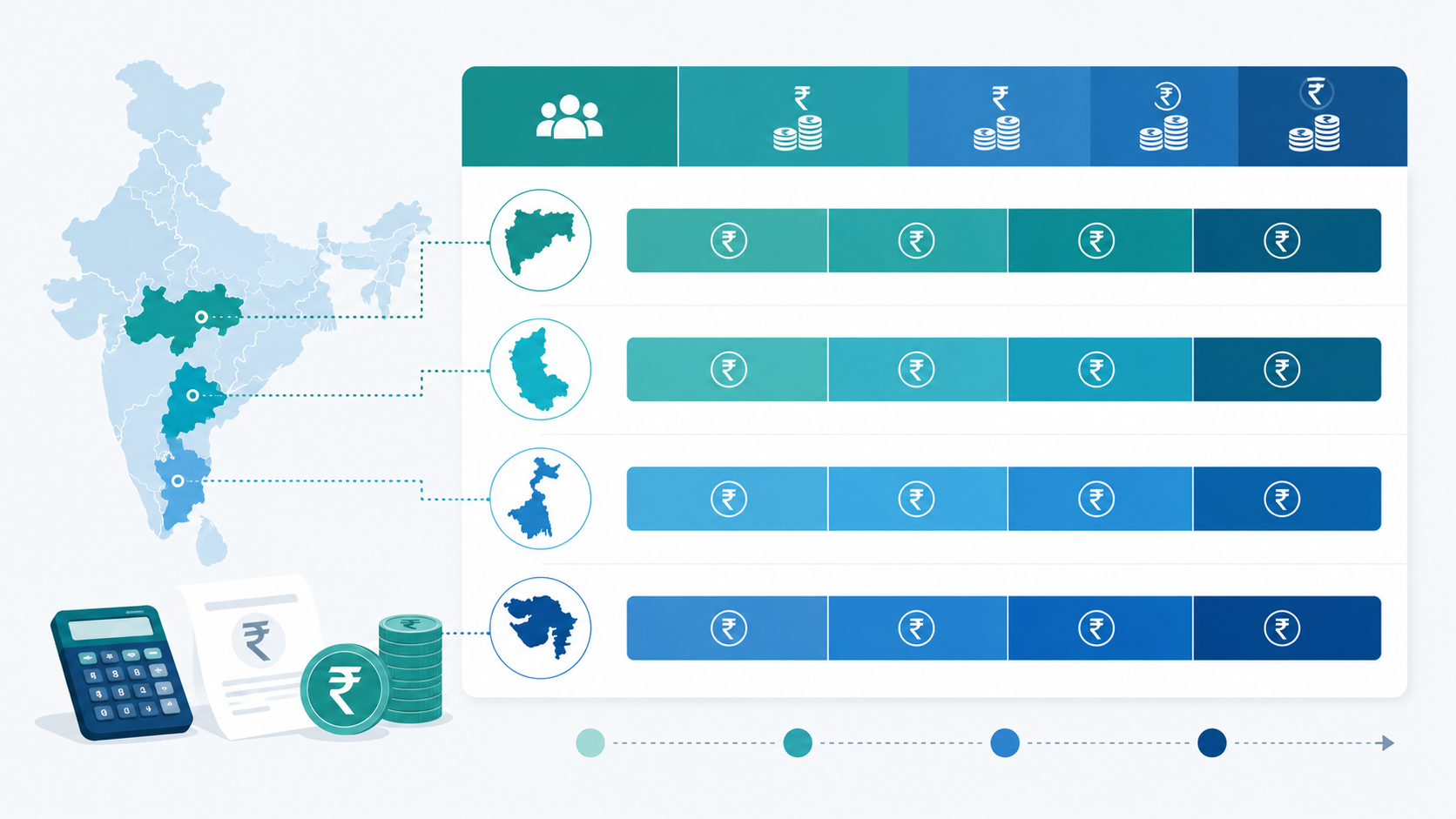
Not all states have Professional Tax. Here’s the current status — verified for FY 2026–27:
| State / UT | PT Applicable? | Max Annual PT |
|---|---|---|
| Maharashtra | ✅ Yes | ₹2,500 |
| Karnataka | ✅ Yes | ₹2,400 |
| West Bengal | ✅ Yes | ₹2,500 |
| Andhra Pradesh | ✅ Yes | ₹2,400 |
| Telangana | ✅ Yes | ₹2,400 |
| Gujarat | ✅ Yes | ₹2,400 |
| Madhya Pradesh | ✅ Yes | ₹2,500 |
| Tamil Nadu | ✅ Yes (nominal) | ₹1,200 |
| Kerala | ✅ Yes (nominal) | ₹1,200 |
| Assam | ✅ Yes | ₹2,400 |
| Odisha | ✅ Yes | ₹2,400 |
| Meghalaya | ✅ Yes | ₹2,400 |
| Delhi | ❌ No | — |
| Haryana | ❌ No | — |
| Uttar Pradesh | ❌ No | — |
| Rajasthan | ❌ No | — |
Important note for HR managers with multi-state teams: PT applicability is based on where the employer has a registered establishment, not where the employee physically works from. If your Gurugram-based employee is on the rolls of your Bangalore office, Karnataka PT applies.
Professional Tax Slabs by State 2026 — The Numbers You Need
PT slabs are based on the employee’s monthly gross salary. Here are the current slabs for the major states your payroll team is most likely dealing with:
Maharashtra
Maharashtra has one of the simpler PT structures — but with a February quirk that catches HR managers off guard every year.
| Monthly Gross Salary | Monthly PT |
|---|---|
| Up to ₹10,000 | ₹0 |
| Above ₹10,000 | ₹200 (₹300 in February) |
The ₹300 in February is how Maharashtra ensures the annual total hits ₹2,500 (11 × ₹200 + 1 × ₹300). Don’t miss this when processing February payroll.
Karnataka
Karnataka has a graduated slab structure — relevant for your IT and startup teams in Bengaluru.
| Monthly Gross Salary | Monthly PT |
|---|---|
| Up to ₹9,999 | ₹0 |
| ₹10,000 – ₹14,999 | ₹100 |
| ₹15,000 – ₹24,999 | ₹150 |
| ₹25,000 and above | ₹200 |
West Bengal
West Bengal has multiple slabs, with PT starting at ₹8,500 gross monthly salary.
| Monthly Gross Salary | Monthly PT |
|---|---|
| Up to ₹8,499 | ₹0 |
| ₹8,500 – ₹9,999 | ₹90 |
| ₹10,000 – ₹14,999 | ₹110 |
| ₹15,000 – ₹24,999 | ₹130 |
| ₹25,000 and above | ₹150–₹200 |
Gujarat
| Monthly Gross Salary | Monthly PT |
|---|---|
| Up to ₹5,999 | ₹0 |
| ₹6,000 – ₹8,999 | ₹100 |
| ₹9,000 – ₹11,999 | ₹150 |
| ₹12,000 and above | ₹200 |
For Tamil Nadu and Kerala: PT is technically applicable, but the practical annual impact is ₹1,200 or less. Always verify the current state notification before processing.
Rather than manually looking up state slabs every month, use the EZHRM Professional Tax Calculator — just enter the gross salary and select the state, and the correct PT is calculated instantly. It’s free and updated for FY 2026–27.
How Is Professional Tax Calculated on Salary?
Professional Tax is always calculated on monthly gross salary — not CTC, not basic, not net pay. Gross salary includes basic pay, HRA, special allowances, and other monthly salary components, but typically excludes one-time payments like arrears, bonuses, and reimbursements.
The calculation steps are straightforward:
- Determine the employee’s monthly gross salary for that payroll month
- Identify the state of the employer’s registered establishment
- Look up the applicable PT slab for that salary range
- Deduct the PT amount from the employee’s net pay
- Deposit the collected PT with the state government by the due date
Example: Sunita is a senior HR executive working at your company’s Pune office (Maharashtra). Her monthly gross salary is ₹62,000. Since ₹62,000 is above ₹10,000, her PT is ₹200 per month for 11 months and ₹300 in February — totalling ₹2,500 for the year. This ₹2,500 is fully deductible from her gross salary under Section 16(iii) when computing her income tax liability — applicable under both old and new tax regimes.
Need to see how this feeds into the full salary calculation? Check out our Full & Final Settlement Calculator (for leavers) and our CTC Salary Calculator for active employees.
Who Is Exempt from Professional Tax?
Exemptions vary significantly by state, but these are the most common categories across Indian states:
- Salary below the minimum slab threshold: Employees earning below ₹6,000–₹10,000 per month (depending on state) pay nil PT
- Parents/guardians of disabled children: Exempt in Maharashtra, Karnataka, and several other states — you need a certificate from the relevant authority
- Individuals with physical disabilities or mental illness: Exempt in most states with PT
- Members of the Armed Forces: Exempt under the provisions of the Army Act, Navy Act, and Air Force Act
- Badli workers (temporary/daily workers): Maharashtra specifically exempts badli workers
- Women earning below a threshold: Some states like Andhra Pradesh historically had gender-based exemptions — verify the current state notification for your state
HR managers: keep documentary proof for every exemption claim. State PT authorities do conduct audits.
PT Compliance: Employer Obligations, Registration & Deadlines
Employer Registration
Every employer covered under the state’s PT Act must obtain an Enrolment Certificate (EC) from the state PT authority — typically within 30 days of establishment. Some states also require a separate Registration Certificate (RC) to deduct and deposit PT on behalf of employees.
Deposit Deadlines by State
| State | Deposit Frequency | Typical Deadline |
|---|---|---|
| Maharashtra | Monthly | Last day of following month |
| Karnataka | Monthly | 20th of following month |
| West Bengal | Monthly / Quarterly | 21st of following month/quarter |
| Gujarat | Monthly | 15th of following month |
| Andhra Pradesh / Telangana | Monthly | 10th of following month |
| Madhya Pradesh | Monthly | Last day of following month |
Missing these deadlines typically attracts interest at 1.25–2% per month on the outstanding amount, plus late filing penalties. For a company with 100 employees in Maharashtra, a month’s non-compliance can easily cost ₹20,000–₹40,000 in penalties — far more than the actual PT amount.
EZHRM’s compliance management module tracks these state-wise PT deadlines automatically and flags them before the due date — so your payroll team never has to remember 16 different state calendars.
Professional Tax vs Income Tax — The Key Differences
HR managers sometimes confuse PT with income tax or wonder if it’s double-taxation. It isn’t — and here’s the clear distinction:
| Feature | Professional Tax | Income Tax |
|---|---|---|
| Authority | State Government | Central Government (CBDT) |
| Maximum amount | ₹2,500/year | No ceiling |
| Who deducts | Employer (from employee) | Employer (TDS) or employee |
| Applicability | Only in ~16 states | All India |
| Deductibility | Deductible from gross salary u/s 16(iii) | Not deductible from income tax |
| Slab basis | Monthly gross salary | Annual total income |
| Returns filing | State PT authority | Income Tax Department |
The best part about PT from an employee’s perspective: because it’s deductible under Section 16(iii), it reduces the gross salary that’s subject to income tax. An employee in the 30% tax slab effectively saves ₹750 in income tax from the ₹2,500 PT deduction.
What HR Managers Get Wrong About Professional Tax
1. Applying the wrong state’s slabs. Remote work made this messier. A company registered in Bengaluru with employees working from home in Hyderabad must apply Karnataka PT — not Telangana. The state of employer registration governs, not the employee’s work location.
2. Forgetting the February ₹300 in Maharashtra. Payroll software misconfigured for ₹200 flat will deduct short by ₹100 in February. Over a year, this creates a liability that someone has to reconcile.
3. Not getting the Enrolment Certificate before processing first payroll. Some companies start deducting PT before completing EC/RC registration, which creates a compliance gap. Register first, then deduct.
4. Including reimbursements in gross salary for PT calculation. Expense reimbursements (conveyance claims, fuel, mobile bills) generally should not form part of the PT salary base. Including them inflates the slab and over-deducts PT.
5. Applying PT to employees on notice period or F&F month. The month in which an employee’s service ends often needs careful calculation. See our Full & Final Settlement Calculator for handling this correctly.
6. Assuming all states work the same. Each state has its own Act, slabs, return formats, and deposit schedules. Multi-state employers need to track each separately.
Frequently Asked Questions — Professional Tax India 2026
Is Professional Tax applicable in Delhi and Haryana?
No. Delhi, Haryana, Uttar Pradesh, and Rajasthan do not levy Professional Tax. Employers registered in these states have zero PT liability. This is worth knowing if your head office is in Gurugram or Noida but you have branch offices in Maharashtra or Karnataka.
Does Professional Tax apply under the new tax regime (FY 2026–27)?
Yes. The deduction for Professional Tax under Section 16(iii) of the Income Tax Act is available under both the old and the new tax regime. Unlike most deductions and exemptions disallowed under the new regime, Section 16(iii) PT deduction remains available. Your employees choosing the new regime still get this deduction.
What happens if an employer doesn’t deposit PT on time?
Late deposit of PT attracts interest — typically 1.25% to 2% per month depending on the state — plus late filing penalties. Persistent non-compliance can result in prosecution under the relevant state PT Act. Always deposit by the state deadline — even if your payroll run is delayed.
How is PT calculated for a new joiner who joins mid-month?
For a mid-month joiner, PT is calculated on the salary actually paid for that partial month. If the prorated salary falls below the slab threshold, nil PT applies for that month. Most states follow this approach, though it’s worth confirming your state’s specific rule.
Can an employee claim a refund if PT is over-deducted?
Over-deducted PT can generally be adjusted in the following month’s payroll within the same financial year. Formal refunds from the state PT authority are possible but procedurally tedious. Best practice: reconcile PT deductions before year-end.
Does the Employer also pay PT separately from employee deductions?
Yes. The employer pays its own PT (Enrolment Certificate PT) — typically ₹2,500 per year — separately from the PT deducted from employee salaries. This is a company-level cost, not recoverable from employees. Make sure your accounts team tracks both the RC deposits (employee PT) and the EC payment (employer PT) separately.
For more HR compliance guides like this, visit the EZHRM blog. Also browse our full suite of free HR calculators including the PF & ESI Calculator, Gratuity Calculator, and Overtime Calculator.
The quickest way to get your PT numbers right every month is to run them through the EZHRM Professional Tax Calculator — it covers all major Indian states with current FY 2026–27 slabs and shows both monthly and annual PT in one click. And if you’re running payroll for more than 20 employees, our payroll software handles PT deductions automatically as part of the full salary run — so state-wise compliance is one less thing your team has to track manually.