
A 38-employee logistics firm in Gurgaon got a Section 134 show-cause from the MCA last month — their FY 2024-25 Board’s Report didn’t mention POSH compliance anywhere. The director had no clue this disclosure became mandatory from 14 July 2025. If your company has crossed 10 employees and you haven’t touched the POSH file since the IC was constituted, this one is for you.
TL;DR — POSH compliance in 2026, in 30 seconds
- POSH compliance under the Sexual Harassment of Women at Workplace Act, 2013 applies to every Indian workplace with 10 or more employees — even if you have zero women on the rolls.
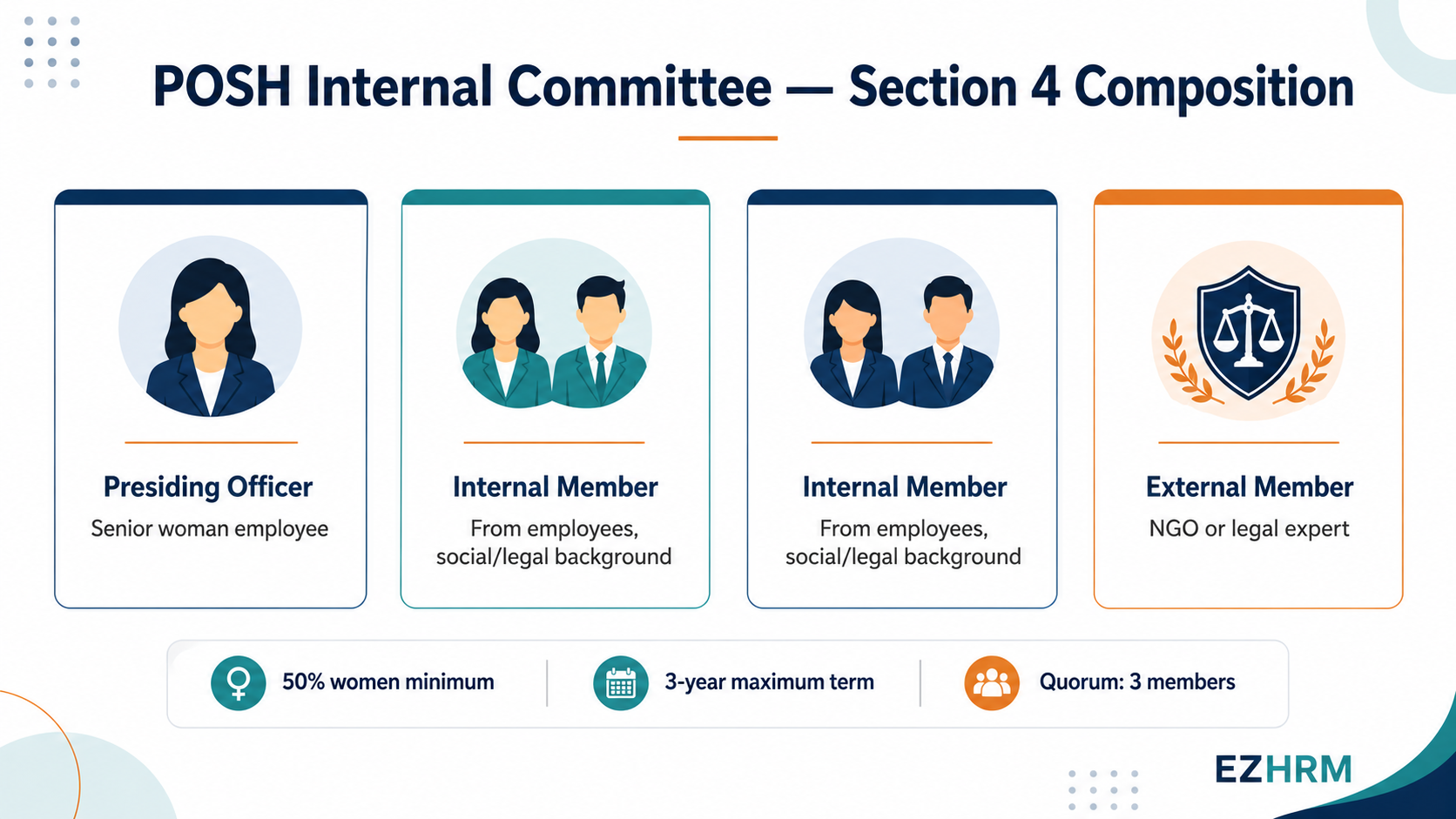
- Your Internal Committee (IC) needs at least 4 members, half of them women, one external member from an NGO or legal background, with a maximum 3-year term.
- Every complaint must be resolved within 90 days. The IC also files an Annual Report to the District Officer by 31 January each year.
- Since 14 July 2025, the MCA’s amended Companies (Accounts) Rules require POSH disclosures inside the Board’s Report. Penalties for missing these can run up to ₹5 lakh, on top of the ₹50,000 fine under Section 26 of the POSH Act.
What POSH compliance actually means in 2026
POSH compliance is the legal obligation every Indian employer has under the POSH Act 2013 to prevent workplace sexual harassment, set up an Internal Committee (IC), conduct awareness programmes, and file an Annual Report with the District Officer. It is not a one-time policy signed at incorporation — it is year-round, audit-ready compliance, the same as PF and TDS.
Most SME HR managers miss this: the Act covers the full workforce — permanent, probationer, contract, intern, apprentice, daily wager, plus visitors on your premises. A 25-person factory in Bahadurgarh with one woman in accounts still needs a POSH policy, an IC and an Annual Report. The threshold is on headcount, not gender.
Internal Committee composition — the rules you can’t fudge
Section 4 of the POSH Act is specific about the IC structure. Get it wrong and the entire inquiry can be challenged in a writ — happens often in Delhi High Court.
- Presiding Officer: a senior woman employee. If none is available, nominate from another office, unit or branch.
- Two members from among employees — preferably committed to the cause of women or with social work or legal experience.
- One external member from an NGO or with sexual harassment expertise.
- At least 50% women, including the Presiding Officer.
- Term: Maximum 3 years. Continuing into year 4 invalidates the IC.
Compliant vs non-compliant IC — a quick comparison
| IC element | Compliant ✅ | Non-compliant ❌ |
|---|---|---|
| Presiding Officer | Senior woman, 5+ years experience, in active service | Junior HR executive, or a male manager “for now” |
| Internal members | 2 employees from different functions, gender-mixed | 2 members from the same function or reporting line |
| External member | Empanelled lawyer or NGO representative with written consent | Family friend of the founder with no POSH background |
| Gender ratio | 50% or more women | 1 woman in a 4-member IC |
| Tenure | 3 years, reconstituted on time | Same IC since 2021, no renewal letter on file |
The 90-day timeline that quietly catches HR teams
The POSH Act gives the IC exactly 90 days to complete the inquiry from the date of complaint, 10 more days to submit the report to the employer, and 60 days for the employer to act on the recommendation. That is Section 11(4), Section 13(1) and Section 13(4) read together.
HR teams break in three spots. One, the complaint arrives on WhatsApp and never gets a written acknowledgement, so the 90-day clock starts late or never. Two, the IC can’t get quorum (3 members) because one external is busy and an internal is on leave. Three, documentation is patchy — no meeting minutes, no signed statements, no chain-of-custody on evidence — and the whole inquiry can be challenged later.
Run a clean case file from Day 1: complaint date, IC composition, meeting dates, witness statements, show-cause notices, final report, action taken. A grievance workflow inside your HRMS timestamps all of this automatically, which matters if the matter ends up in court.
POSH Annual Report — what you file by 31 January
Section 21 of the POSH Act says the IC must prepare an Annual Report each calendar year and submit it to the employer and to the District Officer. Rule 14 of the POSH Rules 2013 spells out the contents.
What goes inside the Annual Report
- Number of sexual harassment complaints received in the calendar year (1 January to 31 December)
- Number of complaints disposed of during the year
- Number of cases pending for more than 90 days
- Number of workshops or awareness programmes conducted
- Nature of action taken by the employer or District Officer
Even zero complaints all year, you still file. A “Nil” return is still a return. Two filing routes: hand-deliver one signed original to the District Officer (usually the District Magistrate) and get a stamped duplicate, or send via Registered Post with Acknowledgment Due. Keep the postal receipt forever — that is your only proof. The Government’s SheBox portal is being upgraded for digital filing in Maharashtra, Karnataka and Delhi NCT, but as of May 2026, hard-copy or RPAD is the safer route in most districts.
The MCA disclosure that nobody told the founder about
Effective 14 July 2025, the MCA amended the Companies (Accounts) Rules, 2014. Every company (private or public) preparing a Board’s Report under Section 134 now has to make detailed POSH disclosures inside that report — complaints received, disposed, pending beyond 90 days, awareness workshops, and action taken by the employer.
It is the same data as the Annual Report, but now it lives in a document your auditors, lenders and ROC read. Missing it attracts penalties under Section 134(8), separate from POSH Act fines. If your FY 2025-26 Board’s Report isn’t signed yet, fix it first.
Penalties — what actually happens if you slip
- Section 26, POSH Act: Up to ₹50,000 for the first offence, doubled for repeats, plus possible cancellation of business licences/registrations.
- Section 134(8), Companies Act: Up to ₹3 lakh on the company and ₹50,000 on every officer in default for the missing Board’s Report disclosure.
- Reputation cost: Improperly constituted ICs have been struck down (Aureliano Fernandes vs State of Goa, SC 2023) — the “guilty” employee can walk free and sue you back.
- DPDP angle: Complaint files contain sensitive personal data. Under the DPDP Rules 2025, mishandling can attract up to ₹250 crore. Treat IC files like payroll data — access-controlled, encrypted, retained only as long as needed.
What HR managers in SMEs keep getting wrong
- “We have no women, so no POSH needed.” Wrong. The 10-employee trigger has nothing to do with gender.
- Old IC running into year 5 with no renewal letter. Three-year tenure is hard-coded. Reconstitute with fresh appointment letters and a board resolution.
- External member is the founder’s CA. The external member must come from outside your business circle — an empanelled NGO or POSH-experienced lawyer.
- No annual workshop. Section 19 mandates awareness programmes. One Zoom session a year with attendance recorded is the minimum.
- No POSH in employee onboarding. Every new joiner should sign acknowledgement of the POSH policy on Day 1.
- Annual Report filed only to the employer. The District Officer is a statutory recipient too. Internal filing alone is non-compliance.
Your 2026 POSH compliance checklist
- Written POSH policy circulated and signed at onboarding
- IC reconstituted within the 3-year window, appointment letters on file
- Empanelled external member with written consent and NDA
- One annual awareness workshop completed, attendance recorded
- IC contact details displayed on every notice board and intranet
- Complaint workflow that timestamps every entry — auto-starts the 90-day clock
- Annual Report filed with District Officer by 31 January, with RPAD proof
- POSH disclosures inserted into the Board’s Report before sign-off
- IC files stored with role-based access and a DPDP-aligned retention policy
POSH compliance FAQs for Indian HR managers
Is POSH compliance mandatory for companies with only male employees?
Yes. The POSH Act applies the moment your workplace has 10 or more employees, regardless of gender mix. The reasoning is that visitors, clients, vendors and future hires (who are women) need to be protected. You must still constitute an IC with a Presiding Officer who is a woman — you can hire her externally or borrow from another branch.
What is the deadline for filing the POSH Annual Report in 2026?
The Annual Report covers the calendar year 1 January to 31 December and is filed with the District Officer by 31 January of the following year. Your CY 2026 report is due 31 January 2027. Maharashtra and Karnataka now accept digital filing through the SheBox portal — check your local district notification.
Can the IC inquiry exceed 90 days?
No. Section 11(4) sets a hard 90-day limit on the inquiry, with the report due within 10 days after that under Section 13. There is no extension clause. If you are running out of time, document the reasons in writing and seek interim relief — silently missing the deadline becomes a ground for the whole inquiry being challenged.
What if my company doesn’t have a senior woman to be Presiding Officer?
The Act anticipates this. You can nominate a senior woman from any other office, unit, branch or even a different workplace of the same employer. Many SME factories borrow a Presiding Officer from a sister concern’s HR team. The appointment must still be formal — board resolution and signed consent on file.
Do contractual or third-party employees count under POSH?
Yes. Section 2(f) defines “employee” broadly — regular, temporary, ad hoc, daily wage, contract, apprentice, intern and probationer, on or off your direct payroll. A contract security guard or housekeeping staffer who files a complaint comes under your IC. Add a POSH compliance clause in your vendor agreements too.
What is the difference between an Internal Committee (IC) and a Local Committee (LC)?
The IC is constituted by your company for its own workplace. The LC is constituted by the District Officer and handles complaints from workplaces with fewer than 10 employees, or where the complaint is against the employer themselves. For a 50-person SME, your IC is the primary forum — the LC matters only if the respondent is the owner.
Make POSH compliance a 5-minute checklist, not a January panic
POSH compliance fails not because HR managers are careless, but because the workflow lives in emails, Word docs and WhatsApp screenshots. Bring it into one audit trail — IC composition, 90-day tracker, awareness records, Annual Report draft and Board’s Report pack. EZHRM’s POSH compliance module handles all six requirements out of the box. Book a 20-minute walkthrough when you have a free slot.