
An employee walks into your cabin, smiles, and tells you she’s expecting her first child in October. Congratulations are easy. The next 30 minutes — figuring out leave dates, salary continuity, ESI overlap, and the crèche question your CEO will inevitably ask — is where most HR managers in Indian SMEs trip up.
The Maternity Benefit Act, 1961 (amended in 2017) is one of the few labour laws every founder claims to know but very few HR teams actually implement correctly. Get one detail wrong and you’re looking at a ₹5,000 fine, three months’ imprisonment for the employer, and a labour officer visit you don’t want.
This is the working guide we wish someone had handed us when we started. Bookmark it.
TL;DR — Maternity Benefit Act in 2026
- Eligibility: Any woman who has worked at least 80 days in the 12 months before her expected delivery date, in an establishment with 10 or more employees.
- Leave: 26 weeks paid leave for the first two children, 12 weeks from the third child onwards.
- Pay: Average daily wage for the 3 months prior to leave, paid in full.
- Crèche: Mandatory for establishments with 50 or more employees, within prescribed distance.
- ESI overlap: If the employee is covered under ESI (gross ≤ ₹21,000), maternity benefit is paid by ESIC, not the employer.
Who Does the Maternity Benefit Act Apply To?
The Maternity Benefit Act applies to every shop, factory, mine, plantation, and establishment (including government and private) employing 10 or more persons. That covers almost every SME you can think of — from a 12-person SaaS startup in Bengaluru to a 400-employee garment unit in Tirupur.
An employee qualifies for maternity benefit if she has worked for the employer for at least 80 days in the 12 months immediately preceding her expected delivery date. Note the wording: it’s 80 days of actual work, not 80 days of being on the payroll. Paid holidays, weekly offs, and earned leave count as work; loss-of-pay leave does not.
What about contract employees and consultants?
The Supreme Court has been consistent: if the work is regular, supervised, and the worker has put in 80 days, the Act applies — call sheets and contractor labels do not override the law. We’ve seen this go badly for retailers and BPO firms who assumed otherwise. If she’s on your floor, doing your work, the safest position is to extend benefits.
How Much Maternity Leave Does She Get?
The 2017 amendment made India’s maternity leave one of the most generous in Asia. Here’s the breakdown your team needs to memorise:
| Situation | Paid Leave Entitlement | Notes |
|---|---|---|
| First or second child | 26 weeks | Up to 8 weeks before delivery; rest after |
| Third child onwards | 12 weeks | Up to 6 weeks before delivery |
| Adoption (child below 3 months) | 12 weeks | From the date child is handed over |
| Commissioning mother (surrogacy) | 12 weeks | From the date of commissioning |
| Miscarriage / medical termination | 6 weeks | Immediately following the event |
| Tubectomy | 2 weeks | Following the operation |
| Illness arising from pregnancy | 1 additional month | On medical certificate |
The “work from home” clause everyone misses
Section 5(5) of the Act allows the employer and employee to mutually agree on work from home after the maternity leave ends, where the nature of work permits. This is gold for IT, design, content, and finance roles. Document it — a simple policy line in the offer letter or a separate agreement is enough.
How to Calculate Maternity Pay Correctly
The formula is straightforward: maternity benefit equals the average daily wage for the three calendar months immediately preceding the date she goes on leave, multiplied by the number of days of leave taken.
“Average daily wage” means the gross monthly wage (basic + DA + retaining allowance + cash equivalent of foodgrains, where applicable) divided by the number of working days. It does not include bonus, employer’s PF contribution, gratuity accrual, or one-off reimbursements.
Worked example
Priya is a payroll executive in a Pune-based SaaS company. Her last three months’ wages (basic + DA + applicable allowances) total ₹1,80,000 across 78 working days. Her average daily wage = ₹1,80,000 ÷ 78 = ₹2,308. For 26 weeks (182 days) of leave, her maternity benefit = ₹2,308 × 182 = ₹4,20,056. The company pays this in line with her normal salary cycle, with TDS treated as regular income.
Medical bonus
If your company does not provide free pre-natal and post-natal medical care, you owe a medical bonus of ₹3,500 in addition to the salary. This number was set in 2008 and the Centre has the power to revise it; until that notification comes, ₹3,500 it is.
The Crèche Rule: 50+ Employees, Read Carefully
If your establishment has 50 or more employees (men + women, all categories), the Maternity Benefit Act requires a crèche facility within the prescribed distance. Most state rules notify the distance as 500 metres of the workplace, with at least four daily visits permitted to the mother.
Your options for compliance are:
- In-house crèche: Dedicated room with trained staff, adequate ventilation, separate sleeping and play areas. Practical for factories and large IT campuses.
- Tie-up crèche: Partner with a registered day-care provider near your office. Common in metro IT parks.
- Crèche allowance: Some state governments allow a monetary allowance in lieu of physical facility. Verify with your state’s Shops & Establishments authority before relying on this.
The minimum compliance is to have a written crèche policy, a designated nodal officer, and proof of facility (lease agreement, vendor contract, or an internal SOP). A surprise inspection in 2025 in a Gurugram tech firm cost the employer ₹1.2 lakh in compounding fees — entirely avoidable with documentation.
ESI vs Maternity Benefit Act: Which One Pays?
This is the question that derails most payroll teams. Here’s the clean rule:
- If the employee’s gross monthly wage is up to ₹21,000, she is covered under the Employees’ State Insurance Act, 1948. Maternity benefit is paid by ESIC, not by the employer. Your role is to ensure ESI contributions are deposited and to issue the Form 19 certificate when she claims.
- If the employee’s gross monthly wage is above ₹21,000, the Maternity Benefit Act applies and the employer pays the maternity benefit directly.
- An employee cannot claim under both Acts for the same period — it is one or the other based on her ESI eligibility on the date the leave begins.
Practical tip: if a borderline employee crosses ₹21,000 mid-pregnancy (say, after a salary hike in April), the rule is “as on the date the leave commences”. Configure your payroll software to flag this; manual tracking gets missed.
What HR Managers Get Wrong (Avoid These)
- Counting only post-delivery weeks. The 26 weeks is total — pre + post. An employee who starts leave 4 weeks before delivery gets 22 weeks after, not 26.
- Forgetting the 80-day threshold for new joiners. If she joined three months ago, she does not qualify under MBA — but she may still qualify under your internal policy. Be explicit in writing.
- Treating maternity leave as “leave without pay” in payroll. It is paid leave. PF contributions continue (employer + employee share, deducted from the maternity benefit), and the period counts towards gratuity, increments, and seniority.
- Asking her to “use up” earned leave first. Illegal. Maternity leave is a separate statutory entitlement; her EL balance stays intact.
- No written notice from the employee. The Act requires the employee to give 8 weeks’ notice and a medical certificate. Build this into your leave management workflow so neither side forgets.
- Crèche allowance as a substitute everywhere. Not all states permit it. Check your state notification before assuming you’re compliant.
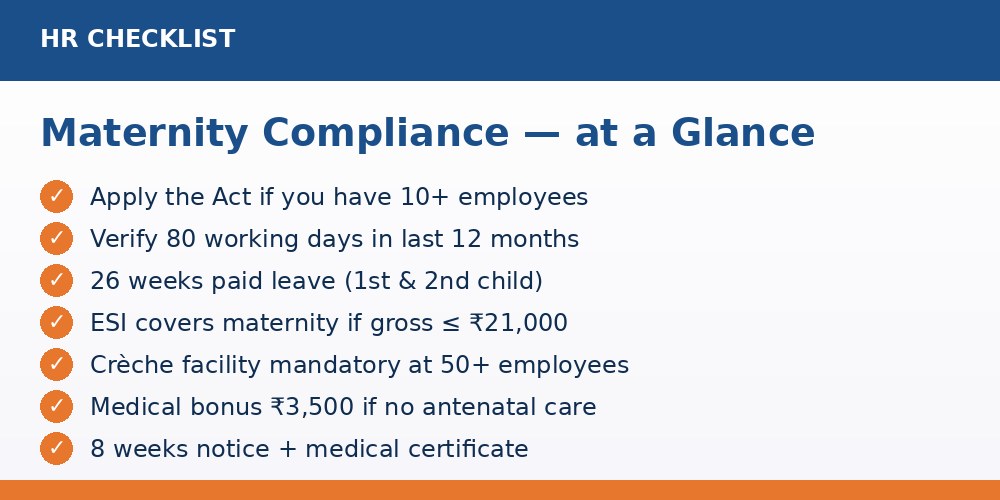
HR Manager’s 10-Point Maternity Compliance Checklist
- Written maternity policy circulated to all employees, in English and local language.
- HR template letter for “intimation of pregnancy” with the 8-week notice clause.
- Medical certificate format aligned with Schedule I of the Act.
- Payroll system flagged for ESI vs MBA eligibility on date of leave commencement.
- Crèche facility or tie-up agreement on file (50+ employees).
- Designated crèche nodal officer named in the HR manual.
- Workplace risk assessment done — no hazardous duties in the 10 weeks pre-delivery.
- Reintegration plan with optional work-from-home clause documented.
- Annual filing of returns under the state Shops & Establishments rules.
- Quarterly internal audit of maternity claims paid vs entitlement.
Frequently Asked Questions
Can a company terminate a pregnant employee?
No. Section 12 of the Maternity Benefit Act prohibits termination during the maternity leave period or for any reason connected to the pregnancy. Termination during this window is void unless it is for proven gross misconduct, with proper inquiry. Reckless dismissal is a ground for criminal prosecution of the employer.
Is the 26-week leave applicable to contract or fixed-term employees?
Yes, if the woman has completed 80 days of work in the preceding 12 months with the same employer or principal employer. The Act does not distinguish between permanent, contractual, daily-wage, or fixed-term employees. The 80-day test is what matters.
Does maternity leave count for PF, gratuity, and increments?
Yes. The leave period is treated as continuous service. PF contributions continue (deducted from the benefit), gratuity accrual does not break, and the employee remains eligible for any annual increment cycle that falls within the leave window. Don’t reset her grade or seniority on return.
What if the employee’s salary increases during maternity leave?
Increments granted to the cohort during the leave period must be applied to her on return. The maternity benefit itself is locked at the average wage of the three months before leave — it is not retroactively recomputed.
Are stillbirth and miscarriage covered?
Yes. In case of miscarriage or medical termination of pregnancy, the employee is entitled to 6 weeks of paid leave from the date of the event, on production of a medical certificate. Stillbirth is treated similarly to a delivery for the purposes of leave entitlement.
Can male employees take paternity leave under this Act?
The Maternity Benefit Act does not provide for paternity leave. Central Government employees get 15 days under separate rules. Private sector paternity leave is policy-driven, not statutory — most well-run SMEs offer 5 to 15 days as company policy. The pending Code on Social Security may change this; until then, it stays voluntary.
Make Maternity Compliance One Less Thing to Worry About
Maternity is a defining moment for an employee. The Act is generous because it should be — your job as HR is to make the paperwork invisible so she can focus on her family. EZHRM automates the maternity workflow end-to-end: eligibility checks, ESI vs MBA routing, payslip continuity, and crèche-policy reminders. Book a quick demo and we’ll show you the exact screens your team will use the next time someone walks into the cabin with happy news.