
You know that moment when an employee who’s been around for seven years hands in their notice, and your finance head asks: “How much gratuity do we owe?” If you’ve ever fumbled through a calculator or copied a formula off some 2017 blog post, this guide is for you. Gratuity calculation in India looks straightforward on paper, but the small details — what counts as “wages”, whether the eligibility clock was met, and how the new Labour Code rules apply — trip up most HR managers.
And there’s a fresh twist for 2026: the Code on Social Security, 2020 is now in force from 21 November 2025, and it has quietly rewritten parts of how you calculate gratuity. Let’s clean this up once and for all.
TL;DR
- Gratuity formula (Act-covered employees): (Last drawn Basic + DA) × 15 × Years of service ÷ 26.
- Eligibility: 5 years of continuous service for permanent staff; 1 year for fixed-term employees under the new Code on Social Security.
- Tax-free limit: ₹20 lakh under Section 10(10) of the Income Tax Act — lifetime cap, not per employer.
- Payment deadline: 30 days from due date, or 10% simple interest applies.
- New for 2026: “Wages” are now standardised across labour laws — Basic + DA + Retaining Allowance.
What is Gratuity, and Who Pays It?
Gratuity is a lump-sum statutory benefit paid by an employer to an employee for long-term service rendered. It is governed primarily by the Payment of Gratuity Act, 1972, now read with Chapter V of the Code on Social Security, 2020. The Act applies to every factory, mine, plantation, port, railway company, shop, or establishment in India that employs 10 or more people on any day in the preceding 12 months.
Once your headcount crosses 10, the Act applies forever — even if you later drop below 10. A common mistake: SMEs that started small assume they’re exempt because they’re “only 8 people now”. That doesn’t matter. If you ever crossed 10 employees, gratuity obligations stay with you.
Who is Eligible for Gratuity in India in 2026?
Gratuity eligibility now has two parallel tracks:
Permanent employees: 5 years of continuous service with the same employer. The 5-year clock includes paid leave, maternity leave (up to 26 weeks), lay-off periods, and authorised absence due to sickness or accident.
Fixed-term employees (post 21 November 2025): Just 1 year of continuous service is enough, on a pro-rata basis. This is the biggest practical change brought in by the Code on Social Security, 2020. If your offer letters carry “Fixed-Term Contract” clauses — and many IT services and project-based firms use them — this directly impacts your liability accruals.
The 5-year (or 1-year FTC) rule is waived in three situations:
- Death of the employee — gratuity is paid to the nominee, regardless of years served.
- Total disablement due to accident or disease.
- The widely-accepted 4 years and 240 days rule from the Madras High Court ruling, which most HR teams treat as eligible service in the 5th year.
The Gratuity Formula (with Worked Examples)
For employees covered under the Payment of Gratuity Act, the formula is:
Gratuity = (Last drawn Basic + DA) × 15 × Years of completed service ÷ 26
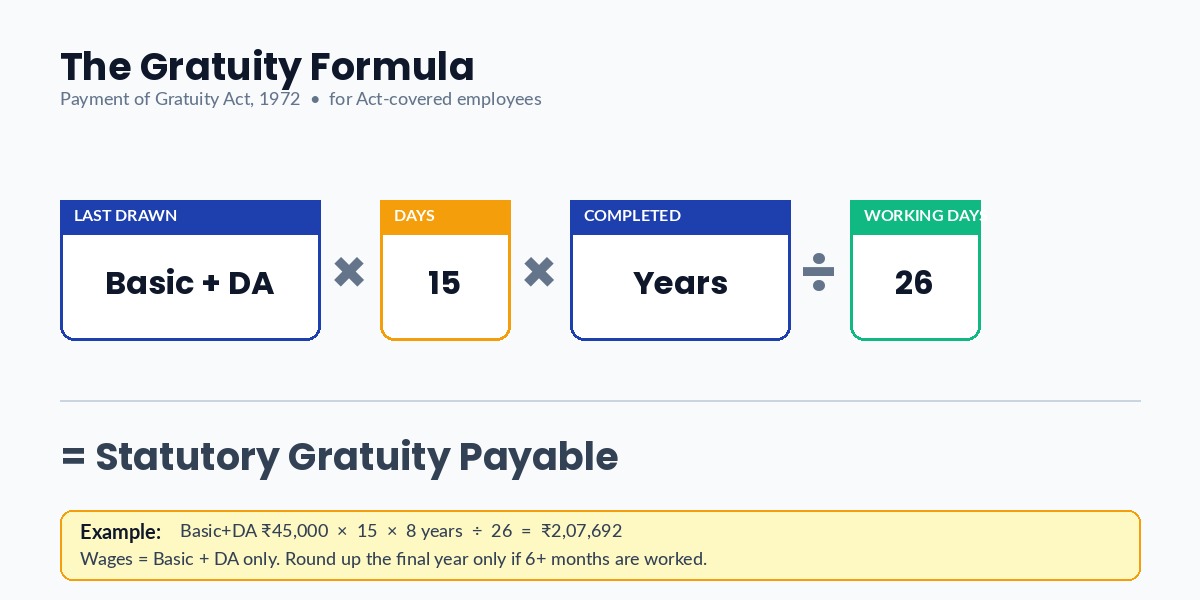
The 26 represents the average number of working days in a month (one day off per week). The 15 represents 15 days’ wages for every year served.
Example 1: Resigning IT employee
Priya joined a Gurugram-based IT services firm on 1 January 2018. She is resigning on 30 April 2026. Her last drawn Basic is ₹40,000 and DA is ₹5,000.
- Years of service: 8 years and 4 months → rounded to 8 years (less than 6 months in the final year is rounded down)
- Wages for gratuity: ₹40,000 + ₹5,000 = ₹45,000
- Gratuity = (₹45,000 × 15 × 8) ÷ 26 = ₹2,07,692
Example 2: 7 months into final year
If Priya had worked till 31 July 2026 (8 years, 7 months), the final year rounds up to 9 years: gratuity = (₹45,000 × 15 × 9) ÷ 26 = ₹2,33,654. That extra 90 days in service is worth ₹25,962 — useful to know for borderline cases.
Formula for non-Act establishments
If your establishment is not covered under the Act (rare, but possible for very small organisations), gratuity is calculated as:
Gratuity = (Last drawn Basic + DA) × 15 × Years of service ÷ 30
Note: 30 working days, not 26. This produces a slightly lower figure.
Quick Reference: Gratuity by Years of Service
This table assumes Basic + DA of ₹50,000 per month:
| Years of service | Gratuity (Act-covered) | Gratuity (Non-Act) |
|---|---|---|
| 5 | ₹1,44,231 | ₹1,25,000 |
| 7 | ₹2,01,923 | ₹1,75,000 |
| 10 | ₹2,88,462 | ₹2,50,000 |
| 15 | ₹4,32,692 | ₹3,75,000 |
| 20 | ₹5,76,923 | ₹5,00,000 |
| 25 | ₹7,21,154 | ₹6,25,000 |
Gratuity Tax Exemption in India 2026
Under Section 10(10) of the Income Tax Act:
- Government employees — entire gratuity is tax-free (up to ₹25 lakh ceiling for central government).
- Private-sector employees covered by the Act — lower of (a) actual gratuity received, (b) ₹20 lakh, or (c) the formula amount — whichever is lowest is exempt.
- Private-sector, non-Act employees — lower of (a) actual gratuity, (b) ₹20 lakh, or (c) half month’s average salary × completed years of service.
The ₹20 lakh limit is a lifetime cumulative cap, not per employer. If an employee received ₹12 lakh tax-free from a previous employer, only ₹8 lakh is tax-free with the next employer’s payout. This catches a lot of HR teams off-guard with senior hires — always ask for prior gratuity certificates during onboarding.
For death or disability cases, the entire gratuity paid to the nominee or employee is tax-free.
Payment Timeline and Penalties
The Act says gratuity must be paid within 30 days from the date it becomes payable. If you miss this:
- Pay simple interest at 10% per annum from the due date.
- Wilful non-payment can attract imprisonment of 6 months to 2 years and a fine.
- The Controlling Authority (Labour Department) can be approached by the employee.
Practical timeline once an employee resigns or retires:
- Employee submits Form I (application for gratuity) within 30 days.
- Employer issues Form L (acceptance) within 15 days, with the payment date.
- Payment must hit the employee’s account within 30 days.
Interest on delayed gratuity is taxable in the employee’s hands as “income from other sources”.
What HR Managers Get Wrong About Gratuity
1. Counting only Basic, ignoring DA. Dearness Allowance is part of the gratuity wage definition. If your CTC structure has DA, it must be included — even if it’s a token amount.
2. Excluding gratuity from CTC, then refusing to pay. Many SMEs structure CTC to include a gratuity contribution line. If you’ve shown it as part of CTC for 5 years, you cannot deny payment on technicalities.
3. Forgetting the nomination form. Every employee must fill Form F (nomination) within 30 days of joining. Without it, you’re looking at family disputes during a death claim — and your team caught in the middle.
4. Wrong salary base for resigning employees. Use the last drawn Basic + DA, not the year’s average. This matters for employees who got an increment in their last 6 months.
5. Treating fixed-term contracts as “no gratuity”. Post the Code on Social Security, any FTC employee with 1 year of continuous service is entitled to pro-rata gratuity. Audit offer letters and HRMS settings now.
6. Treating gratuity as discretionary. It isn’t. Once eligible, it’s a statutory right — not a retention tool you can withhold.
How to Fund Gratuity Liability: Trust vs LIC vs Pay-as-you-go
For a 50-person SME, gratuity liability builds up quietly. By Year 6, a single resignation can hit ₹3-5 lakh in one shot. You have three practical options:
- Pay-as-you-go: Pay from operating cash when due. Simplest, riskiest. The liability isn’t formally recognised on books and audit gets messy as headcount grows.
- Approved Gratuity Trust: Set up an irrevocable trust under the Income Tax Act. Contributions are tax-deductible up to 8.33% of salary. Best for 50+ employee firms with a stable HR function.
- LIC Group Gratuity Scheme: Outsource the funding to LIC or another insurer. They invest the corpus and handle claims. Most 20–100 person firms in cities like Delhi NCR, Bangalore, and Pune use this route.
Talk to your CA before choosing. The right answer depends on your headcount, salary structure, and audit cycle.
Frequently Asked Questions
Q: Is gratuity payable if I resign before 5 years?
For permanent employees, generally no — the Payment of Gratuity Act requires 5 years of continuous service. Exceptions are death, permanent disablement, or fixed-term contract employees who now qualify after just 1 year under the Code on Social Security, 2020. Some courts also accept 4 years and 240 days as eligible service.
Q: How is gratuity calculated for an employee with a partial final year?
If service in the final year exceeds 6 months, it’s rounded up to a full year. If less than 6 months, it’s rounded down. So 8 years 7 months counts as 9 years, while 8 years 4 months counts as 8 years. This rule applies only to the final year of service.
Q: Is the ₹20 lakh gratuity tax exemption limit per employer or lifetime?
It is a lifetime cumulative cap across all employers. If an employee received ₹15 lakh tax-free from a previous employer, only ₹5 lakh is tax-free with the next employer’s payout — the remainder becomes taxable salary income. Always collect prior gratuity certificates during onboarding.
Q: Can an employer refuse gratuity if an employee was terminated for misconduct?
Partially yes. The Act permits forfeiture of gratuity if termination is due to wilful misconduct, riotous behaviour, or moral turpitude — but only to the extent of damages caused. Full forfeiture requires documented evidence of fraud or proven moral turpitude. Document everything; courts scrutinise these closely.
Q: Do contractors and gig workers get gratuity?
Direct contract employees with the principal employer for the qualifying period are eligible. Workers hired through a labour contractor receive gratuity from the contractor, not the principal. Gig workers are covered by separate social security provisions under the new Code.
Q: Is gratuity payable on retrenchment or layoff?
Yes. Gratuity is paid in full if the employee meets the 5-year threshold (1 year for FTC). Retrenchment compensation under the Industrial Disputes Act is separate and additional — both must be paid at separation.
Stop Calculating Gratuity in Excel
If you’re still running gratuity calculations in a spreadsheet — pulling Basic + DA from one tab, joining and leaving dates from another — you’re one typo away from a Labour Department complaint. EZHRM’s payroll module auto-calculates gratuity at full and final settlement, with the Act/non-Act formula and FTC rules applied correctly based on your statutory compliance setup. Pair it with our leave management to keep continuous-service tracking clean from Day 1.