
Modern businesses in India are rapidly shifting away from paper trails and manual spreadsheets. An Online HRM System is now the essential solution, acting as a unified, digital platform to manage every core function of the employee lifecycle. This comprehensive guide, informed by world-class industry insights, will break down what modern Online HR Software does, how it works, and why it is the definitive investment for achieving operational excellence, compliance, and superior employee experience in today’s fast-paced corporate environment.
What is an Online HRM System, and Why the Cloud Matters
An Online HRM System is a sophisticated, cloud-based software solution designed to integrate and automate all critical Human Resources tasks under a single dashboard. Unlike outdated on-premise software or manual systems, this digital solution uses the power of the internet and secure cloud hosting to deliver real-time data access and automated workflows. The primary search intent here is definitional and discovery-oriented: users want to know what an HRM system is, specifically the online or cloud version, and how it directly benefits a modern organization operating in India.
The “cloud” aspect is critical, offering several benefits that address common pain points in Indian businesses:
- Centralized Data: All employee records, documents, contracts, and history are stored securely in one location, eliminating scattered files and redundant data entry.
- Accessibility: HR teams, managers, and remote employees can access the platform from any location, making it ideal for the hybrid and multi-branch structures prevalent across India.
- Scalability: The system scales effortlessly with organizational growth, meaning a startup can use the same platform components as an enterprise-level company, without the need for costly hardware upgrades.
- Automatic Updates: The vendor (like EZHRM) handles all software maintenance, security patches, and, most importantly for the Indian context, statutory compliance updates, ensuring the system is always current with rapidly changing labour laws.
This Online HR Management Software transforms HR from a reactive administrative function into a proactive, strategic partner, capable of managing complex tasks like payroll, performance, and compliance with high precision and speed.
Key Functional Pillars: The Core of Online HR Management Software
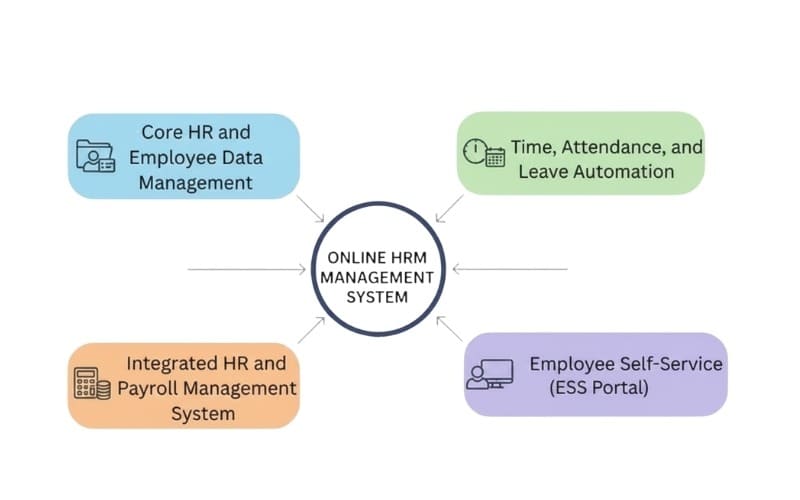
Competitor analysis shows that top-performing articles categorize the HR system’s functions. To surpass this, we detail the operational impact of the four core pillars, demonstrating the system’s experience and expertise. The most valuable aspect of an Online HRM Software is its integrated nature, where data flows seamlessly between modules.
1. Core HR and Employee Data Management
This foundational module creates a secure, digital profile for every team member. It houses critical details, from joining date and designation to banking information and digital document storage. This is where the paper file is finally retired. Beyond mere storage, it powers organizational charts, tracks asset allocation, and manages the entire employee lifecycle (onboarding, transfers, and exits). By centralizing this data, HR gains the ability to generate instantaneous headcount reports and manage sensitive records securely, which is paramount for legal compliance and EEAT (Trust).
2. Time, Attendance, and Leave Automation
The Attendance Management Software component is essential for accurate payroll and productivity tracking. Modern systems go beyond simple punch-in/punch-out. They incorporate GPS-based attendance for field or remote staff, integrate with biometric devices for office workers, and handle complex rotating shift schedules. Crucially, the system links seamlessly with the leave module to automatically track balances, manage custom leave types (like sick, casual, or earned leave specific to Indian policies), and execute approval workflows. This automation eliminates manual reconciliation, which is a major time sink for HR teams.
3. Integrated HR and Payroll Management System
This is arguably the highest-value component for any business. The HR and Payroll Management System uses verified data from the Attendance and Leave modules to calculate salaries. It automatically handles all statutory deductions in India, including PF, ESI, TDS, and professional tax, based on the latest government regulations. The system generates accurate, digital payslips and handles compliance reporting for tax authorities. This integration reduces manual data handling risks to near zero, ensuring accurate and timely salary disbursement, a key factor in employee retention and organizational credibility.
4. Employee Self-Service (ESS Portal)
The Employee Self Service Portal (ESS Portal) empowers the workforce by giving them direct access and control over their own HR-related tasks. Employees can apply for leave, view real-time leave balances, check their attendance logs, download payslips, and update personal contact information without involving the HR department. This self-service model drastically reduces administrative overhead for HR, allowing them to shift focus to more strategic initiatives like training and engagement. A great ESS portal is vital for improving employee experience (EX) and fostering transparency.
Beyond Automation: Strategic Benefits for India-Specific Challenges
To achieve true topical authority, the article must address the unique operational and legal landscape of India. An Online HRM System provides strategic advantages that directly mitigate country-specific risks and challenges:
- Mastering Statutory Compliance: India’s labour laws (such as the Code on Wages, ESI Act, and PF Act) are dynamic and complex, often carrying high penalties for non-compliance. A dedicated Online HR Software platform is built with these regulations embedded, ensuring all calculations and filings are current, accurate, and audit-ready. This trust factor is a massive EEAT component for Indian readers.
- Support for Hybrid and Remote Work: Given the vast geographies and reliance on contract/remote work in India, cloud-based access is non-negotiable. Modern systems enable geo-fencing and mobile-based attendance tracking, ensuring fair and verifiable timekeeping for multi-location teams, a capability manual systems cannot match.
- Predictive HR Analytics: Leading systems integrate HR analytics, offering management predictive insights into attrition trends, cost-to-company (CTC) analysis, and utilization rates. This shifts HR from reactive record-keeping to proactive, data-driven decision-making, directly impacting business strategy.
- Enhanced Employee Experience (EX): Providing a transparent, instantaneous service through the ESS Portal leads to higher employee satisfaction. Quick payslip access, fast leave approvals, and instant HR support (often via integrated chatbots) all contribute to a positive workplace culture.
Implementing Your Online HRM System: A Phased Approach
The implementation phase is a crucial part of the user journey, answering the common PAA question: “How do I implement an HRM system?” Effective deployment demands clear planning to ensure the best return on investment.
- Needs Assessment and Goal Setting: Clearly define the pain points (e.g., “Payroll takes 5 days,” or “Attendance errors are 10%”) and set quantifiable goals (e.g., “Reduce payroll processing time to 1 day”). This ensures the selected Online HRM System solves specific business problems.
- Vendor Selection and Data Audit: Choose a vendor that specializes in the Indian regulatory environment and offers local support. Before migration, audit and cleanse your existing employee data. The success of the new system hinges on the quality of the data migrated from old spreadsheets or legacy systems.
- Configuration and Customization: Configure modules like the Attendance Management Software and leave policies to align with your company’s unique structure, employee groups, and the regional mandates of your operating locations. Avoid over-customization, which can complicate future updates.
- Training and User Acceptance Testing (UAT): Conduct role-specific training for HR, managers, and all employees on the Employee Self Service Portal (ESS Portal). UAT is essential to test all critical workflows, especially the HR and Payroll Management System, before the final “go-live.”
Why EZHRM is the Preferred Online HR Management Software in India
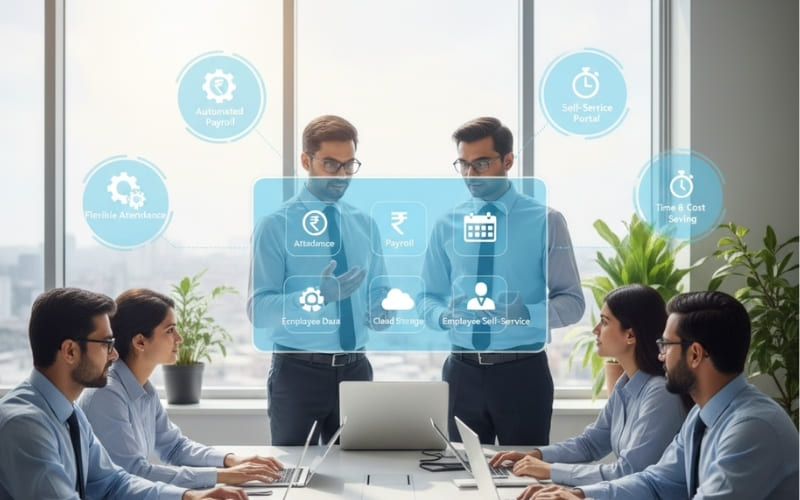
In a crowded market, local expertise and focused design set certain platforms apart. EZHRM has distinguished itself by offering a robust Online HRM System that is specifically engineered for the complexities of the Indian business landscape. The platform combines a user-friendly interface with deep, India-focused compliance automation.
EZHRM’s key differentiators include:
- Precision Payroll Engine: A highly accurate HR and Payroll Management System that handles all statutory complexities across states.
- Mobile-First Design: Ensuring full functionality is accessible via a mobile app, critical for the widely distributed workforce using the Online HRM Software.
- Simple Onboarding: Known for its rapid setup, allowing even small and mid-sized businesses (SMEs) to digitize their HR functions quickly and cost-effectively.
Businesses leveraging EZHRM often experience tangible results: faster payroll disbursement, a noticeable reduction in attendance-related disputes, and a highly satisfied, connected workforce that fully utilizes the transparency provided by the ESS portal.
Frequently Asked Questions (FAQs)
1. Is an Online HRM System only for large corporations?
No. While large enterprises use them, modern Online HR Management Software is highly scalable and cost-effective for SMEs as well. Small businesses benefit immensely from the time savings and reduced compliance risk, enabling them to professionalize HR without hiring a large team.
2. How does an Online HRM System handle employee data security?
Trusted platforms use industry-leading security protocols, including cloud-based encryption, two-factor authentication (2FA), and secure access controls. Data is protected on secure servers, providing a far higher level of security than storing files in a physical cabinet or on local hard drives.
3. What is the difference between an Online HRM Software and an HRIS?
An HRIS (Human Resource Information System) is primarily a database for employee records. An Online HRM System (or HRMS) is a more comprehensive, functional solution that includes the HRIS database but adds key process management features like the Attendance Management Software, payroll processing, and performance tracking.
4. Can an ESS Portal be used by managers for approvals?
Yes. The Employee Self Service Portal (ESS Portal) typically includes a manager self-service (MSS) layer. Managers use this feature to review and approve leave requests, track team attendance, approve timesheets, and conduct performance reviews, streamlining the management workflow.
Conclusion
The adoption of a full-featured Online HRM System is no longer optional, it is a mandatory step for modern businesses in India aiming for efficiency, compliance, and competitive edge. By automating routine processes via a cutting-edge platform, organizations free up their HR teams to focus on talent strategy, employee development, and engagement, leading to better business outcomes. Solutions like EZHRM provide the ideal blend of global technology standards with localized regulatory expertise, making it a reliable and powerful choice.
To future-proof your HR operations and start benefiting from automation, explore how an integrated Online HR Software can transform your workforce management today.